Carvings about 70,000 years old on a snake-like rock in a cave in Botswana indicate that Stone Age people developed religious rituals far earlier than previously believed, a researcher said on Thursday.
Ancestors of Botswana's San people apparently ground away at a natural outcrop about 2 metres high and 6 metres long (6 by 20 ft) to heighten its similarity to a python's head and body, said Sheila Coulson, an associate professor at Oslo University.
"We believe this is the earliest archaeological proof of religion," Coulson, a Canadian expert in Stone Age tools, told Reuters of findings made during a trip in mid-2006 to the Tsolido Hills in northwestern Botswana.
The previous oldest archaeological evidence of religious worship is about 40,000 years old from European caves. The Botswana find bolsters evidence that modern humans originated in Africa, along with religion and culture.
Coulson said the python-like rock had 300-400 carved indentations. In flickering firelight, the patterns might have seemed like scales and given the impression of movement to the rock as part of some sacred rite.
Scores of carved stone items, including 115 points and 22 burnt red spearheads, were abandoned on the floor of the cave beneath the snake-like rock. Many had been brought more than 200 km (125 miles) across the Kalahari Desert.
"The snake symbol runs through all the mythologies, stories, cultures, languages of southern Africa," Coulson said. The cave, with a floor of 26 square metres (280 sq ft), was not known to archaeologists until the 1990s.
In San mythology, humankind descended from a python, and ancient streambeds nearby were believed to have been created by a shake slithering around the hills in search of water....
At the back of the Botswanan cave was a well-worn chamber, large enough for a shaman to hide and to speak, perhaps in imitation of a snake.
Thursday, November 30, 2006


Wednesday, November 29, 2006
"Pro-Peace Symbol Forces Win...."
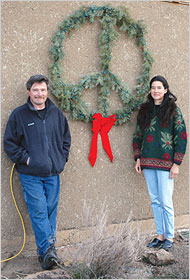
Peace is fighting back in Pagosa Springs (Colorado).
Last week, a couple were threatened with fines of $25 a day by their homeowners’ association unless they removed a four-foot wreath shaped like a peace symbol from the front of their house.
The fines have been dropped, and the three-member board of the association has resigned, according to an e-mail message sent to residents on Monday.
Two board members have disconnected their telephones, apparently to escape the waves of callers asking what the board could have been thinking, residents said. The third board member, with a working phone, did not return a call for comment.
In its original letter to the couple, Lisa Jensen and Bill Trimarco, the association said some neighbors had found the peace symbol politically “divisive.”...
In any case, there are now more peace symbols in Pagosa Springs, a town of 1,700 people 200 miles southwest of Denver, than probably ever in its history.
On Tuesday morning, 20 people marched through the center carrying peace signs and then stomped a giant peace sign in the snow perhaps 300 feet across on a soccer field, where it could be easily seen.
“There’s quite a few now in our subdivision in a show of support,” Mr. Trimarco said.
A former president of the Loma Linda community, where Mr. Trimarco lives, said Tuesday that he had stepped in to help form an interim homeowners’ association.
The former president, Farrell C. Trask, described himself in a telephone interview as a military veteran who would fight for anyone’s right to free speech, peace symbols included.
Town Manager Mark Garcia said Pagosa Springs was building its own peace wreath, too. Mr. Garcia said it would be finished by late Tuesday and installed on a bell tower in the center of town.
"Sea Change As Plankton Head North"
As reported @ the Scotsman.com - DRAMATIC and extraordinary changes in the kinds of plankton living in British waters as a result of climate change are having a profound effect on all marine life, according to a "disturbing" report.
The first "annual report card" by a group of government scientists and leading academics involved in studying the sea, published today, provides an assessment of the state of UK waters. It details rising sea levels, an increase in storms and acidity and a rise in salt levels in surface sea water.
It also reports a major shift in the types of plankton - the fundamental building block of most marine animal life - found off the coast of Britain. Species found off the coast of Brittany 40 years ago have gradually drifted 600 miles north to southern Scotland as seas have warmed.
And warm-water fish, such as tuna and stingrays, appear to be slowly following on behind, while cold-water species such as cod are suffering.
Experts said sea birds, such as guillemots and puffins, might gradually have to move northwards while the decline of the kittiwake, one of Scotland's most common seabirds, which has seen its numbers fall by half over the past 15 years, has been linked to increasing winter temperatures. Meanwhile, numbers of Mediterranean gulls, though small, are increasing in the south of the UK....
Another fear is that the eco-system could become out of sync. One reason for the decline of the cod is believed to be the differing breeding times of plankton. Warmer water plankton breed at a different time of year to colder kinds previously found in UK waters, and when cod larvae hatch, their access to their main source of food is significantly reduced.
Dr David Sims, at the Marine Biological Association in Plymouth, said a rise in numbers of warm-water species had been noticed over the past 100 years and there was some evidence global warming was hitting traditional fish populations.
"Climate is affecting plankton in a pronounced way and it's likely this will echo through the food chain," he said.
The first "annual report card" by a group of government scientists and leading academics involved in studying the sea, published today, provides an assessment of the state of UK waters. It details rising sea levels, an increase in storms and acidity and a rise in salt levels in surface sea water.
It also reports a major shift in the types of plankton - the fundamental building block of most marine animal life - found off the coast of Britain. Species found off the coast of Brittany 40 years ago have gradually drifted 600 miles north to southern Scotland as seas have warmed.
And warm-water fish, such as tuna and stingrays, appear to be slowly following on behind, while cold-water species such as cod are suffering.
Experts said sea birds, such as guillemots and puffins, might gradually have to move northwards while the decline of the kittiwake, one of Scotland's most common seabirds, which has seen its numbers fall by half over the past 15 years, has been linked to increasing winter temperatures. Meanwhile, numbers of Mediterranean gulls, though small, are increasing in the south of the UK....
Another fear is that the eco-system could become out of sync. One reason for the decline of the cod is believed to be the differing breeding times of plankton. Warmer water plankton breed at a different time of year to colder kinds previously found in UK waters, and when cod larvae hatch, their access to their main source of food is significantly reduced.
Dr David Sims, at the Marine Biological Association in Plymouth, said a rise in numbers of warm-water species had been noticed over the past 100 years and there was some evidence global warming was hitting traditional fish populations.
"Climate is affecting plankton in a pronounced way and it's likely this will echo through the food chain," he said.
"EPA SCIENTISTS FILE MASS PETITION FOR ACTION ON GLOBAL WARMING"
— Majority of Entire EPA Workforce Calls for Regulation of Greenhouse Gases
Washington, DC — In an unprecedented action, representatives for more than 10,000 U.S. Environmental Protection Agency scientists are calling on Congress to take immediate action against global warming, according to a petition released today by Public Employees for Environmental Responsibility (PEER). The petition also calls for an end to censorship of agency scientists and other specialists on topics of climate change and the effects of air pollution.
The petition stresses that time is running out to prevent cataclysmic environmental changes induced by human-caused pollution and urges Congress to undertake prompt actions:
“If we wait, we will be committing the next generation of Americans to approximately double the current global warming concentrations, with the associated adverse impacts on human health and the environment.”
The filing of this petition coincides with today’s oral arguments before the U.S. Supreme Court on a case (Massachusetts v. EPA, Case No. 05-1120) brought by states seeking to force the Bush administration to regulate greenhouse gases that fuel global warming under the Clean Air Act.
The petition signatories represent more than half of the total agency workforce. Addressed to the members of the Senate and House committees overseeing EPA, the petition argues that:
• The Bush administration strategy of “using primarily voluntary and incentive-based programs” to reduce greenhouse gases is not working nor “has [this approach] been effectively carried out;”
• EPA has abdicated its enforcement responsibilities by “failing to investigate coal-electric plants for technical options to control carbon;” and
• “EPA’s scientists and engineers [must be able] to speak frankly and directly with Congress and the public regarding climate change, without fear of reprisal.”
Washington, DC — In an unprecedented action, representatives for more than 10,000 U.S. Environmental Protection Agency scientists are calling on Congress to take immediate action against global warming, according to a petition released today by Public Employees for Environmental Responsibility (PEER). The petition also calls for an end to censorship of agency scientists and other specialists on topics of climate change and the effects of air pollution.
The petition stresses that time is running out to prevent cataclysmic environmental changes induced by human-caused pollution and urges Congress to undertake prompt actions:
“If we wait, we will be committing the next generation of Americans to approximately double the current global warming concentrations, with the associated adverse impacts on human health and the environment.”
The filing of this petition coincides with today’s oral arguments before the U.S. Supreme Court on a case (Massachusetts v. EPA, Case No. 05-1120) brought by states seeking to force the Bush administration to regulate greenhouse gases that fuel global warming under the Clean Air Act.
The petition signatories represent more than half of the total agency workforce. Addressed to the members of the Senate and House committees overseeing EPA, the petition argues that:
• The Bush administration strategy of “using primarily voluntary and incentive-based programs” to reduce greenhouse gases is not working nor “has [this approach] been effectively carried out;”
• EPA has abdicated its enforcement responsibilities by “failing to investigate coal-electric plants for technical options to control carbon;” and
• “EPA’s scientists and engineers [must be able] to speak frankly and directly with Congress and the public regarding climate change, without fear of reprisal.”
Tuesday, November 28, 2006
"Global Warming Goes to Court"
(Editorial in today's New York Times)
The Bush administration has been on a six-year campaign to expand its powers, often beyond what the Constitution allows. So it is odd to hear it claim that it lacks the power to slow global warming by limiting the emission of harmful gases. But that is just what it will argue to the Supreme Court tomorrow, in what may be the most important environmental case in many years.
A group of 12 states, including New York and Massachusetts, is suing the Environmental Protection Agency for failing to properly do its job. These states, backed by environmental groups and scientists, say that the Clean Air Act requires the E.P.A. to impose limits on carbon dioxide and other greenhouse gases emitted by new cars. These gases are a major contributor to the “greenhouse effect” that is dangerously heating up the planet.
The Bush administration insists that the E.P.A. does not have the power to limit these gases. It argues that they are not “air pollutants” under the Clean Air Act. Alternatively, it contends that the court should dismiss the case because the states do not have “standing,” since they cannot show that they will be specifically harmed by the agency’s failure to regulate greenhouse gases.
A plain reading of the Clean Air Act shows that the states are right. The act says that the E.P.A. “shall” set standards for “any air pollutant” that in its judgment causes or contributes to air pollution that “may reasonably be anticipated to endanger public health or welfare.” The word “welfare,” the law says, includes “climate” and “weather.” The E.P.A. makes an array of specious arguments about why the act does not mean what it expressly says. But it has no right to refuse to do what Congress said it “shall” do.
Beneath the statutory and standing questions, this is a case about how seriously the government takes global warming. The E.P.A.’s decision was based in part on its poorly reasoned conclusion that there was too much “scientific uncertainty” about global warming to worry about it. The government’s claim that the states lack standing also scoffs at global warming, by failing to acknowledge that the states have a strong interest in protecting their land and citizens against coastal flooding and the other kinds of damage that are being projected.
In a friend-of-the-court brief, climate scientists from the NASA Goddard Institute for Space Studies, Stanford University and other respected institutions warn that “the scientific evidence of the risks, long time lags and irreversibility of climate change argue persuasively for prompt regulatory action.” The Supreme Court can strike an important blow in defense of the planet simply by ruling that the E.P.A. must start following the law.
The Bush administration has been on a six-year campaign to expand its powers, often beyond what the Constitution allows. So it is odd to hear it claim that it lacks the power to slow global warming by limiting the emission of harmful gases. But that is just what it will argue to the Supreme Court tomorrow, in what may be the most important environmental case in many years.
A group of 12 states, including New York and Massachusetts, is suing the Environmental Protection Agency for failing to properly do its job. These states, backed by environmental groups and scientists, say that the Clean Air Act requires the E.P.A. to impose limits on carbon dioxide and other greenhouse gases emitted by new cars. These gases are a major contributor to the “greenhouse effect” that is dangerously heating up the planet.
The Bush administration insists that the E.P.A. does not have the power to limit these gases. It argues that they are not “air pollutants” under the Clean Air Act. Alternatively, it contends that the court should dismiss the case because the states do not have “standing,” since they cannot show that they will be specifically harmed by the agency’s failure to regulate greenhouse gases.
A plain reading of the Clean Air Act shows that the states are right. The act says that the E.P.A. “shall” set standards for “any air pollutant” that in its judgment causes or contributes to air pollution that “may reasonably be anticipated to endanger public health or welfare.” The word “welfare,” the law says, includes “climate” and “weather.” The E.P.A. makes an array of specious arguments about why the act does not mean what it expressly says. But it has no right to refuse to do what Congress said it “shall” do.
Beneath the statutory and standing questions, this is a case about how seriously the government takes global warming. The E.P.A.’s decision was based in part on its poorly reasoned conclusion that there was too much “scientific uncertainty” about global warming to worry about it. The government’s claim that the states lack standing also scoffs at global warming, by failing to acknowledge that the states have a strong interest in protecting their land and citizens against coastal flooding and the other kinds of damage that are being projected.
In a friend-of-the-court brief, climate scientists from the NASA Goddard Institute for Space Studies, Stanford University and other respected institutions warn that “the scientific evidence of the risks, long time lags and irreversibility of climate change argue persuasively for prompt regulatory action.” The Supreme Court can strike an important blow in defense of the planet simply by ruling that the E.P.A. must start following the law.
Saturday, November 25, 2006
Nanotechnology in the News
EPA to regulate form of nanotechnology
Consumer products using extremely small particles of silver to kill germs will need Environmental Protection Agency approval, part of the government's first move to regulate the burgeoning nanotechnology industry.
The EPA said Wednesday it was changing federal policy to require that manufacturers provide scientific evidence that their use of nanosilver won't harm waterways or public health.
Environmentalists and others are concerned that after the material is discarded and enters the environment, it may be killing helpful bacteria and aquatic organisms or even pose a risk to humans.
Nanosilver is used to kill germs in shoe liners, food-storage containers, air fresheners, washing machines and other products.
Silver is among the most common type of nanomaterials marketed to consumers, of which more than 200 now exist, according to the Project on Emerging Nanotechnologies... But the EPA doesn't plan to oversee most nanomaterials, which can be as small as one-millionth the width of a head of a pin...
A recent article in "Nature" - (it sounds like these scientists are reluctant to say that there could be problems)
Safe handling of nanotechnology
When the physicist and Nobel laureate Richard Feynman challenged the science community to think small in his 1959 lecture 'There's Plenty of Room at the Bottom', he planted the seeds of a new era in science and technology. Nanotechnology, which is about controlling matter at near-atomic scales to produce unique or enhanced materials, products and devices, is now maturing rapidly with more than 300 claimed nanotechnology products already on the market. Yet concerns have been raised that the very properties of nanostructured materials that make them so attractive could potentially lead to unforeseen health or environmental hazards....
As research leaders in our respective fields, we recognize that systematic risk research is needed if emerging nano-industries are to thrive. We cannot set the international research agenda on our own, but we can inspire the scientific community — including government, industry, academia and other stakeholders — to move in the right direction...
Fears over the possible dangers of some nanotechnologies may be exaggerated, but they are not necessarily unfounded. Recent studies examining the toxicity of engineered nanomaterials in cell cultures and animals have shown that size, surface area, surface chemistry, solubility and possibly shape all play a role in determining the potential for engineered nanomaterials to cause harm. This is not surprising: we have known for many years that inhaled dusts cause disease, and that their harmfulness depends on both what they are made of and their physical nature. For instance, small particles of inhaled quartz lead to lung damage and the potential development of progressive lung disease, yet the same particles with a thin coating of clay are less harmful. Asbestos presents a far more dramatic example: thin, long fibres of the material can lead to lung disease if inhaled, but grind the fibres down to shorter particles with the same chemical make-up and the harmfulness is significantly reduced.
It is generally accepted that, in principle, some nanomaterials may have the potential to cause harm to people and the environment. But the way science is done is often ill-equipped to address novel risks associated with emerging technologies. Research into understanding and preventing risk often has a low priority in the competitive worlds of intellectual property, research funding and technology development. And yet there is much at stake in how potential nano-specific risks are understood and managed. Without strategic and targeted risk research, people producing and using nanomaterials could develop unanticipated illness arising from their exposure; public confidence in nanotechnologies could be reduced through real or perceived dangers; and fears of litigation may make nanotechnologies less attractive to investors and the insurance industry....
Their suggestions:
1. Develop instruments to assess exposure to engineered nanomaterials in air and water, within the next 3–10 years.
2. Develop and validate methods to evaluate the toxicity of engineered nanomaterials, within the next 5–15 years.
3. Develop models for predicting the potential impact of engineered nanomaterials on the environment and human health, within the next 10 years.
4. Develop robust systems for evaluating the health and environmental impact of engineered nanomaterials over their entire life, within the next 5 years.
5. Develop strategic programmes that enable relevant risk-focused research, within the next 12 months.
_________
It seems pretty obvious to me that none of these technologies should make it out of the laboratories without being thoroughly tested for safety. The time to test and regulate is NOT after the things have become integrated into the marketplace - but before.
Consumer products using extremely small particles of silver to kill germs will need Environmental Protection Agency approval, part of the government's first move to regulate the burgeoning nanotechnology industry.
The EPA said Wednesday it was changing federal policy to require that manufacturers provide scientific evidence that their use of nanosilver won't harm waterways or public health.
Environmentalists and others are concerned that after the material is discarded and enters the environment, it may be killing helpful bacteria and aquatic organisms or even pose a risk to humans.
Nanosilver is used to kill germs in shoe liners, food-storage containers, air fresheners, washing machines and other products.
Silver is among the most common type of nanomaterials marketed to consumers, of which more than 200 now exist, according to the Project on Emerging Nanotechnologies... But the EPA doesn't plan to oversee most nanomaterials, which can be as small as one-millionth the width of a head of a pin...
A recent article in "Nature" - (it sounds like these scientists are reluctant to say that there could be problems)
Safe handling of nanotechnology
When the physicist and Nobel laureate Richard Feynman challenged the science community to think small in his 1959 lecture 'There's Plenty of Room at the Bottom', he planted the seeds of a new era in science and technology. Nanotechnology, which is about controlling matter at near-atomic scales to produce unique or enhanced materials, products and devices, is now maturing rapidly with more than 300 claimed nanotechnology products already on the market. Yet concerns have been raised that the very properties of nanostructured materials that make them so attractive could potentially lead to unforeseen health or environmental hazards....
As research leaders in our respective fields, we recognize that systematic risk research is needed if emerging nano-industries are to thrive. We cannot set the international research agenda on our own, but we can inspire the scientific community — including government, industry, academia and other stakeholders — to move in the right direction...
Fears over the possible dangers of some nanotechnologies may be exaggerated, but they are not necessarily unfounded. Recent studies examining the toxicity of engineered nanomaterials in cell cultures and animals have shown that size, surface area, surface chemistry, solubility and possibly shape all play a role in determining the potential for engineered nanomaterials to cause harm. This is not surprising: we have known for many years that inhaled dusts cause disease, and that their harmfulness depends on both what they are made of and their physical nature. For instance, small particles of inhaled quartz lead to lung damage and the potential development of progressive lung disease, yet the same particles with a thin coating of clay are less harmful. Asbestos presents a far more dramatic example: thin, long fibres of the material can lead to lung disease if inhaled, but grind the fibres down to shorter particles with the same chemical make-up and the harmfulness is significantly reduced.
It is generally accepted that, in principle, some nanomaterials may have the potential to cause harm to people and the environment. But the way science is done is often ill-equipped to address novel risks associated with emerging technologies. Research into understanding and preventing risk often has a low priority in the competitive worlds of intellectual property, research funding and technology development. And yet there is much at stake in how potential nano-specific risks are understood and managed. Without strategic and targeted risk research, people producing and using nanomaterials could develop unanticipated illness arising from their exposure; public confidence in nanotechnologies could be reduced through real or perceived dangers; and fears of litigation may make nanotechnologies less attractive to investors and the insurance industry....
Their suggestions:
1. Develop instruments to assess exposure to engineered nanomaterials in air and water, within the next 3–10 years.
2. Develop and validate methods to evaluate the toxicity of engineered nanomaterials, within the next 5–15 years.
3. Develop models for predicting the potential impact of engineered nanomaterials on the environment and human health, within the next 10 years.
4. Develop robust systems for evaluating the health and environmental impact of engineered nanomaterials over their entire life, within the next 5 years.
5. Develop strategic programmes that enable relevant risk-focused research, within the next 12 months.
_________
It seems pretty obvious to me that none of these technologies should make it out of the laboratories without being thoroughly tested for safety. The time to test and regulate is NOT after the things have become integrated into the marketplace - but before.
Tuesday, November 21, 2006
The Beyond Einstein Project
A description of the project can be found at the blog Science and Reason which I found by way of Galactic Interactions
From the NASA page - Beyond Einstein
The questions ->
What powered the Big Bang?
...NASA's Cosmic Background Explorer (COBE) satellite discovered the fluctuations and, most recently, NASA's Wilkinson Microwave Anisotropy Probe (WMAP) has refined the measurement. We see how gravity has pulled these wrinkles into stars and planets. We can even determine the ratio the ratio of matter to energy, the era of first starlight, and the age of the Universe, 13.8 billion years.
What we don't know is the most basic fact: What started it all? Modern theoretical ideas that try to answer this question predict that the wrinkles COBE discovered arose from two kinds of primordial particles: from the energy field that powered the Big Bang; and gravitons, which are fundamental particles of space and time.
Clues to the nature of these particles exist in the Big Bang afterglow. Measurements from Beyond Einstein missions will coax information from this ancient light, which has held its secrets for so long. This would enable us to piece together the story of how time, space, and energy worked together to power the Big Bang.
What happens at the edge of a black hole?
...One key mission will create movies from the X-ray light emitted from multimillion-degree gas as it approaches a black hole's border, called the event horizon. Another mission will listen for gravitational waves, which are ripples in spacetime predicted by Einstein. These waves are created by black hole mergers; they move undisturbed across the "sea" of space at light speed, and offer an unobstructed view of these powerful collisions.
Einstein himself never dreamed that it would be possible to detect gravitational waves, which only distort the distance between objects as far apart as the Earth and Moon by less than the width of an atom. Yet the technology now exists to do so.
Data from X-ray satellites, such as NASA's Chandra X-ray Observatory and ESA's XMM-Newton, show signs of gas whizzing about black holes at close to the speed of light and hint that time is slowing as the gas plunges into the zone from which escape is impossible. Beyond Einstein missions will take a census of black holes in the Universe and give detailed pictures of what happens to space and time at the edges of these gravitational chasms.
What is dark energy?
...Because Einstein originally thought the Universe was static, he conjectured that even the emptiest possible space, devoid of matter and radiation, might still have an energy countering gravity, which he called a "Cosmological Constant." When Edwin Hubble discovered the expansion of the Universe, Einstein rejected his own idea, calling it his greatest blunder.
But the Universe isn't just expanding; the expansion rate, which appears to have slowed several billion years ago, is revving up. We live in a runaway Universe, in which the most distant galaxies visible today will soon fly off forever beyond the horizon. This acceleration could be due to the concept that "empty space" isn't empty. Richard Feynman and others who developed the quantum theory of matter realized that empty space is filled with "virtual" particles continually forming and destroying themselves. These particles create a negative pressure that pulls space outward. No one, however, could predict this energy's magnitude.
Independent measurements reveal that dark energy comprises about 70% of the total mass-energy budget of the Universe. We still do not know whether or how the highly accelerated expansion in the early Universe, called inflation, and the current accelerated expansion, due to dark energy, are related. A Beyond Einstein mission will measure the expansion accurately enough to learn whether this energy is a constant property of empty space, as Einstein conjectured, or whether its strength varies over time, a property predicted by modern theories of the forces of nature.
From the NASA page - Beyond Einstein
The questions ->
What powered the Big Bang?
...NASA's Cosmic Background Explorer (COBE) satellite discovered the fluctuations and, most recently, NASA's Wilkinson Microwave Anisotropy Probe (WMAP) has refined the measurement. We see how gravity has pulled these wrinkles into stars and planets. We can even determine the ratio the ratio of matter to energy, the era of first starlight, and the age of the Universe, 13.8 billion years.
What we don't know is the most basic fact: What started it all? Modern theoretical ideas that try to answer this question predict that the wrinkles COBE discovered arose from two kinds of primordial particles: from the energy field that powered the Big Bang; and gravitons, which are fundamental particles of space and time.
Clues to the nature of these particles exist in the Big Bang afterglow. Measurements from Beyond Einstein missions will coax information from this ancient light, which has held its secrets for so long. This would enable us to piece together the story of how time, space, and energy worked together to power the Big Bang.
What happens at the edge of a black hole?
...One key mission will create movies from the X-ray light emitted from multimillion-degree gas as it approaches a black hole's border, called the event horizon. Another mission will listen for gravitational waves, which are ripples in spacetime predicted by Einstein. These waves are created by black hole mergers; they move undisturbed across the "sea" of space at light speed, and offer an unobstructed view of these powerful collisions.
Einstein himself never dreamed that it would be possible to detect gravitational waves, which only distort the distance between objects as far apart as the Earth and Moon by less than the width of an atom. Yet the technology now exists to do so.
Data from X-ray satellites, such as NASA's Chandra X-ray Observatory and ESA's XMM-Newton, show signs of gas whizzing about black holes at close to the speed of light and hint that time is slowing as the gas plunges into the zone from which escape is impossible. Beyond Einstein missions will take a census of black holes in the Universe and give detailed pictures of what happens to space and time at the edges of these gravitational chasms.
What is dark energy?
...Because Einstein originally thought the Universe was static, he conjectured that even the emptiest possible space, devoid of matter and radiation, might still have an energy countering gravity, which he called a "Cosmological Constant." When Edwin Hubble discovered the expansion of the Universe, Einstein rejected his own idea, calling it his greatest blunder.
But the Universe isn't just expanding; the expansion rate, which appears to have slowed several billion years ago, is revving up. We live in a runaway Universe, in which the most distant galaxies visible today will soon fly off forever beyond the horizon. This acceleration could be due to the concept that "empty space" isn't empty. Richard Feynman and others who developed the quantum theory of matter realized that empty space is filled with "virtual" particles continually forming and destroying themselves. These particles create a negative pressure that pulls space outward. No one, however, could predict this energy's magnitude.
Independent measurements reveal that dark energy comprises about 70% of the total mass-energy budget of the Universe. We still do not know whether or how the highly accelerated expansion in the early Universe, called inflation, and the current accelerated expansion, due to dark energy, are related. A Beyond Einstein mission will measure the expansion accurately enough to learn whether this energy is a constant property of empty space, as Einstein conjectured, or whether its strength varies over time, a property predicted by modern theories of the forces of nature.
Monday, November 20, 2006
Misc Ocean News
Melting continues in Arctic
Signs of warming continue in the Arctic with a decline in sea ice, an increase in shrubs growing on the tundra, and rising concerns about the Greenland ice sheet.
“There have been regional warming periods before. Now we’re seeing Arctic-wide changes,” James Overland, an oceanographer at the Pacific Marine Environmental Laboratory in Seattle, said late last week.
For the last five years, it was at least one degree Celsius above average over the Arctic over the entire year, he noted.
The new “State of the Arctic” analysis, released by the U.S. National Oceanic and Atmospheric Administration, also reported an increase in northward movement of warmer water through the Bering Strait in 2001-04....
Hands across the oceans
Ken Sherman, a scientist with the National Oceanic and Atmospheric Administration, believes many factors contribute to the depletion of fishing stocks and has developed a scheme for managing the world’s oceans that has now been put in place around the world....
__________
Also - interesting resource: UN Atlas of the Oceans
__________
Signs of warming continue in the Arctic with a decline in sea ice, an increase in shrubs growing on the tundra, and rising concerns about the Greenland ice sheet.
“There have been regional warming periods before. Now we’re seeing Arctic-wide changes,” James Overland, an oceanographer at the Pacific Marine Environmental Laboratory in Seattle, said late last week.
For the last five years, it was at least one degree Celsius above average over the Arctic over the entire year, he noted.
The new “State of the Arctic” analysis, released by the U.S. National Oceanic and Atmospheric Administration, also reported an increase in northward movement of warmer water through the Bering Strait in 2001-04....
Hands across the oceans
Ken Sherman, a scientist with the National Oceanic and Atmospheric Administration, believes many factors contribute to the depletion of fishing stocks and has developed a scheme for managing the world’s oceans that has now been put in place around the world....
__________
Also - interesting resource: UN Atlas of the Oceans
__________
Notes from Nairobi
Climate conference settles on next steps to negotiate future emissions cuts
NAIROBI, Kenya: A U.N. conference on climate change has set a rough timetable for reaching a new agreement to cut greenhouse-gas emissions, but some officials and activists warn that the world is still moving too slowly and selfishly in the fight against global warming.
China agreed Friday to a review of the Kyoto Protocol by 2008 — crucial toward setting new quotas on carbon dioxide and other emissions — but only after being assured it and other developing countries would remain exempt from mandatory cuts in the near future....
"The science tells us that we need faster and deeper political progress if we are to avoid the social, economic and humanitarian consequences of unchecked climate change," a joint statement said. "Every country has a part to play in the drive to prevent dangerous climate change."
The 1997 Kyoto pact obliges 35 industrial nations to reduce emissions of greenhouse gases by 5 percent below 1990 levels by 2012. The United States rejects that accord, with U.S. President George W. Bush contending it would damage the U.S. economy and should have given poorer countries obligations as well....
"We have made progress and have reached agreements on all of the priorities for the conference," said Stavros Dimas, the European Union environment commissioner. But he added, "There is no time to waste. We must cut global emissions by 50 percent by the middle of the century."
Meanwhile, emissions by the United States, the world's biggest emitter, have grown by 16 percent since 1990. And China is expected to overtake the United States as the No. 1 carbon dioxide emitter before 2010, the International Energy Agency reports.
UN climate pact unlikely until after Bush--experts
This week's U.N. climate talks kept a plan for fighting global warming on track for expansion beyond 2012, but breakthroughs look unlikely before U.S. President George W. Bush steps down, experts said on Saturday.
"Everyone is waiting for the United States. I think the whole process will be on ice until 2009," when Bush's second term expires, said Paal Prestrud, head of the Center for International Climate and Environmental Research in Oslo.
The United States is the biggest source of greenhouse gases, mainly from burning fossil fuels, and Bush's decision to reject caps under the U.N.'s Kyoto Protocol discourages involvement by other big-polluting outsiders such as China and India.
After two weeks of talks, about 70 environment ministers in Nairobi agreed on Friday to a 2008 review of Kyoto as a possible prelude to deeper emission cuts by rich nations beyond 2012 and steps by developing countries to brake rising emissions.
They also agreed modest schemes to help Africa adapt to the feared effects of climate change such as drought, storms, disease and rising seas. Ministers agreed to promote green technologies, such as wind or solar power, in the poorest continent....
Several senior delegates at the U.N. talks say 2010 now looks the most likely date for a new global pact to replace Kyoto. "We'd love a deadline of 2008 or 2009 but that looks unlikely unless Bush has a change of heart," one said.
Environmentalists want a 2008 deadline. "Technically it's still not impossible," said Hans Verolme, climate director of the WWF conservation group. "The planet cannot wait."
More notes here and here
NAIROBI, Kenya: A U.N. conference on climate change has set a rough timetable for reaching a new agreement to cut greenhouse-gas emissions, but some officials and activists warn that the world is still moving too slowly and selfishly in the fight against global warming.
China agreed Friday to a review of the Kyoto Protocol by 2008 — crucial toward setting new quotas on carbon dioxide and other emissions — but only after being assured it and other developing countries would remain exempt from mandatory cuts in the near future....
"The science tells us that we need faster and deeper political progress if we are to avoid the social, economic and humanitarian consequences of unchecked climate change," a joint statement said. "Every country has a part to play in the drive to prevent dangerous climate change."
The 1997 Kyoto pact obliges 35 industrial nations to reduce emissions of greenhouse gases by 5 percent below 1990 levels by 2012. The United States rejects that accord, with U.S. President George W. Bush contending it would damage the U.S. economy and should have given poorer countries obligations as well....
"We have made progress and have reached agreements on all of the priorities for the conference," said Stavros Dimas, the European Union environment commissioner. But he added, "There is no time to waste. We must cut global emissions by 50 percent by the middle of the century."
Meanwhile, emissions by the United States, the world's biggest emitter, have grown by 16 percent since 1990. And China is expected to overtake the United States as the No. 1 carbon dioxide emitter before 2010, the International Energy Agency reports.
UN climate pact unlikely until after Bush--experts
This week's U.N. climate talks kept a plan for fighting global warming on track for expansion beyond 2012, but breakthroughs look unlikely before U.S. President George W. Bush steps down, experts said on Saturday.
"Everyone is waiting for the United States. I think the whole process will be on ice until 2009," when Bush's second term expires, said Paal Prestrud, head of the Center for International Climate and Environmental Research in Oslo.
The United States is the biggest source of greenhouse gases, mainly from burning fossil fuels, and Bush's decision to reject caps under the U.N.'s Kyoto Protocol discourages involvement by other big-polluting outsiders such as China and India.
After two weeks of talks, about 70 environment ministers in Nairobi agreed on Friday to a 2008 review of Kyoto as a possible prelude to deeper emission cuts by rich nations beyond 2012 and steps by developing countries to brake rising emissions.
They also agreed modest schemes to help Africa adapt to the feared effects of climate change such as drought, storms, disease and rising seas. Ministers agreed to promote green technologies, such as wind or solar power, in the poorest continent....
Several senior delegates at the U.N. talks say 2010 now looks the most likely date for a new global pact to replace Kyoto. "We'd love a deadline of 2008 or 2009 but that looks unlikely unless Bush has a change of heart," one said.
Environmentalists want a 2008 deadline. "Technically it's still not impossible," said Hans Verolme, climate director of the WWF conservation group. "The planet cannot wait."
More notes here and here
"Dutch bask in warmest autumn in three centuries"
The autumn of 2006 has been the warmest in the Netherlands for over 300 years, 12.5 percent hotter than the previous year which was already a record, meteorologists said.
"Beating the record by more than one degree centigrade, that is exceptional," the Royal Netherlands Meteorological Institute said in a statement.
The average temperature for the months leading up to November 17 was up to 13.5 degrees (56 degrees F), as compared to 12 degrees last year, which was already the hottest autumn on record.
The average over the last three centuries for this period of the year has been 9.9 degrees.
At least three factors are responsible for the increased temperatures, the Institute said: global warming, winds from the south that have blown over the Netherlands more than in most years, and a slower cooling down after an exceptionally hot summer, especially in July.
"Beating the record by more than one degree centigrade, that is exceptional," the Royal Netherlands Meteorological Institute said in a statement.
The average temperature for the months leading up to November 17 was up to 13.5 degrees (56 degrees F), as compared to 12 degrees last year, which was already the hottest autumn on record.
The average over the last three centuries for this period of the year has been 9.9 degrees.
At least three factors are responsible for the increased temperatures, the Institute said: global warming, winds from the south that have blown over the Netherlands more than in most years, and a slower cooling down after an exceptionally hot summer, especially in July.
Michele Bachelet
Michele Bachelet...president in Chile... appointed 50% of women in every level of government....
Acclaimed Chilean Novelist Isabel Allende on Michele Bachelet, Immigration and Chile as a "Country of Poets"
(From Democracy Now!)
ISABEL ALLENDE: Michele Bachelet is an extraordinary person, no matter that she’s a woman. It’s wonderful that we have a woman president in Chile for the first time. And what is even more wonderful is that she has come to the government and appointed 50% of women in every level of government. So when you see a photograph of the secretaries of state or any official photograph, the caption says, “Count the women,” because 50% are women. It’s the first time in history that female energy and male energy, in equal terms, are running a country. It’s the management of the country with this female energy. And I think that it’s an extraordinary experiment. And if it works, it will be imitated, and it will open up new spaces for peace and understanding in the world. (snip)
JUAN GONZALEZ: Isabel Allende, I’d like to ask you, getting back to a remark you made a few minutes ago about the changes in Chile and the genuine feminization of the infrastructure of the government, have you noticed the impact of that, in other words, in terms of types of policies that have been adopted that might not have been adopted in prior governments or even in other countries by overwhelmingly male leaderships?
ISABEL ALLENDE: Michele Bachelet has been accused of being weak, because her style is different from the male style. But to give you an example of something that has changed, 64% of the national budget goes to social programs. Can you imagine what the United States would be like if 64% of our budget would be for social programs?
Acclaimed Chilean Novelist Isabel Allende on Michele Bachelet, Immigration and Chile as a "Country of Poets"
(From Democracy Now!)
ISABEL ALLENDE: Michele Bachelet is an extraordinary person, no matter that she’s a woman. It’s wonderful that we have a woman president in Chile for the first time. And what is even more wonderful is that she has come to the government and appointed 50% of women in every level of government. So when you see a photograph of the secretaries of state or any official photograph, the caption says, “Count the women,” because 50% are women. It’s the first time in history that female energy and male energy, in equal terms, are running a country. It’s the management of the country with this female energy. And I think that it’s an extraordinary experiment. And if it works, it will be imitated, and it will open up new spaces for peace and understanding in the world. (snip)
JUAN GONZALEZ: Isabel Allende, I’d like to ask you, getting back to a remark you made a few minutes ago about the changes in Chile and the genuine feminization of the infrastructure of the government, have you noticed the impact of that, in other words, in terms of types of policies that have been adopted that might not have been adopted in prior governments or even in other countries by overwhelmingly male leaderships?
ISABEL ALLENDE: Michele Bachelet has been accused of being weak, because her style is different from the male style. But to give you an example of something that has changed, 64% of the national budget goes to social programs. Can you imagine what the United States would be like if 64% of our budget would be for social programs?
Sunday, November 19, 2006
"Blighted Homeland"
This shows one reason why nuclear energy is not as "cheap" as some people think. Because we are not paying for the true costs. We are not paying for cleanup - or for people's healthcare (or life insurance for the survivors) when they get cancer from being around the radiation. We as a people are not as good at keeping everyone safe from the consequences as some would think. Mostly because it is not usually in the news.
(The water article from Monday - link below - was esp. tragic - as is the whole thing. The extreme poisoning combined with the complete lack of regard and accountability is staggering.)
A 4 part series running in the LA Times - starting today:
A peril that dwelt among the Navajos
Fifty years ago, cancer rates on the reservation were so low that a medical journal published an article titled "Cancer immunity in the Navajo."
Back then, the contamination of the tribal homeland was just beginning. Mining companies were digging into one of the world's richest uranium deposits, in a reservation spanning parts of Arizona, New Mexico and Utah.
From 1944 to 1986, 3.9 million tons of uranium ore were chiseled and blasted from the mountains and plains. The mines provided uranium for the Manhattan Project, the top-secret effort to develop an atomic bomb, and for the weapons stockpile built up during the arms race with the Soviet Union.
Private companies operated the mines, but the U.S. government was the sole customer. The boom lasted through the early '60s. As the Cold War threat gradually diminished over the next two decades, more than 1,000 mines and four processing mills on tribal land shut down.
The companies often left behind radioactive waste piles and open tunnels and pits. Few bothered to fence the properties or post warning signs. Federal inspectors seldom intervened.
Over the decades, Navajos inhaled radioactive dust from the waste piles, borne aloft by fierce desert winds.
They drank contaminated water from abandoned pit mines that filled with rain. They watered their herds there, then butchered the animals and ate the meat.
Their children dug caves in piles of mill tailings and played in the spent mines....
Today, there is no talk of cancer immunity in the Navajos.
The cancer death rate on the reservation — historically much lower than that of the general U.S. population — doubled from the early 1970s to the late 1990s, according to Indian Health Service data. The overall U.S. cancer death rate declined slightly over the same period....
In every corner of the reservation, sandy mill tailings and chunks of ore, squared off nicely by blasting, were left unattended at old mines and mills, free for the taking. They were fashioned into bread ovens, cisterns, foundations, fireplaces, floors and walls.
Navajo families occupied radioactive dwellings for decades, unaware of the risks....
Just 200 miles from the reservation, in Grand Junction, Colo., residents faced the same situation. But there, the government was moving with urgency to eliminate the health risk posed by homes, schools and churches made with tailings from the Climax Uranium Co.
State health authorities had armed themselves with research and demanded federal action. The local congressman, Democrat Wayne N. Aspinall, was chairman of the House Interior Committee. He held hearings and helped secure funds for a thorough cleanup, which ultimately cost more than $500 million.
The Navajos had no such champion....
___
ABOUT THIS SERIES:
From 1944 to 1986, 3.9 million tons of uranium ore were dug and blasted from Navajo soil, nearly all of it for America's atomic arsenal. Navajos inhaled radioactive dust, drank contaminated water and built homes using rock from the mines and mills. Many of the dangers persist to this day. This four-part series examines the legacy of uranium mining on the Navajo reservation.
SUNDAY: Unaware of the danger
A peril that dwelt among the Navajos
MONDAY: Toxic water
Oases in Navajo desert contained 'a witch's brew'
TUESDAY: Botched cleanup
Navajos' desert cleanup no more than a mirage
WEDNESDAY: New technology
(The water article from Monday - link below - was esp. tragic - as is the whole thing. The extreme poisoning combined with the complete lack of regard and accountability is staggering.)
A 4 part series running in the LA Times - starting today:
A peril that dwelt among the Navajos
Fifty years ago, cancer rates on the reservation were so low that a medical journal published an article titled "Cancer immunity in the Navajo."
Back then, the contamination of the tribal homeland was just beginning. Mining companies were digging into one of the world's richest uranium deposits, in a reservation spanning parts of Arizona, New Mexico and Utah.
From 1944 to 1986, 3.9 million tons of uranium ore were chiseled and blasted from the mountains and plains. The mines provided uranium for the Manhattan Project, the top-secret effort to develop an atomic bomb, and for the weapons stockpile built up during the arms race with the Soviet Union.
Private companies operated the mines, but the U.S. government was the sole customer. The boom lasted through the early '60s. As the Cold War threat gradually diminished over the next two decades, more than 1,000 mines and four processing mills on tribal land shut down.
The companies often left behind radioactive waste piles and open tunnels and pits. Few bothered to fence the properties or post warning signs. Federal inspectors seldom intervened.
Over the decades, Navajos inhaled radioactive dust from the waste piles, borne aloft by fierce desert winds.
They drank contaminated water from abandoned pit mines that filled with rain. They watered their herds there, then butchered the animals and ate the meat.
Their children dug caves in piles of mill tailings and played in the spent mines....
Today, there is no talk of cancer immunity in the Navajos.
The cancer death rate on the reservation — historically much lower than that of the general U.S. population — doubled from the early 1970s to the late 1990s, according to Indian Health Service data. The overall U.S. cancer death rate declined slightly over the same period....
In every corner of the reservation, sandy mill tailings and chunks of ore, squared off nicely by blasting, were left unattended at old mines and mills, free for the taking. They were fashioned into bread ovens, cisterns, foundations, fireplaces, floors and walls.
Navajo families occupied radioactive dwellings for decades, unaware of the risks....
Just 200 miles from the reservation, in Grand Junction, Colo., residents faced the same situation. But there, the government was moving with urgency to eliminate the health risk posed by homes, schools and churches made with tailings from the Climax Uranium Co.
State health authorities had armed themselves with research and demanded federal action. The local congressman, Democrat Wayne N. Aspinall, was chairman of the House Interior Committee. He held hearings and helped secure funds for a thorough cleanup, which ultimately cost more than $500 million.
The Navajos had no such champion....
___
ABOUT THIS SERIES:
From 1944 to 1986, 3.9 million tons of uranium ore were dug and blasted from Navajo soil, nearly all of it for America's atomic arsenal. Navajos inhaled radioactive dust, drank contaminated water and built homes using rock from the mines and mills. Many of the dangers persist to this day. This four-part series examines the legacy of uranium mining on the Navajo reservation.
SUNDAY: Unaware of the danger
A peril that dwelt among the Navajos
MONDAY: Toxic water
Oases in Navajo desert contained 'a witch's brew'
TUESDAY: Botched cleanup
Navajos' desert cleanup no more than a mirage
WEDNESDAY: New technology
Wednesday, November 15, 2006
Boxer and Global Warming Hearings
I noticed on a discussion board - someone suggesting the dicotomy between people who tend to be concerned about the public good and those who are more concerned about private (& individual) rights. That the Democrats have become the party of the public good and the Repubicans that party of private rights. This is abundently clear with issues like global warming and the environment.
There have been Republicans who have been concerned for the environment - but these days - the Republicans are so keen on protecting industry and corporate interests - the private rights of the owners - that they have become anti-any-kind-of regulation-that protects-the public.
Heck - they won't admit that there is a problem. They leave it up to the corporations to do something or not. Mostly they don't.
One person was equating the Puritan, civic attitudes with concern for the public good and the Southern, Baptists (?) who are more interested in private rights. So like it's rather a continuation of the North/South split. And with the Bush elections - that is how the red and blue states were divided up.
I think with the global warming issue that the public good is going to have to win the day. It would be nice to think that individuals and corporations would all do what is best for the world as a whole - but I can't imagine anyone who really sees that as realistic. So now the Democrats have control of Congress - we'll see what they can do. (Of course most stuff would get vetoed - but there might be ways to get something done).
So anyway, this is good news for the public good - Boxer plans Senate hearings on global warming

The Democrats' coming takeover of Congress is expected to feel pressure for policy change on a number of fronts, from Iraq to taxes, but the starkest change may come at the Senate Environment and Public Works Committee, when Sen. James Inhofe, R-Okla., will surrender the gavel to Sen. Barbara Boxer, D-Calif. Her appointment was announced Tuesday, but won't take effect until January.
Inhofe rejects a wide scientific consensus that human use of fossil fuels is largely responsible for catastrophic climate change, calling it "the greatest hoax ever perpetrated on the American people." He's accused environmental activists of exploiting people's fears to raise money. And he's blocked legislation aimed at curbing global warming.
Boxer, in contrast, is a fiercely liberal environmental activist. She has railed against Inhofe, crusaded for cleaner drinking water and led wilderness protection efforts in her home state and for Alaska's Arctic National Wildlife Refuge.
There have been Republicans who have been concerned for the environment - but these days - the Republicans are so keen on protecting industry and corporate interests - the private rights of the owners - that they have become anti-any-kind-of regulation-that protects-the public.
Heck - they won't admit that there is a problem. They leave it up to the corporations to do something or not. Mostly they don't.
One person was equating the Puritan, civic attitudes with concern for the public good and the Southern, Baptists (?) who are more interested in private rights. So like it's rather a continuation of the North/South split. And with the Bush elections - that is how the red and blue states were divided up.
I think with the global warming issue that the public good is going to have to win the day. It would be nice to think that individuals and corporations would all do what is best for the world as a whole - but I can't imagine anyone who really sees that as realistic. So now the Democrats have control of Congress - we'll see what they can do. (Of course most stuff would get vetoed - but there might be ways to get something done).
So anyway, this is good news for the public good - Boxer plans Senate hearings on global warming

The Democrats' coming takeover of Congress is expected to feel pressure for policy change on a number of fronts, from Iraq to taxes, but the starkest change may come at the Senate Environment and Public Works Committee, when Sen. James Inhofe, R-Okla., will surrender the gavel to Sen. Barbara Boxer, D-Calif. Her appointment was announced Tuesday, but won't take effect until January.
Inhofe rejects a wide scientific consensus that human use of fossil fuels is largely responsible for catastrophic climate change, calling it "the greatest hoax ever perpetrated on the American people." He's accused environmental activists of exploiting people's fears to raise money. And he's blocked legislation aimed at curbing global warming.
Boxer, in contrast, is a fiercely liberal environmental activist. She has railed against Inhofe, crusaded for cleaner drinking water and led wilderness protection efforts in her home state and for Alaska's Arctic National Wildlife Refuge.
Tuesday, November 14, 2006
Spain Requires Solar/ Sweden Tops list
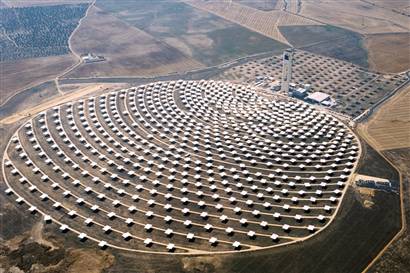
Spain requires new buildings use solar power
Solar panels are now compulsory on all new and renovated buildings in Spain as part of the country’s efforts to bring its building rules up to date and curb growing demand for energy, ministers said on Monday.
Until now Spain’s building standards have dated from the 1970s and have done little in seeking to improve energy efficiency.
“We have to make up the time we have lost,” Environment Minister Cristina Narbona said, inaugurating a seminar on the new technical building code.
The code will come into force fully next March but the energy saving element was implemented on Sept. 29.
This means new homes have to be equipped with solar panels to provide between 30 and 70 percent of their hot water, depending on where the building is located and on its expected water usage.
New non-residential buildings, such as shopping centers and hospitals, now have to have photovoltaic panels to generate a proportion of their electricity.
Solar power has not yet taken off in Spain, largely because subsidies have been directed at wind energy, and it provided a negligible amount of the country’s electricity in 2005.
Other measures in the new building code enforce the use of better insulation, improve the maintenance of heating and cooling systems and increase the use of natural light.
“The new standards will bring energy savings of 30 to 40 percent for each building and a reduction of carbon dioxide (CO2) emissions from energy consumption of 40 to 55 percent,” the Environment and Housing Ministries said in a joint statement.
Also:
Sweden doing most to fight global warming, Saudi Arabia the least
Sweden, Britain and Denmark top the list of countries doing the most to address global warming, while the United States, China, Malaysia and Saudi Arabia rank as doing the least according to a new report released by environmental groups. Still, warns the report, even the best ranking countries are not doing enough to stave off climate change.
"If climate change protection were an Olympic Discipline, no country would make it to the medal ranks", said Matthias Duwe, Director of Climate Action Europe, one of the groups behind the 2007 Climate Change Performance Index (CCPI).
The index, which ranks 56 countries that were part of a 1992 climate treaty or contribute at least 1 percent of the world's greenhouse gas emissions, took into account emissions trends, emissions levels and climate policy...
The countries making up the index are responsible for 90 percent of global carbon dioxide emissions. According to the Germanwatch, the environmental group that made the calculations for the index, the United States, the world's largest carbon dioxide polluter, emits 21.8 percent of global CO2 despite only having 4.6 percent of the world's population. The second largest CO2 emitter, China, has 17.9% of the world's share of carbon dioxide emissions but 20.5 percent of the population.
"...Rumsfeld gloating over ruins of Iraq"
I think it's difficult to paint one's anger. I like the use of symbolisms in this.
 Iraqi artist paints Rumsfeld gloating over ruins of Iraq
Moayyed Mohsen likes to paint great figures from Iraq's past like the mythical hero Gilgamesh. But this year he turned his talents to another larger-than-life subject in his country's history -- Donald Rumsfeld.
Dominating the wall of a Baghdad art gallery in the Sunni neighborhood of Adhamiyah is a massive mural that is no tribute to the outgoing US defense secretary.
Rumsfeld is depicted leaning back reading papers, with combat-boot-clad feet propped up on a ruined building. Beside him is a weathered image of the Lion of Babylon -- potent symbol of Iraq's illustrious past -- atop a ruined plinth. The US official is surrounded by whirling bits of paper that morph into birds and fly off into the distance.
The artist's image is striking and it was conceived in anger -- not just over the occupation of Iraq but also over what Mohsen sees as the humiliation of a nation that once taught mankind how to write....
More than any other official, the controversial Rumsfeld came to symbolize the US intervention in Iraq as one of the main architects of the invasion and subsequent occupation.
His resignation on November 8 -- the first casualty of the Republican defeat in mid-term congressional elections last week -- met with almost universal acclaim across Iraq's divided communities, who seem to agree on little else than the situation in their war-ravaged country is getting worse by the day.
Many Iraqis feel the US defense secretary's handling of the war showed arrogance and disdain for their country -- tellingly symbolized by his famous quip that "stuff happens" when asked to comment on the looting of Baghdad, including its museum, in the invasion's aftermath.
Mohsen, who loves reading American magazines, said his model was a photograph he found of Rumsfeld. "The way he sat was very strange to us here in the East -- it is an insult to those around," he said.
In the Middle East, showing the soles of one's feet is considered very poor manners, so the Rumsfeld in the painting automatically offends the viewer.
The Lion of Babel atop a ruined perch sends another message.
"I decided to make the base of the statue a bookcase containing volumes on the arts, literature and knowledge left by Iraqis," he said. "Then I destroyed the base to symbolize the repeated wars and showed the papers flying through the air and changing into white birds showing love and peace to the world."
By juxtaposing his subject with ancient monuments, Mohsen sought to pit the endurance of history against the fleeting nature of man -- an apt visual statement, it turned out, in light of Rumsfeld's resignation....
 Iraqi artist paints Rumsfeld gloating over ruins of Iraq
Moayyed Mohsen likes to paint great figures from Iraq's past like the mythical hero Gilgamesh. But this year he turned his talents to another larger-than-life subject in his country's history -- Donald Rumsfeld.
Dominating the wall of a Baghdad art gallery in the Sunni neighborhood of Adhamiyah is a massive mural that is no tribute to the outgoing US defense secretary.
Rumsfeld is depicted leaning back reading papers, with combat-boot-clad feet propped up on a ruined building. Beside him is a weathered image of the Lion of Babylon -- potent symbol of Iraq's illustrious past -- atop a ruined plinth. The US official is surrounded by whirling bits of paper that morph into birds and fly off into the distance.
The artist's image is striking and it was conceived in anger -- not just over the occupation of Iraq but also over what Mohsen sees as the humiliation of a nation that once taught mankind how to write....
More than any other official, the controversial Rumsfeld came to symbolize the US intervention in Iraq as one of the main architects of the invasion and subsequent occupation.
His resignation on November 8 -- the first casualty of the Republican defeat in mid-term congressional elections last week -- met with almost universal acclaim across Iraq's divided communities, who seem to agree on little else than the situation in their war-ravaged country is getting worse by the day.
Many Iraqis feel the US defense secretary's handling of the war showed arrogance and disdain for their country -- tellingly symbolized by his famous quip that "stuff happens" when asked to comment on the looting of Baghdad, including its museum, in the invasion's aftermath.
Mohsen, who loves reading American magazines, said his model was a photograph he found of Rumsfeld. "The way he sat was very strange to us here in the East -- it is an insult to those around," he said.
In the Middle East, showing the soles of one's feet is considered very poor manners, so the Rumsfeld in the painting automatically offends the viewer.
The Lion of Babel atop a ruined perch sends another message.
"I decided to make the base of the statue a bookcase containing volumes on the arts, literature and knowledge left by Iraqis," he said. "Then I destroyed the base to symbolize the repeated wars and showed the papers flying through the air and changing into white birds showing love and peace to the world."
By juxtaposing his subject with ancient monuments, Mohsen sought to pit the endurance of history against the fleeting nature of man -- an apt visual statement, it turned out, in light of Rumsfeld's resignation....
"Sky is no longer sky..."
From the site of the Worldwatch Insitute
“In China, sky is no longer sky, ground is not ground, mountain is not mountain, and water is not water, because humans are no longer ‘human.’ Only one day, when we go back to our niche, does the environment have a hope to be improved.”
Quote by Xiaoyi Liao - the president of Global Village Environmental Education Center in Beijing
“In China, sky is no longer sky, ground is not ground, mountain is not mountain, and water is not water, because humans are no longer ‘human.’ Only one day, when we go back to our niche, does the environment have a hope to be improved.”
Quote by Xiaoyi Liao - the president of Global Village Environmental Education Center in Beijing
Monsanto in Mexico
Monsanto makes me sick just thinking about them.
Monsanto Stands Firm on GM Maize in Mexico
In 2005, some 8.5 million farmers in 21 countries planted genetically modified (GM) crops over 400 million hectares. Most of the transgenic seed was produced by Monsanto.
The corporation has been accused of pressuring and bribing government officials, of going after farmers who fail to pay royalties to Monsanto for seed production, of altering scientific reports, and even of having taken part in creating agent orange, the chemical weapon that became infamous during the Vietnam War (1964-1975).
The representative from Monsanto, a company that rarely grants press interviews, denies many of those charges, but does acknowledge that there was a case of bribery. Pérez announced that the firm does not plan to leave Mexico, despite the Vicente Fox government's ban on GM maize.
See link for interview.
Monsanto Stands Firm on GM Maize in Mexico
In 2005, some 8.5 million farmers in 21 countries planted genetically modified (GM) crops over 400 million hectares. Most of the transgenic seed was produced by Monsanto.
The corporation has been accused of pressuring and bribing government officials, of going after farmers who fail to pay royalties to Monsanto for seed production, of altering scientific reports, and even of having taken part in creating agent orange, the chemical weapon that became infamous during the Vietnam War (1964-1975).
The representative from Monsanto, a company that rarely grants press interviews, denies many of those charges, but does acknowledge that there was a case of bribery. Pérez announced that the firm does not plan to leave Mexico, despite the Vicente Fox government's ban on GM maize.
See link for interview.
"The European Project for Ice Coring in Antarctica"
This doesn't surprise me at all - but it's interesting anyway.
Antarctic Ice Core Reveals Climate Link with Greenland
...The European Project for Ice Coring in Antarctica (EPICA) has managed to look back to the future. Their analysis of the ice core drilled at the Kohnen Station has revealed a significant link between temperature variations in Greenland and Antarctica -- a mechanism that governs the oscillation between warm and cold phases in the Northern and Southern hemispheres. "We call it the bipolar seesaw", says Hubertus Fischer, a researcher at Germanys Alfred Wegener Institute for Polar and Marine Research (AWI) and the main author of the new study.
His main concern was with the evidence of unusual climate change Greenland ice cores had revealed a few years ago. Temperatures during the last Ice Age, the cores revealed, had swung repeatedly up and down -- "by more than 10 degrees within a few decades," Fischer explains.
Scientists have long wondered if these enormous swings in temperature were only a regional phenomenon. This latest research now shows that they weren't. The 2,774 meter-long ice core the EPICA team finished extracting out of the Antarctic ice in February reveals a mirror image of the temperature changes in the Northern Hemisphere. "When it was warm in the north, the ocean surrounding Antarctica cooled down," says Fischer. "And vice versa: the Southern Hemisphere warmed up when it got colder in the north."
These temperature swings seem to be caused by the system of currents in the Atlantic Ocean. Acting like a giant conveyor belt it carries water from the southern pole to the tropics and from there on to Europe and Greenland. The northern extension is better known as the Gulf Stream.
The current varies in its flow -- sometimes stronger, sometimes weaker. The analysis of the ice core now shows that two factors determine these fluctuations: On the one hand, precipitation and massive amounts of melt-water can weaken the stream. The influx of freshwater makes the water lighter; it doesn't rush as quickly into the depths in the region between Greenland and the Arctic island of Spitsbergen. "The result is that the conveyor belt slows down," says Fischer.
Some time later, however, it picks up again, and the impulse may come from the south. Initially, the weakened current causes the southern seas to become warmer. Eventually, after a time lag which could last up to a few hundred years, southern waters could increase in temperature by as much as 3 degrees Celsius, Fischer and his team have concluded based on their analysis of the ice core....
And the ice core contained another surprise for the researchers. The massive ice masses of the Antarctic are a lot less stable than had been thought up to now. When the team's drillmaster Frank Wilhelms bored deeper into the rock, water surged into the hole. "There is a bubbling brook underneath the ice crust," he reports.
The massive pressure of 250 bar is apparently causing the ice to melt -- even at the temperature of minus 2 degrees Celsius (28.4 degrees Fahrenheit). "We would have to assume that a considerable part of the Antarctic interior ice lies on top of this watery layer," the AWI scientist concludes.
The newly discovered north-south connection could definitely have consequences: "In particular Australia, South America and South Africa could experience even higher temperatures than we had previously thought," Fischer says.
Antarctic Ice Core Reveals Climate Link with Greenland
...The European Project for Ice Coring in Antarctica (EPICA) has managed to look back to the future. Their analysis of the ice core drilled at the Kohnen Station has revealed a significant link between temperature variations in Greenland and Antarctica -- a mechanism that governs the oscillation between warm and cold phases in the Northern and Southern hemispheres. "We call it the bipolar seesaw", says Hubertus Fischer, a researcher at Germanys Alfred Wegener Institute for Polar and Marine Research (AWI) and the main author of the new study.
His main concern was with the evidence of unusual climate change Greenland ice cores had revealed a few years ago. Temperatures during the last Ice Age, the cores revealed, had swung repeatedly up and down -- "by more than 10 degrees within a few decades," Fischer explains.
Scientists have long wondered if these enormous swings in temperature were only a regional phenomenon. This latest research now shows that they weren't. The 2,774 meter-long ice core the EPICA team finished extracting out of the Antarctic ice in February reveals a mirror image of the temperature changes in the Northern Hemisphere. "When it was warm in the north, the ocean surrounding Antarctica cooled down," says Fischer. "And vice versa: the Southern Hemisphere warmed up when it got colder in the north."
These temperature swings seem to be caused by the system of currents in the Atlantic Ocean. Acting like a giant conveyor belt it carries water from the southern pole to the tropics and from there on to Europe and Greenland. The northern extension is better known as the Gulf Stream.
The current varies in its flow -- sometimes stronger, sometimes weaker. The analysis of the ice core now shows that two factors determine these fluctuations: On the one hand, precipitation and massive amounts of melt-water can weaken the stream. The influx of freshwater makes the water lighter; it doesn't rush as quickly into the depths in the region between Greenland and the Arctic island of Spitsbergen. "The result is that the conveyor belt slows down," says Fischer.
Some time later, however, it picks up again, and the impulse may come from the south. Initially, the weakened current causes the southern seas to become warmer. Eventually, after a time lag which could last up to a few hundred years, southern waters could increase in temperature by as much as 3 degrees Celsius, Fischer and his team have concluded based on their analysis of the ice core....
And the ice core contained another surprise for the researchers. The massive ice masses of the Antarctic are a lot less stable than had been thought up to now. When the team's drillmaster Frank Wilhelms bored deeper into the rock, water surged into the hole. "There is a bubbling brook underneath the ice crust," he reports.
The massive pressure of 250 bar is apparently causing the ice to melt -- even at the temperature of minus 2 degrees Celsius (28.4 degrees Fahrenheit). "We would have to assume that a considerable part of the Antarctic interior ice lies on top of this watery layer," the AWI scientist concludes.
The newly discovered north-south connection could definitely have consequences: "In particular Australia, South America and South Africa could experience even higher temperatures than we had previously thought," Fischer says.
My Pet Butterfly

I guess I should name her.
I was out in the yard on Friday - spreading around some milkweed seeds. And so I was down near the unmown field and noticed this butterfly flapping around.
Apparently her wings didn't get all the way unfolded - so she couldn't fly. She was having a heck of a time.
I'm figuring she couldn't have been out of her cocoon for very long - because she wouldn't be able to make it like that. Originally I had hoped that her wings could be in process of opening - but they haven't changed.
It seems very odd to me that a monarch would be emerging around November 10th anyway. She should have been down in Florida a month ago and over to Mexico by now. I figured our warm house could seem like Mexico more or less.
So she's living in a bucket. The neighbor's forsythia are blooming - in recent years they have been blooming in the Spring AND the FALL. So I got a couple of branches with flowers for her. So far she is doing alright - but I don't know how long it's going to last.
Sunday, November 12, 2006
Uncle Tom's Cabin in History
Recently I read Uncle Tom's Cabin by Harriet Beecher Stowe. The book was the most widely read book in the 19th century (after the Bible). There is a Harriet Beecher Stowe Center in Hartford, CT. I like how she exposed the various bogus justifications the slave owners held at the time. And the way that she humanized the slaves.
I think it's unfortunate that the book was adapted into (against the author's wishes) a bunch of racist stuff - so that the character, Uncle Tom is commonly given a wholly different symbolism than what Stowe intended. In her book Tom stands up to his master and refuses to hurt other slaves. He is practically Christ-like. Now some will use the term "Uncle Tom" to mean 'traitor" - as if Tom betrayed other slaves (based on depictions in Minstrel shows and such) but that does not reflect the book. See: Uncle Tom's Cabin and American Culture Archive.
After I read it - I became more curious as to where the book fit into the scheme of things - leading up to the Civil War.
By 1835, people started petitioning Congress to end slavery.
In 1836, Charles Pinckney of South Carolina, introduced the "gag rule" to end discussion about slavery in the House of Representatives. It was in force until 1844. The gag rule got people more riled up than ever.
The Fugitive Slave Act was passed in 1850. This Act made it a crime for citizens of free states to help slaves who were running away. The Fugitive Slave Act was partly what inspired Stowe to write her book - her first novel.
From the Stowe Center website:
Uncle Tom's Cabin humanized slavery by telling the story of individuals and families. Harriet portrayed the physical, sexual, and emotional abuse endured by enslaved people....
The Civil War grew out of a mixture of causes including regional conflicts between North and South, economic trends, and humanitarian concerns for the welfare of enslaved people. This war, which pitted one section of the country against another, almost destroyed the United States. Uncle Tom's Cabin contributed to the outbreak of war because it brought the evils of slavery to the attention of Americans more vividly than any other book had done before. The book had a strong emotional appeal that moved and inspired people in a way that political speeches, tracts and newspapers accounts could not duplicate.
Also:
Through a column in a large New York newspaper, The Independent, she urged the women of the United States to use their influence against slavery by obtaining signatures on petitions, spreading information, and inviting lecturers to speak to community groups on the subject.
The book started coming out in serial form in 1851 and the book was published in 1852.
In 1856 - the US Supreme Court came out with the Dred Scott decision.
Scott was suing to be a free man based on his owner having taken him to a free state. Taney - the Supreme Court Justice argued that Scott did not have a right to sue - that he was not a citizen. His characterization of slaves - articulating the dehumanization of slaves on the part of "free" people - was not something that could be accepted. One excerpt:
"They had for more than a century before been regarded as beings of an inferior order, and altogether unfit to associate with the white race, either in social or political relations; and so far inferior, that they had no rights which the white man was bound to respect; and that the negro might justly and lawfully be reduced to slavery for his benefit. He was bought and sold, and treated as an ordinary article of merchandise and traffic, whenever a profit could be made by it. This opinion was at that time fixed and universal in the civilized portion of the white race. It was regarded as an axiom in morals as well as in politics, which no one thought of disputing, or supposed to be open to dispute; and men in every grade and position in society daily and habitually acted upon it in their private pursuits, as well as in matters of public concern; without doubting for a moment the correctness of this opinion." pg19
This would have been received all the worse - the way Taney characterized Slaves - after reading Uncle Tom's Cabin. Before - more Northerners might have turned a blind eye and figured that it was none of their affair. But the book followed by the Scott case - and whatever all else was going on at the time - were enough to convince people that the situation was intolerable. The book challenged people's ethics and religious values and their actions based on those values. It's no surprise that Stowe's father was a minister.
The people of the Southern States felt that the slavery issue had been resolved to their satisfaction when the US Constitution was written - figured that it was part of the contract that they agreed to in becoming States within the United States. And were mightily provoked when then it became an issue again some years later.
You can see from the South Caroline document that 1852 was a pivotal year - and the State considered seceding then. But they waited through the '52 election, and the '56 election and then when Lincoln was elected - that was it.
From the succession documents:
Declaration of the Immediate Causes Which Induce and Justify the Secession of South Carolina
from the Federal Union
The people of the State of South Carolina, in Convention assembled, on the 26th day of April, A.D., 1852, declared that the frequent violations of the Constitution of the United States, by the Federal Government, and its encroachments upon the reserved rights of the States, fully justified this State in then withdrawing from the Federal Union; but in deference to the opinions and wishes of the other slaveholding States, she forbore at that time to exercise this right. Since that time, these encroachments have continued to increase, and further forbearance ceases to be a virtue.
...Sectional interest and animosity will deepen the irritation, and all hope of remedy is rendered vain, by the fact that public opinion at the North has invested a great political error with the sanction of more erroneous religious belief...
Adopted December 24, 1860
______________________________
I think it's unfortunate that the book was adapted into (against the author's wishes) a bunch of racist stuff - so that the character, Uncle Tom is commonly given a wholly different symbolism than what Stowe intended. In her book Tom stands up to his master and refuses to hurt other slaves. He is practically Christ-like. Now some will use the term "Uncle Tom" to mean 'traitor" - as if Tom betrayed other slaves (based on depictions in Minstrel shows and such) but that does not reflect the book. See: Uncle Tom's Cabin and American Culture Archive.
After I read it - I became more curious as to where the book fit into the scheme of things - leading up to the Civil War.
By 1835, people started petitioning Congress to end slavery.
In 1836, Charles Pinckney of South Carolina, introduced the "gag rule" to end discussion about slavery in the House of Representatives. It was in force until 1844. The gag rule got people more riled up than ever.
The Fugitive Slave Act was passed in 1850. This Act made it a crime for citizens of free states to help slaves who were running away. The Fugitive Slave Act was partly what inspired Stowe to write her book - her first novel.
From the Stowe Center website:
Uncle Tom's Cabin humanized slavery by telling the story of individuals and families. Harriet portrayed the physical, sexual, and emotional abuse endured by enslaved people....
The Civil War grew out of a mixture of causes including regional conflicts between North and South, economic trends, and humanitarian concerns for the welfare of enslaved people. This war, which pitted one section of the country against another, almost destroyed the United States. Uncle Tom's Cabin contributed to the outbreak of war because it brought the evils of slavery to the attention of Americans more vividly than any other book had done before. The book had a strong emotional appeal that moved and inspired people in a way that political speeches, tracts and newspapers accounts could not duplicate.
Also:
Through a column in a large New York newspaper, The Independent, she urged the women of the United States to use their influence against slavery by obtaining signatures on petitions, spreading information, and inviting lecturers to speak to community groups on the subject.
The book started coming out in serial form in 1851 and the book was published in 1852.
In 1856 - the US Supreme Court came out with the Dred Scott decision.
Scott was suing to be a free man based on his owner having taken him to a free state. Taney - the Supreme Court Justice argued that Scott did not have a right to sue - that he was not a citizen. His characterization of slaves - articulating the dehumanization of slaves on the part of "free" people - was not something that could be accepted. One excerpt:
"They had for more than a century before been regarded as beings of an inferior order, and altogether unfit to associate with the white race, either in social or political relations; and so far inferior, that they had no rights which the white man was bound to respect; and that the negro might justly and lawfully be reduced to slavery for his benefit. He was bought and sold, and treated as an ordinary article of merchandise and traffic, whenever a profit could be made by it. This opinion was at that time fixed and universal in the civilized portion of the white race. It was regarded as an axiom in morals as well as in politics, which no one thought of disputing, or supposed to be open to dispute; and men in every grade and position in society daily and habitually acted upon it in their private pursuits, as well as in matters of public concern; without doubting for a moment the correctness of this opinion." pg19
This would have been received all the worse - the way Taney characterized Slaves - after reading Uncle Tom's Cabin. Before - more Northerners might have turned a blind eye and figured that it was none of their affair. But the book followed by the Scott case - and whatever all else was going on at the time - were enough to convince people that the situation was intolerable. The book challenged people's ethics and religious values and their actions based on those values. It's no surprise that Stowe's father was a minister.
The people of the Southern States felt that the slavery issue had been resolved to their satisfaction when the US Constitution was written - figured that it was part of the contract that they agreed to in becoming States within the United States. And were mightily provoked when then it became an issue again some years later.
You can see from the South Caroline document that 1852 was a pivotal year - and the State considered seceding then. But they waited through the '52 election, and the '56 election and then when Lincoln was elected - that was it.
From the succession documents:
Declaration of the Immediate Causes Which Induce and Justify the Secession of South Carolina
from the Federal Union
The people of the State of South Carolina, in Convention assembled, on the 26th day of April, A.D., 1852, declared that the frequent violations of the Constitution of the United States, by the Federal Government, and its encroachments upon the reserved rights of the States, fully justified this State in then withdrawing from the Federal Union; but in deference to the opinions and wishes of the other slaveholding States, she forbore at that time to exercise this right. Since that time, these encroachments have continued to increase, and further forbearance ceases to be a virtue.
...Sectional interest and animosity will deepen the irritation, and all hope of remedy is rendered vain, by the fact that public opinion at the North has invested a great political error with the sanction of more erroneous religious belief...
Adopted December 24, 1860
______________________________
Thursday, November 09, 2006
New Tonga Volcano
New island emerges in Tonga
Nuku'alofa, Tonga:
A NEW island has emerged out of the sea between Tonga's volcanic islands of Kao in the Ha'apai Group and Late in the Vava'u Group, according to an eyewitness report.
The island is thought to have emerged after a volcanic eruption in early September that has also spewed large amounts of floating pumice into Tongan waters that has been sweeping across Fiji about 350 km to the west south west of where the new island has formed.
Siaosi Fenukitau, a captain of one of the fishing boats of the Maritime Projects Co. (Tonga) Ltd., confirmed on Saturday, November 4, that about six weeks ago they sighted a new volcanic island near Home Reef, to the South West of Vava'u. "It was bigger than Fotuha'a," he said comparing it to the small raised limestone island in Ha'apai with a population of about 134 people.
Tonga volcanic eruption seen by yacht crew (blog) (More Photos)
Giant Snails in Barbados
Allaby Small, 66, shows a dead African snail at his home in the rural parish of St. George, central Barbados, Wednesday, Nov. 8, 2006. A breed of giant, ravenous snails that first appeared in Barbados six years ago is thriving on the tropical island, destroying crops and prompting calls for the government to eliminate the slimy pests. Small, who has started lighting bonfires a few nights a week to kill the snails encroaching on his house, said he worries they will find a way under his roof and infest his home. AP Photo/CHRIS BRANDIS
Barbados fights giant snail invasion
A nocturnal survey last weekend found hundreds of thousands of African snails - which are often about the size of a human hand - swarming the central parish of St. George, the country's agricultural heartland, where farmers complained of damage to sugar cane, bananas, papayas and other crops.
"We saw snails riding on each other's backs and moving in clusters," said David Walrond, chairman of the local emergency response office that organized 60 volunteers for the expedition. "You're just crunching the shells as you're walking through."
...The snails are known to consume as many as 500 different plants and can transmit meningitis and other diseases through their mucous.
"At present the snail is regarded as an agricultural pest, but in other parts of the world it is also a very important public health pest," said Ian Gibbs, a government entomologist.
Walrond said his group aims to help the country avert an ecological disaster. Beyond threatening the food supply, he said the snails can lead to an increase in the populations of rats, which prey on the fast-multiplying creatures, and mosquitoes, which breed in water that collects in shells of dead snails.
The turban-shaped snails can grow as long as 8 to 10 inches (20 to 25 centimeters) and about 3 to 4 inches (8 to 10 centimeters) wide, but most aren't quite that big.
In a Maybe World
I saw/heard Lisa Germano in concert last month. In a Maybe World is her latest album.
Lisa Germano seems to speak to the essence of things. In a Maybe World about sums it up.
Her song Too Much Space.
You can see her puppet video and other ones here.
Interview with Lisa Germano.
Lisa Germano seems to speak to the essence of things. In a Maybe World about sums it up.
Her song Too Much Space.
You can see her puppet video and other ones here.
Interview with Lisa Germano.
Phytoplankton and Clouds (& Global Warming)
If you combine this with the story about people vacuuming up Krill as well as the report explaining less Krill in the the Northern Pacific due to climate conditions - it seems that what you end up with is some kind of loop. Like less krill = fewer clouds = warmer temperatures = less krill, etc. (Also less ocean animals, sea gulls, etc.)
 Researchers Link Ocean Organisms With Increased Cloud Cover And Potential Climate Change
Atmospheric scientists have reported a new and potentially important mechanism by which chemical emissions from ocean phytoplankton may influence the formation of clouds that reflect sunlight away from our planet.
...Based on satellite data, the researchers hypothesized that airborne particles produced by oxidation of the chemical isoprene -- which is emitted by the phytoplankton -- may have contributed to a doubling of cloud droplet concentrations seen over a large area of ocean off the eastern coast of South America.
Using complex numerical models, they estimated that the resulting increase in cloudiness reduced the absorption of sunlight by an amount comparable to what has been measured in highly polluted areas of the globe....Many environmental scientists believe that increased cloud cover may be partially countering the effects of global warming by reducing the amount of energy the planet absorbs from the sun....
The researchers stumbled upon the phytoplankton-cloud connection quite accidentally. "While looking at the satellite pictures, I noticed that cloud properties over large phytoplankton blooms were significantly different from those that occurred away from the blooms," recalled Meskhidze, now an assistant professor in NC State's College of Physical and Mathematical Sciences.
The Southern Ocean normally has relatively few particles around which cloud droplets can form. The isoprene mechanism could therefore have a significant effect on the development of clouds there -- and may account for most of variation in the area's cloud cover.
"If a lot of particles form because of isoprene oxidation, you suddenly have a lot more droplets in clouds, which tends to make them brighter," Nenes explained. "In addition to becoming brighter, the clouds can also have less frequent precipitation, so you might have a build-up of clouds. Overall, this makes the atmosphere cloudier and reflects more sunlight back into space."
In their paper, the researchers estimated that the isoprene emissions reduced energy absorption in the area by about 15 watts per square meter. "This is a huge signal," said Nenes. "You would normally expect to see a change of a couple of watts."
The Southern Ocean is ideal for study because it is largely untouched by pollution and has relatively steady temperature and meteorological conditions during the seasons in which phytoplankton blooms appear. "This seems to be one of those rare regions in the globe where the biology really takes over," Nenes explained. "That allows us to see strongly the impact of biology on the clouds." (snip)
"It shows that there is still a lot we need to explore to better understand the delicate balance in nature," said Meskhidze. "It will require the cooperative efforts of researchers from many different fields to identify the chemical components in these aerosols, to estimate the amounts of this and other potentially important gases emitted from the ocean, and to better characterize the effort of organics on cloud droplet formation."
 Researchers Link Ocean Organisms With Increased Cloud Cover And Potential Climate Change
Atmospheric scientists have reported a new and potentially important mechanism by which chemical emissions from ocean phytoplankton may influence the formation of clouds that reflect sunlight away from our planet.
...Based on satellite data, the researchers hypothesized that airborne particles produced by oxidation of the chemical isoprene -- which is emitted by the phytoplankton -- may have contributed to a doubling of cloud droplet concentrations seen over a large area of ocean off the eastern coast of South America.
Using complex numerical models, they estimated that the resulting increase in cloudiness reduced the absorption of sunlight by an amount comparable to what has been measured in highly polluted areas of the globe....Many environmental scientists believe that increased cloud cover may be partially countering the effects of global warming by reducing the amount of energy the planet absorbs from the sun....
The researchers stumbled upon the phytoplankton-cloud connection quite accidentally. "While looking at the satellite pictures, I noticed that cloud properties over large phytoplankton blooms were significantly different from those that occurred away from the blooms," recalled Meskhidze, now an assistant professor in NC State's College of Physical and Mathematical Sciences.
The Southern Ocean normally has relatively few particles around which cloud droplets can form. The isoprene mechanism could therefore have a significant effect on the development of clouds there -- and may account for most of variation in the area's cloud cover.
"If a lot of particles form because of isoprene oxidation, you suddenly have a lot more droplets in clouds, which tends to make them brighter," Nenes explained. "In addition to becoming brighter, the clouds can also have less frequent precipitation, so you might have a build-up of clouds. Overall, this makes the atmosphere cloudier and reflects more sunlight back into space."
In their paper, the researchers estimated that the isoprene emissions reduced energy absorption in the area by about 15 watts per square meter. "This is a huge signal," said Nenes. "You would normally expect to see a change of a couple of watts."
The Southern Ocean is ideal for study because it is largely untouched by pollution and has relatively steady temperature and meteorological conditions during the seasons in which phytoplankton blooms appear. "This seems to be one of those rare regions in the globe where the biology really takes over," Nenes explained. "That allows us to see strongly the impact of biology on the clouds." (snip)
"It shows that there is still a lot we need to explore to better understand the delicate balance in nature," said Meskhidze. "It will require the cooperative efforts of researchers from many different fields to identify the chemical components in these aerosols, to estimate the amounts of this and other potentially important gases emitted from the ocean, and to better characterize the effort of organics on cloud droplet formation."
"The Real Scoop on Biofuels"
Posted at Common Dreams:
You can hardly open up a major newspaper or national magazine these days without encountering the latest hype about biofuels, and how they’re going to save oil, reduce pollution and prevent climate change. Bill Gates, Sun Microsystems’ Vinod Khosla, and other major venture capitalists are investing millions in new biofuel production, whether in the form of ethanol, mainly derived from corn in the US today, or biodiesel, mainly from soybeans and canola seed....
The Times reported earlier this year that some 40 new ethanol plants are currently under construction in the US, aiming toward a 30 percent increase in domestic production. Archer Daniels Midland, the company that first sold the idea of corn-derived ethanol as an auto fuel to Congress in the late 1970s, has doubled its stock price and profits over the last two years. ADM currently controls a quarter of US ethanol fuel production, and recently hired a former Chevron executive as its CEO.
...WorldWatch Institute founder Lester Brown, long concerned about the sustainability of world food supplies, says that fuel producers are already competing with food processors in the world’s grain markets. “Cars, not people, will claim most of the increase in grain production this year,” reports Brown, a serious concern in a world where the grain required to make enough ethanol to fill an SUV tank is enough to feed a person for a whole year. Others have dismissed the ethanol gold rush as nothing more than the subsidized burning of food to run automobiles.
The biofuel rush is having a significant impact worldwide as well. Brazil, often touted as the the most impressive biofuel success story, is using half its annual sugarcane crop to provide 40 percent of its auto fuel, while increasing deforestation to grow more sugarcane and soybeans. Malaysian and Indonesian rainforests are being bulldozed for oil palm plantations—threatening endangered orangutans, rhinos, tigers and countless other species—in order to serve at the booming European market for biodiesel.
Are these reasonable tradeoffs for a troubled planet, or merely another corporate push for profits?
Read more at the link for information about the studies about this - like how much energy it takes to make energy from crops and the problem of displacing the forests which are needed to absorb Co2. The bottom line(s) :
Biofuels may still prove advantageous in some local applications, such as farmers using crop wastes to fuel their farms, and running cars from waste oil that is otherwise thrown away by restaurants. But as a solution to long-term energy needs on a national or international scale, the costs appear to far outweigh the benefits. The solution lies in technologies and lifestyle changes that can significantly reduce energy use and consumption.... But no one has figured out how to make a fortune on conservation and efficiency.
By Brian Tokar who directs the Biotechnology Project at Vermont’s Institute for Social Ecology
You can hardly open up a major newspaper or national magazine these days without encountering the latest hype about biofuels, and how they’re going to save oil, reduce pollution and prevent climate change. Bill Gates, Sun Microsystems’ Vinod Khosla, and other major venture capitalists are investing millions in new biofuel production, whether in the form of ethanol, mainly derived from corn in the US today, or biodiesel, mainly from soybeans and canola seed....
The Times reported earlier this year that some 40 new ethanol plants are currently under construction in the US, aiming toward a 30 percent increase in domestic production. Archer Daniels Midland, the company that first sold the idea of corn-derived ethanol as an auto fuel to Congress in the late 1970s, has doubled its stock price and profits over the last two years. ADM currently controls a quarter of US ethanol fuel production, and recently hired a former Chevron executive as its CEO.
...WorldWatch Institute founder Lester Brown, long concerned about the sustainability of world food supplies, says that fuel producers are already competing with food processors in the world’s grain markets. “Cars, not people, will claim most of the increase in grain production this year,” reports Brown, a serious concern in a world where the grain required to make enough ethanol to fill an SUV tank is enough to feed a person for a whole year. Others have dismissed the ethanol gold rush as nothing more than the subsidized burning of food to run automobiles.
The biofuel rush is having a significant impact worldwide as well. Brazil, often touted as the the most impressive biofuel success story, is using half its annual sugarcane crop to provide 40 percent of its auto fuel, while increasing deforestation to grow more sugarcane and soybeans. Malaysian and Indonesian rainforests are being bulldozed for oil palm plantations—threatening endangered orangutans, rhinos, tigers and countless other species—in order to serve at the booming European market for biodiesel.
Are these reasonable tradeoffs for a troubled planet, or merely another corporate push for profits?
Read more at the link for information about the studies about this - like how much energy it takes to make energy from crops and the problem of displacing the forests which are needed to absorb Co2. The bottom line(s) :
Biofuels may still prove advantageous in some local applications, such as farmers using crop wastes to fuel their farms, and running cars from waste oil that is otherwise thrown away by restaurants. But as a solution to long-term energy needs on a national or international scale, the costs appear to far outweigh the benefits. The solution lies in technologies and lifestyle changes that can significantly reduce energy use and consumption.... But no one has figured out how to make a fortune on conservation and efficiency.
By Brian Tokar who directs the Biotechnology Project at Vermont’s Institute for Social Ecology
Wednesday, November 08, 2006
Celestia
I was looking for the transit of Mercury and found this. I thought it was sort of fun.
Here is a movie of the Transit of Mercury
Krill & Pirates
Pirates, Vacuum-Fishing Threaten Antarctic Waters
Pirates seeking Chilean sea bass and fishing vessels that vacuum up tiny shrimp-like creatures that are a staple for whales, seals and penguins are menacing Antarctic waters, environmentalists said Thursday.
...Both kinds of fishing could undermine the complex ecosystem of the Southern Ocean around Antarctica, the US conservation experts said in a telephone news conference, and will be on the agenda next week at a meeting of the Conservation of Antarctic Marine Living Resources in Hobart, Australia.
One problem is the rising demand for Chilean sea bass, also known as toothfish and not really a genuine sea bass at all, Stevens said on the conference call.
"It's a deep-living, slow-growing, long-lived predator fish found in the Southern Ocean around Antarctica ... It's important for the survival of Weddel seals, killer whales and sperm whales," Stevens said.
Current fishing for krill is below mandated limits, but there is localized depletion, he said. New regulations could ensure continued sustainable fishing, but two factors may make this difficult, he said.
First, there is a growing demand for krill, which can be used as feed for farmed salmon, and second, the latest technology for catching krill, with ships that continuously vacuum them up, could deplete their numbers.
Some members of the Antarctic marine conservation group -- Australia, New Zealand, the United Kingdom, Chile, the United States, Norway and South Africa -- favor reformed requirements on krill, but fishing nations -- including Japan, Ukraine, Russia, South Korea and possibly Poland -- could derail this, Curtis said.
More information is available online at Krill Count and Convention on the Conservation of Antarctic Marine Living Resources .
We had learned from this article how important the krill are. And how their declining numbers due to various factors impacts the food chain:
"There seems to be a window of opportunity that was missed when the upwelling was delayed," Kudela said. "A key organism is the krill, because krill feed directly on the phytoplankton and they, in turn, are fed on by all kinds of other organisms, from fish and seabirds to whales. So if the krill are affected it has a huge impact."
It sounds to me like the pirate article is downplaying the message. Maybe the author didn't get the memo that at the rate things are going by 2048 there won't be enough fish to bother with. The vaccuum practice by "legitimate" fisherman sounds esp. bad.
It sounds like the countries that are more for the Kyoto Protocal are more likely to be against Fishing regulations and vice-versa. It seems to me that there needs to be a comprehensive plan for countries not to ruin the planet. Of course Pirates are not going to cooperate, regardless.
Pirates seeking Chilean sea bass and fishing vessels that vacuum up tiny shrimp-like creatures that are a staple for whales, seals and penguins are menacing Antarctic waters, environmentalists said Thursday.
...Both kinds of fishing could undermine the complex ecosystem of the Southern Ocean around Antarctica, the US conservation experts said in a telephone news conference, and will be on the agenda next week at a meeting of the Conservation of Antarctic Marine Living Resources in Hobart, Australia.
One problem is the rising demand for Chilean sea bass, also known as toothfish and not really a genuine sea bass at all, Stevens said on the conference call.
"It's a deep-living, slow-growing, long-lived predator fish found in the Southern Ocean around Antarctica ... It's important for the survival of Weddel seals, killer whales and sperm whales," Stevens said.
Current fishing for krill is below mandated limits, but there is localized depletion, he said. New regulations could ensure continued sustainable fishing, but two factors may make this difficult, he said.
First, there is a growing demand for krill, which can be used as feed for farmed salmon, and second, the latest technology for catching krill, with ships that continuously vacuum them up, could deplete their numbers.
Some members of the Antarctic marine conservation group -- Australia, New Zealand, the United Kingdom, Chile, the United States, Norway and South Africa -- favor reformed requirements on krill, but fishing nations -- including Japan, Ukraine, Russia, South Korea and possibly Poland -- could derail this, Curtis said.
More information is available online at Krill Count and Convention on the Conservation of Antarctic Marine Living Resources .
We had learned from this article how important the krill are. And how their declining numbers due to various factors impacts the food chain:
"There seems to be a window of opportunity that was missed when the upwelling was delayed," Kudela said. "A key organism is the krill, because krill feed directly on the phytoplankton and they, in turn, are fed on by all kinds of other organisms, from fish and seabirds to whales. So if the krill are affected it has a huge impact."
It sounds to me like the pirate article is downplaying the message. Maybe the author didn't get the memo that at the rate things are going by 2048 there won't be enough fish to bother with. The vaccuum practice by "legitimate" fisherman sounds esp. bad.
It sounds like the countries that are more for the Kyoto Protocal are more likely to be against Fishing regulations and vice-versa. It seems to me that there needs to be a comprehensive plan for countries not to ruin the planet. Of course Pirates are not going to cooperate, regardless.
It never ends.
Daniel Ortega elected President of Nicaragua (after being out for 16 years). Good for him.
Meanwhile - here at home - Rumsfeld is out and Robert M. Gates (former CIA director) is in (or at least nominated). You have to wonder with the Gates appointment if the intention is go more under-cover. More like the Iran-contra days. Just like our gov't was interfering with Nicaragua and Iraq and Iran back in the 80s - so it goes again. Gates was a big part of that back then. Bush seems to be keeping that era alive. (Oh, and Gates was part of the scheme to do away with a paper record of votes - HAVA and all that).
Ortega Wins Nicaraguan Election
In Nicaragua, Sandinista frontrunner Daniel Ortega has been declared the victor in the country’s presidential elections.
Nicaraguan President-elect Daniel Ortega: "We need to give Nicaragua a sign of stability, a sign that goes above all of our political stances. the responsibility that we have, above all else, is to take Nicaragua out of poverty."
The Bush administration has not yet responded to Ortega’s victory after threatening economic sanctions if he won.
(The irony is not lost on a lot of people who see our interferance with other countries elections as being very undemocratic - where supporting democracy becomes a pretence.)
Bush introduces new secretary of Defense
Criticized for failing to send enough troops to Iraq to quell the insurgency and for interrogation tactics at Abu Ghraib and Guantanamo Bay prisons that gave the United States a black eye around the world, Rumsfeld, resigned as one of the longest-serving Defense chiefs...
To replace him, Bush announced he was appointing Gates, who served as director of the Central Intelligence Agency under President George H.W. Bush. Gates is the president of Texas A & M University and a close friend of the Bush family. He first joined the CIA in 1966 and served in the intelligence community for more than a quarter century under six presidents..
________
Some history. This was written in 2001 - when the US was attempting to block Ortega:
White House Revives Iran-Contra Memories
Mr Ortega was a leader of the Nicaraguan revolution which removed the dictator Anastasio Somoza in 1979. He was elected president in 1984, but lost in 1990 to a coalition candidate, Violeta Chamorro.
While he was president the US backed the contras - counter-revolutionaries - in the civil war. This led to the Irangate scandal: the use of profits from secret weapons sales to Iran to finance the contras after Congress voted to deny them aid.
And from Znet:
Twenty Years After Iran-Contra, Washington’s Role In Nicaragua Still a Scandal
But the US Central Intelligence Agency soon brought guns and money to the enforcers of the toppled dictatorship, Somoza’s hated National Guard. Before long these re-named “contras” were killing health care workers, teachers, and elected officials – the CIA actually prepared a manual which advocated the assassination of the latter. The contras preferred attacking these “soft targets” rather than the national armed forces. In that sense they were very much a terrorist organization; they also used torture and rape as political weapons.
These atrocities brought the contras universal condemnation from humans rights groups such as Amnesty International and Americas Watch. The Sandinistas took the United States to the World Court for its terrorist actions—the same court where the US had won a judgment against Iran just a few years earlier, for the taking of American hostages. The court ruled in favor of Nicaragua, ordering reparations estimated at $17 billion.
The heinous nature of these crimes and the direct involvement of the Reagan Administration disgusted millions of Americans, even more so after Ortega was democratically elected in 1984. Led by activists in the religious community, some hundreds of thousands of US citizens organized against US funding for the contras and convinced Congress to cut it off. That’s where Ollie North came in: on behalf of the Reagan Administration, he illegally sold arms to Iran and used the proceeds to fund the contras. This became the infamous “Iran-Contra” scandal of twenty years ago.
________
Esp. after listening to Democracy Now! this morning (11/9) - where they discussed Gates roles in Iran-Contra, in having Iran hold the hostages until Reagan's inauguration, his lying to Senate Committees about stuff that was widely know.... it doesn't sound like someone who would be good to have in any position and esp. as Defense Secretary. I suppose - deals will be made. Bush will say - "you guys go along with this and I'll go along with blah, blah, blah".
Meanwhile - here at home - Rumsfeld is out and Robert M. Gates (former CIA director) is in (or at least nominated). You have to wonder with the Gates appointment if the intention is go more under-cover. More like the Iran-contra days. Just like our gov't was interfering with Nicaragua and Iraq and Iran back in the 80s - so it goes again. Gates was a big part of that back then. Bush seems to be keeping that era alive. (Oh, and Gates was part of the scheme to do away with a paper record of votes - HAVA and all that).
Ortega Wins Nicaraguan Election
In Nicaragua, Sandinista frontrunner Daniel Ortega has been declared the victor in the country’s presidential elections.
Nicaraguan President-elect Daniel Ortega: "We need to give Nicaragua a sign of stability, a sign that goes above all of our political stances. the responsibility that we have, above all else, is to take Nicaragua out of poverty."
The Bush administration has not yet responded to Ortega’s victory after threatening economic sanctions if he won.
(The irony is not lost on a lot of people who see our interferance with other countries elections as being very undemocratic - where supporting democracy becomes a pretence.)
Bush introduces new secretary of Defense
Criticized for failing to send enough troops to Iraq to quell the insurgency and for interrogation tactics at Abu Ghraib and Guantanamo Bay prisons that gave the United States a black eye around the world, Rumsfeld, resigned as one of the longest-serving Defense chiefs...
To replace him, Bush announced he was appointing Gates, who served as director of the Central Intelligence Agency under President George H.W. Bush. Gates is the president of Texas A & M University and a close friend of the Bush family. He first joined the CIA in 1966 and served in the intelligence community for more than a quarter century under six presidents..
________
Some history. This was written in 2001 - when the US was attempting to block Ortega:
White House Revives Iran-Contra Memories
Mr Ortega was a leader of the Nicaraguan revolution which removed the dictator Anastasio Somoza in 1979. He was elected president in 1984, but lost in 1990 to a coalition candidate, Violeta Chamorro.
While he was president the US backed the contras - counter-revolutionaries - in the civil war. This led to the Irangate scandal: the use of profits from secret weapons sales to Iran to finance the contras after Congress voted to deny them aid.
And from Znet:
Twenty Years After Iran-Contra, Washington’s Role In Nicaragua Still a Scandal
But the US Central Intelligence Agency soon brought guns and money to the enforcers of the toppled dictatorship, Somoza’s hated National Guard. Before long these re-named “contras” were killing health care workers, teachers, and elected officials – the CIA actually prepared a manual which advocated the assassination of the latter. The contras preferred attacking these “soft targets” rather than the national armed forces. In that sense they were very much a terrorist organization; they also used torture and rape as political weapons.
These atrocities brought the contras universal condemnation from humans rights groups such as Amnesty International and Americas Watch. The Sandinistas took the United States to the World Court for its terrorist actions—the same court where the US had won a judgment against Iran just a few years earlier, for the taking of American hostages. The court ruled in favor of Nicaragua, ordering reparations estimated at $17 billion.
The heinous nature of these crimes and the direct involvement of the Reagan Administration disgusted millions of Americans, even more so after Ortega was democratically elected in 1984. Led by activists in the religious community, some hundreds of thousands of US citizens organized against US funding for the contras and convinced Congress to cut it off. That’s where Ollie North came in: on behalf of the Reagan Administration, he illegally sold arms to Iran and used the proceeds to fund the contras. This became the infamous “Iran-Contra” scandal of twenty years ago.
________
Esp. after listening to Democracy Now! this morning (11/9) - where they discussed Gates roles in Iran-Contra, in having Iran hold the hostages until Reagan's inauguration, his lying to Senate Committees about stuff that was widely know.... it doesn't sound like someone who would be good to have in any position and esp. as Defense Secretary. I suppose - deals will be made. Bush will say - "you guys go along with this and I'll go along with blah, blah, blah".
Bob Marley - One Love
(It's really not all about Paul McCartney - it's unfortunate that that is the opening picture).
The Problems with Carbon Trading
Seen linked from Stan Goff: The Flavor of Fear
Carbon Trading Scheme A Sop To King Coal
...The scheme has numerous loopholes. Firstly, it assumes that the participating governments will set an emissions cap that mandates massive decreases in CO2 emissions. Only then would the scarcity of permits increase, pushing up their price and impacting on the bottom line of high-emitting plants.
In one of the first major tests of carbon trading, the European Union's Emissions Trading Scheme (ETS) which began on January 1, 2005, was labelled a “major disappointment” in an April 2006 assessment by the Climate Action Network-Europe, the network of major environmental groups in the EU, as a result of member governments setting lax national emission targets.
According to a May 15, 2005, CAN-Europe press release, EU member states condemned Phase 1 of the scheme to failure from the beginning by being too generous in their allocation of permits so that the “actual emissions of installations covered by the ETS in 2005 were several million tonnes below the granted permits”.
As a result, by May 2006 the market price of permits had dropped to 10 euros per tonne, down from 30 euros per tonne in April.
CAN-Europe criticised the “lack of transparency in most member states processes” to determine their national emission caps, highlighting the vulnerability of carbon-trading schemes to manipulation by governments acting in the interests of the big energy corporations.
On the other hand, a stringent national emissions cap can be undermined by a lack of capacity to enforce the regulations or by penalties that are easily absorbed by corporations that make billions of dollars of profits.
Underlying the three Labor governments’ discussion paper is a commitment to coal-fired electricity generation far into the future. It states that coal “is expected to be the dominant source of fuel till 2030". In fact, one of the key aims of establishing a carbon-trading scheme is to “reduce uncertainty” for capitalists who would otherwise be keen to invest in energy production but are unsure how governments’ future climate change policy will impact on their profit margins.
Carbon Trading Scheme A Sop To King Coal
...The scheme has numerous loopholes. Firstly, it assumes that the participating governments will set an emissions cap that mandates massive decreases in CO2 emissions. Only then would the scarcity of permits increase, pushing up their price and impacting on the bottom line of high-emitting plants.
In one of the first major tests of carbon trading, the European Union's Emissions Trading Scheme (ETS) which began on January 1, 2005, was labelled a “major disappointment” in an April 2006 assessment by the Climate Action Network-Europe, the network of major environmental groups in the EU, as a result of member governments setting lax national emission targets.
According to a May 15, 2005, CAN-Europe press release, EU member states condemned Phase 1 of the scheme to failure from the beginning by being too generous in their allocation of permits so that the “actual emissions of installations covered by the ETS in 2005 were several million tonnes below the granted permits”.
As a result, by May 2006 the market price of permits had dropped to 10 euros per tonne, down from 30 euros per tonne in April.
CAN-Europe criticised the “lack of transparency in most member states processes” to determine their national emission caps, highlighting the vulnerability of carbon-trading schemes to manipulation by governments acting in the interests of the big energy corporations.
On the other hand, a stringent national emissions cap can be undermined by a lack of capacity to enforce the regulations or by penalties that are easily absorbed by corporations that make billions of dollars of profits.
Underlying the three Labor governments’ discussion paper is a commitment to coal-fired electricity generation far into the future. It states that coal “is expected to be the dominant source of fuel till 2030". In fact, one of the key aims of establishing a carbon-trading scheme is to “reduce uncertainty” for capitalists who would otherwise be keen to invest in energy production but are unsure how governments’ future climate change policy will impact on their profit margins.
Pacific Storms
Flooding may be worst in 50 years in the Snohomish River valley in Washington State. The whole Northwest coast has been getting quite the storms. A riverbank collapsed. People stranded. Highways closed.
West Side flooding causes evacuations, voting trouble. Handey said that in Cowlitz County, election officials worked with the sheriff’s office to reach stranded voters to deliver ballots and get votes in.
We may not have seen the worst yet. A Pineapple Express — a tropical jet stream from Hawaii that moved across the eastern Pacific, gathering moisture before unloading in the mountainous Northwest — is being blamed for the deluge that is causing flooding much earlier than usual. Typically, January and February are the worst months for flooding.
Recently - Heavy weather that battered North Korea's eastern coast in late October left more than 7,300 people homeless, an international aid group said Tuesday, but no deaths were reported due to a successfully functioning early warning system.
The storms from Oct. 21-23 caused tidal waves that struck North Korea's Kangwon province, destroying or partially destroying 732 houses and flooding 366 others, the International Federation of Red Cross and Red Crescent Societies said in a statement.
Yesterday a tornado hit Hokkaido, the northern island of Japan resulting in 9 deaths. Though tornadoes are very rare in Japan, the country's Meteorological Agency said that the worst tornado hit Japan two months ago, when three people were killed on the southern island of Kyushu.
West Side flooding causes evacuations, voting trouble. Handey said that in Cowlitz County, election officials worked with the sheriff’s office to reach stranded voters to deliver ballots and get votes in.
We may not have seen the worst yet. A Pineapple Express — a tropical jet stream from Hawaii that moved across the eastern Pacific, gathering moisture before unloading in the mountainous Northwest — is being blamed for the deluge that is causing flooding much earlier than usual. Typically, January and February are the worst months for flooding.
Recently - Heavy weather that battered North Korea's eastern coast in late October left more than 7,300 people homeless, an international aid group said Tuesday, but no deaths were reported due to a successfully functioning early warning system.
The storms from Oct. 21-23 caused tidal waves that struck North Korea's Kangwon province, destroying or partially destroying 732 houses and flooding 366 others, the International Federation of Red Cross and Red Crescent Societies said in a statement.
Yesterday a tornado hit Hokkaido, the northern island of Japan resulting in 9 deaths. Though tornadoes are very rare in Japan, the country's Meteorological Agency said that the worst tornado hit Japan two months ago, when three people were killed on the southern island of Kyushu.
Tuesday, November 07, 2006
Bird-Friendly Communications Towers
U.S. Considers Bird-Friendly Communications Towers
The Federal Communications Commission drew praise from a wildlife conservation group Monday for considering a plan to make communications towers less deadly for migrating birds.
The current lighting and support wires on some towers that carry broadcast and mobile phone signals kill up to 50 million migratory birds a year in the United States, said Darin Schroeder of the American Bird Conservancy.
"The birds that are being killed aren't just your common sparrows," Schroeder said by telephone, after the FCC agreed to seek comment on the tower plan. "These are Baltimore Orioles and Cerulean Warblers, birds that we really need to actively protect.
"If we can find a solution, as simple as changing the lights on a tower, I think everyone wants to see that happen," he said. "We're hopeful that a rule will be developed."
These (safety measures) include: putting antennas on existing structures rather than building new ones; building towers less than 200 feet tall to avoid the requirement that they be lighted so aircraft can see them; using red or white strobe lights on towers over 200 feet instead of solid state or slow pulsing lights; avoiding the use of guy-wires, which extend at an angle from the ground to support the towers.
Most bird kills involving communications towers occur during fall and spring when night-migrating birds are attracted to the aviation safety lights on the towers, the conservancy said in a statement.
The Federal Communications Commission drew praise from a wildlife conservation group Monday for considering a plan to make communications towers less deadly for migrating birds.
The current lighting and support wires on some towers that carry broadcast and mobile phone signals kill up to 50 million migratory birds a year in the United States, said Darin Schroeder of the American Bird Conservancy.
"The birds that are being killed aren't just your common sparrows," Schroeder said by telephone, after the FCC agreed to seek comment on the tower plan. "These are Baltimore Orioles and Cerulean Warblers, birds that we really need to actively protect.
"If we can find a solution, as simple as changing the lights on a tower, I think everyone wants to see that happen," he said. "We're hopeful that a rule will be developed."
These (safety measures) include: putting antennas on existing structures rather than building new ones; building towers less than 200 feet tall to avoid the requirement that they be lighted so aircraft can see them; using red or white strobe lights on towers over 200 feet instead of solid state or slow pulsing lights; avoiding the use of guy-wires, which extend at an angle from the ground to support the towers.
Most bird kills involving communications towers occur during fall and spring when night-migrating birds are attracted to the aviation safety lights on the towers, the conservancy said in a statement.
Problems in China & Starving Orangutans in Indonesia
Water flow in China's Yellow River hits record low
Water levels in the upper reaches of the Yellow River, China's second longest, have hit a historic low, Xinhua news agency said on Tuesday, after a senior official warned that China might run out of water by 2030.
Hot weather and low rainfall led to the dry-up, with water flow over the first 10 months of the year down nearly 33 percent from the long-term average.
The river, which supplies water to over 150 million people and irrigates 15 percent of the country's farmland, is also at serious risk from over-exploitation, Li Guoying, director of the Yellow River Conservancy Committee, told Xinhua.
Nearly two-thirds of the river's water is used for residential and industrial supplies, while international guidelines suggest a 40 percent limit, Li said.
Once known as China's sorrow because of its flooding, in recent years it has sometimes run dry before it reaches the sea.
China City Shuts 43 Cement Factories for Pollution
"Pollution from cement factories is pretty severe and they are not very safe," Zhou said in an interview with Reuters and a small group of foreign media.
"For the sake of bringing Dongguan's environmental protection up a step, we closed the 43 cement factories" over the past two years, Zhou said.
Hong Kong's Beijing-funded Wen Wei Po newspaper said Dongguan authorities also closed down 206 brick factories and 90 quarries, and pledged to spend 21.193 billion yuan (US$2.65 billion) to curb pollution.
Sulphur dioxide emitted by cement factories in Dongguan accounted for about 10 percent of the city's total sulphur dioxide emission, the daily said.
On Wednesday, state media cited China's State Oceanic Administration as saying the Bohai Sea, the body of water between China and the Korean peninsula, was so polluted it would "die" within 10 years.
China to Pass U.S. in 2009 in Emissions
China will surpass the United States in 2009, nearly a decade ahead of previous predictions, as the biggest emitter of the main gas linked to global warming, the International Energy Agency has concluded in a report to be released Tuesday.
China’s rise, fueled heavily by coal, is particularly troubling to climate scientists because as a developing country, China is exempt from the Kyoto Protocol’s requirements for reductions in emissions of global warming gases. Unregulated emissions from China, India and other developing countries are likely to account for most of the global increase in carbon dioxide emissions over the next quarter-century...
If nothing is done, global energy demand is projected to grow 53 percent by 2030, the energy agency said. Oil consumption is seen jumping to 116 million barrels a day, compared with 85 million barrels now, mostly because of increased oil consumption in developing countries.
Demand for coal, mostly for power generation, will rise 59 percent. As a result, energy-related carbon dioxide emissions will increase 55 percent, to 44.1 billion tons in 2030.
Worldwide coal consumption has risen as much in the last three years as it had in the previous 23 years, Mr. Birol said. China accounts for 90 percent of the increase, the result of steeply rising demand for electricity that is mostly generated by coal-fired power plants.
India is responsible for about 8 percent of the increase in coal use, and the United States for most of the rest, Mr. Birol said.
Indonesia Forest Fires, Attacks Kill 1,000 Orangutans
About 1,000 orangutans are estimated to have died in Indonesia during the dry season this year in which raging forest fires have produced thick smoke across huge areas of Southeast Asia, a conservationist said on Monday.
The fires in the Indonesian part of Borneo have deprived orangutans of food and forced them to encroach on human settlements, where they are often attacked for damaging crops, the Borneo Orangutan Survival Foundation said.
"Orangutans are starving. They are sick and many of those we are treating were injured after being attacked by machetes," Willie Smits, an ecologist at the foundation told Reuters, adding that many also suffered from respiratory problems...
Orangutans live on the islands of Borneo and Sumatra, but encroachment on their habitats by humans and massive destruction of forests is threatening their existance.
In 2002, it was estimated there were 56,000 orangutans in the wild but the population has dwindled at a rate of 6,000 a year, conservationists say.
Water levels in the upper reaches of the Yellow River, China's second longest, have hit a historic low, Xinhua news agency said on Tuesday, after a senior official warned that China might run out of water by 2030.
Hot weather and low rainfall led to the dry-up, with water flow over the first 10 months of the year down nearly 33 percent from the long-term average.
The river, which supplies water to over 150 million people and irrigates 15 percent of the country's farmland, is also at serious risk from over-exploitation, Li Guoying, director of the Yellow River Conservancy Committee, told Xinhua.
Nearly two-thirds of the river's water is used for residential and industrial supplies, while international guidelines suggest a 40 percent limit, Li said.
Once known as China's sorrow because of its flooding, in recent years it has sometimes run dry before it reaches the sea.
China City Shuts 43 Cement Factories for Pollution
"Pollution from cement factories is pretty severe and they are not very safe," Zhou said in an interview with Reuters and a small group of foreign media.
"For the sake of bringing Dongguan's environmental protection up a step, we closed the 43 cement factories" over the past two years, Zhou said.
Hong Kong's Beijing-funded Wen Wei Po newspaper said Dongguan authorities also closed down 206 brick factories and 90 quarries, and pledged to spend 21.193 billion yuan (US$2.65 billion) to curb pollution.
Sulphur dioxide emitted by cement factories in Dongguan accounted for about 10 percent of the city's total sulphur dioxide emission, the daily said.
On Wednesday, state media cited China's State Oceanic Administration as saying the Bohai Sea, the body of water between China and the Korean peninsula, was so polluted it would "die" within 10 years.
China to Pass U.S. in 2009 in Emissions
China will surpass the United States in 2009, nearly a decade ahead of previous predictions, as the biggest emitter of the main gas linked to global warming, the International Energy Agency has concluded in a report to be released Tuesday.
China’s rise, fueled heavily by coal, is particularly troubling to climate scientists because as a developing country, China is exempt from the Kyoto Protocol’s requirements for reductions in emissions of global warming gases. Unregulated emissions from China, India and other developing countries are likely to account for most of the global increase in carbon dioxide emissions over the next quarter-century...
If nothing is done, global energy demand is projected to grow 53 percent by 2030, the energy agency said. Oil consumption is seen jumping to 116 million barrels a day, compared with 85 million barrels now, mostly because of increased oil consumption in developing countries.
Demand for coal, mostly for power generation, will rise 59 percent. As a result, energy-related carbon dioxide emissions will increase 55 percent, to 44.1 billion tons in 2030.
Worldwide coal consumption has risen as much in the last three years as it had in the previous 23 years, Mr. Birol said. China accounts for 90 percent of the increase, the result of steeply rising demand for electricity that is mostly generated by coal-fired power plants.
India is responsible for about 8 percent of the increase in coal use, and the United States for most of the rest, Mr. Birol said.
Indonesia Forest Fires, Attacks Kill 1,000 Orangutans
About 1,000 orangutans are estimated to have died in Indonesia during the dry season this year in which raging forest fires have produced thick smoke across huge areas of Southeast Asia, a conservationist said on Monday.
The fires in the Indonesian part of Borneo have deprived orangutans of food and forced them to encroach on human settlements, where they are often attacked for damaging crops, the Borneo Orangutan Survival Foundation said.
"Orangutans are starving. They are sick and many of those we are treating were injured after being attacked by machetes," Willie Smits, an ecologist at the foundation told Reuters, adding that many also suffered from respiratory problems...
Orangutans live on the islands of Borneo and Sumatra, but encroachment on their habitats by humans and massive destruction of forests is threatening their existance.
In 2002, it was estimated there were 56,000 orangutans in the wild but the population has dwindled at a rate of 6,000 a year, conservationists say.
So it's Voting Day
I voted last week - so I feel like I'm just observing.
I think the whole thing is quite discouraging - when you can't trust the electronic machine to count your vote correctly. (See also Hacking Democracy). And I think that that discouragement is a tactic. It's a well known concept that a reduced turnout favors Republicans.
This year there have been reports of various voter suppression tactics:
SPEAKING OF PROBLEM PHONE CALLS...
Jensen says state officials alerted the Justice Department yesterday to several complaints of suspicious phone calls to voters that attempted to misdirect or confuse them about election day. She adds she has now been contacted by FBI agents. The FBI in Richmond refuses to comment.
___
One example:
Tim Daly from Clarendon got a call saying that if he votes Tuesday, he will be arrested. A recording of his voicemail can be found here
The transcript from his voicemail reads:
"This message is for Timothy Daly. This is the Virginia Elections Commission. We've determined you are registered in New York to vote. Therefore, you will not be allowed to cast your vote on Tuesday. If you do show up, you will be charged criminally."
___
There have been different Republican groups making "Robo-calls" that start out sounding like Democrats - essentially to piss people off. Supposedly they say that they are Republicans at the end - should anyone bother to listen to the whole thing.
Republicans Deny Subterfuge as Phone Barrages Anger Voters
...Some voters, sick of interrupted dinners and evenings, say they will punish the offending parties by opposing them in today's elections. But critics say Republicans crafted the messages to delude voters -- especially those who hang up quickly -- into thinking that Democrats placed the calls.
Republicans denied the allegation, noting that their party acknowledges its authorship at the recorded calls' end. After citizens' complaints in New Hampshire, however, the National Republican Congressional Committee agreed to end the calls to households on the federal do-not-call list, even though the law exempts political messages from such restrictions.
___
Also: In a Tense Election Year, Push Polls Flourish
Not only has the Virginia-based company been making millions of calls on behalf of the Economic Freedom Fund, the GOP attack group funded by the money man behind the Swiftboat Veterans for Truth, but the firm has also worked for Common Sense Ohio, a conservative nonprofit group active in the closest Senate races.
These groups go to ccAdvertising for one reason: the company is effective. It provides tremendous but targeted reach, largely under the radar -- and arguably without scruple. You can hear recordings of ccAdvertising's work this election here (from Indiana's 9th, funded by the EFF - a call a polling expert called "egregious") and here (from Tennessee, funded by Common Sense Ohio).
Joseph boasted to Mother Jones that "he can handle 3.5 million calls per day, each one costing less than 15 cents." By comparison, approximately 120 million people voted in the 2004 election. In Indiana, where ccAdvertising flooded the 9th District with robo calls (only to be stopped by a state law that prohibits automated calls), the company admitted in court that it maintains a database of 1.7 million Indiana phone numbers, and that its calling system may dial each number as many as three times. (ccAdvertising lost their challenge of the state's law and has recently appealed.)
As hard as ccAdvertising works to smother its targeted voters with calls, it also works to cloak its identity. So if you get a call from ccAdvertising, you won't know it's them. Although the calls tend to disclose through which organization the call was ordered, the name on a recipient's caller ID is generic-sounding, like "Election Research" or, as in the case of the recent calls to Maryland and Tennessee, "P RSRCH 2006." The company maintains a stable of business aliases like those to stay anonymous. It even went so far as to make calls in a couple states under another business' name.
___
There have also been reports of voter "flipping' where someone thinks they voted for one person and then the final page says that they voted for someone else. Some machines do not have that page -that would even tell them.
Election Problem Log - 2006
___
And today:
Form: Talking Points Memo
So many phone calls about voting questions/problems in Columbus, Ohio, that the county's phone system crashed:
Franklin County's phone system was returned to service about 90 minutes after it collapsed today under a crush of calls from voters and poll workers.
In Pennsylvania - Voter smashes touch-screen machine in Allentown
In California (yesterday) - Thief grabs voting machine from election official's car
She said the precinct officers are directed to keep the voting machines in "secure locations" such as their homes prior to their being set up in the polling place. (That seems pretty odd to me)
If you have problems you can call: 1-866-OURVOTE
----
Update - the Democrats took the House and maybe the Senate. It will be interesting to see what they do with it.
I think the whole thing is quite discouraging - when you can't trust the electronic machine to count your vote correctly. (See also Hacking Democracy). And I think that that discouragement is a tactic. It's a well known concept that a reduced turnout favors Republicans.
This year there have been reports of various voter suppression tactics:
SPEAKING OF PROBLEM PHONE CALLS...
Jensen says state officials alerted the Justice Department yesterday to several complaints of suspicious phone calls to voters that attempted to misdirect or confuse them about election day. She adds she has now been contacted by FBI agents. The FBI in Richmond refuses to comment.
___
One example:
Tim Daly from Clarendon got a call saying that if he votes Tuesday, he will be arrested. A recording of his voicemail can be found here
The transcript from his voicemail reads:
"This message is for Timothy Daly. This is the Virginia Elections Commission. We've determined you are registered in New York to vote. Therefore, you will not be allowed to cast your vote on Tuesday. If you do show up, you will be charged criminally."
___
There have been different Republican groups making "Robo-calls" that start out sounding like Democrats - essentially to piss people off. Supposedly they say that they are Republicans at the end - should anyone bother to listen to the whole thing.
Republicans Deny Subterfuge as Phone Barrages Anger Voters
...Some voters, sick of interrupted dinners and evenings, say they will punish the offending parties by opposing them in today's elections. But critics say Republicans crafted the messages to delude voters -- especially those who hang up quickly -- into thinking that Democrats placed the calls.
Republicans denied the allegation, noting that their party acknowledges its authorship at the recorded calls' end. After citizens' complaints in New Hampshire, however, the National Republican Congressional Committee agreed to end the calls to households on the federal do-not-call list, even though the law exempts political messages from such restrictions.
___
Also: In a Tense Election Year, Push Polls Flourish
Not only has the Virginia-based company been making millions of calls on behalf of the Economic Freedom Fund, the GOP attack group funded by the money man behind the Swiftboat Veterans for Truth, but the firm has also worked for Common Sense Ohio, a conservative nonprofit group active in the closest Senate races.
These groups go to ccAdvertising for one reason: the company is effective. It provides tremendous but targeted reach, largely under the radar -- and arguably without scruple. You can hear recordings of ccAdvertising's work this election here (from Indiana's 9th, funded by the EFF - a call a polling expert called "egregious") and here (from Tennessee, funded by Common Sense Ohio).
Joseph boasted to Mother Jones that "he can handle 3.5 million calls per day, each one costing less than 15 cents." By comparison, approximately 120 million people voted in the 2004 election. In Indiana, where ccAdvertising flooded the 9th District with robo calls (only to be stopped by a state law that prohibits automated calls), the company admitted in court that it maintains a database of 1.7 million Indiana phone numbers, and that its calling system may dial each number as many as three times. (ccAdvertising lost their challenge of the state's law and has recently appealed.)
As hard as ccAdvertising works to smother its targeted voters with calls, it also works to cloak its identity. So if you get a call from ccAdvertising, you won't know it's them. Although the calls tend to disclose through which organization the call was ordered, the name on a recipient's caller ID is generic-sounding, like "Election Research" or, as in the case of the recent calls to Maryland and Tennessee, "P RSRCH 2006." The company maintains a stable of business aliases like those to stay anonymous. It even went so far as to make calls in a couple states under another business' name.
___
There have also been reports of voter "flipping' where someone thinks they voted for one person and then the final page says that they voted for someone else. Some machines do not have that page -that would even tell them.
Election Problem Log - 2006
___
And today:
Form: Talking Points Memo
So many phone calls about voting questions/problems in Columbus, Ohio, that the county's phone system crashed:
Franklin County's phone system was returned to service about 90 minutes after it collapsed today under a crush of calls from voters and poll workers.
In Pennsylvania - Voter smashes touch-screen machine in Allentown
In California (yesterday) - Thief grabs voting machine from election official's car
She said the precinct officers are directed to keep the voting machines in "secure locations" such as their homes prior to their being set up in the polling place. (That seems pretty odd to me)
If you have problems you can call: 1-866-OURVOTE
----
Update - the Democrats took the House and maybe the Senate. It will be interesting to see what they do with it.
Monday, November 06, 2006
"Personal Responsibilty"
I like to get the Philosopher's POV over at Mad Melancholic Feminista. Today she posted on "Why My Students Are Likely to Vote Republican" which is a timely topic.
While I consider myself to be a idealist - I must not be as idealistic as her Republican students - because they seem to think that everyone actually has an equal opportunity. And equal educations. And the money to get started. And no mental health issues, or emotional issues, or other health issues. Or responsibilities that would keep people from fulfilling their goals.
For those who do recognize these obstacles - they don't see the people with obstacles as part of their society. And they pretty much can't relate to any of it. Or so it seems.
I agree that it's important to think that you can - to have a positive attitude. But I wonder how much of that can-do attitude translates into a lack of sympathy and empathy for others. Or the disconnect from the idea that a society as a whole is responsible for the how everyone in that society lives - to one degree or another. (ie. more taxes or less - and for whom, what regulations, what laws, minimum wages, what social programs, what education - funded in what way, etc.)
___
I found another (assistant) professor's blog today - of Physics and Astronomy. I had noticed a link to his post A tale of egregious scientific male misbehavior linked to from Cosmic Variance - Things You Should Read On the Internet .
I thought it was pretty interesting. And the comments seemed to indicate that there are a lot of people in denial - who are unable to recognize their actions for what they are (as if the "South Park" or "Man's Show" mentality is reasonable). Basically unapologetically sexist. No room for any "politically correct" ideas.
I thought I was being pretty nice - but I got deleted. I expect the professor is not interested in having the feminist contingent show up. But you can see for yourself whether you think that the behavior of Herb, the scientist, was "egregious" or not. There seemed to be some disagreement about that.
I think that it's each person's responsibility to treat others with respect. It's a bind when it's your boss or something that's the asshole - but that's no excuse to look the other way. It sounds like a lot of people need a new way of looking at the world - ie - where women are people. Yet where would they learn that - not from the media (nor from pornography, obviously) - that's for sure. If the people around them do not speak up - who will? (This is a good article that Knop linked to: Diminished By Discrimination We Scarcely See).
Maybe someone will learn something from a blog.
______
While I consider myself to be a idealist - I must not be as idealistic as her Republican students - because they seem to think that everyone actually has an equal opportunity. And equal educations. And the money to get started. And no mental health issues, or emotional issues, or other health issues. Or responsibilities that would keep people from fulfilling their goals.
For those who do recognize these obstacles - they don't see the people with obstacles as part of their society. And they pretty much can't relate to any of it. Or so it seems.
I agree that it's important to think that you can - to have a positive attitude. But I wonder how much of that can-do attitude translates into a lack of sympathy and empathy for others. Or the disconnect from the idea that a society as a whole is responsible for the how everyone in that society lives - to one degree or another. (ie. more taxes or less - and for whom, what regulations, what laws, minimum wages, what social programs, what education - funded in what way, etc.)
___
I found another (assistant) professor's blog today - of Physics and Astronomy. I had noticed a link to his post A tale of egregious scientific male misbehavior linked to from Cosmic Variance - Things You Should Read On the Internet .
I thought it was pretty interesting. And the comments seemed to indicate that there are a lot of people in denial - who are unable to recognize their actions for what they are (as if the "South Park" or "Man's Show" mentality is reasonable). Basically unapologetically sexist. No room for any "politically correct" ideas.
I thought I was being pretty nice - but I got deleted. I expect the professor is not interested in having the feminist contingent show up. But you can see for yourself whether you think that the behavior of Herb, the scientist, was "egregious" or not. There seemed to be some disagreement about that.
I think that it's each person's responsibility to treat others with respect. It's a bind when it's your boss or something that's the asshole - but that's no excuse to look the other way. It sounds like a lot of people need a new way of looking at the world - ie - where women are people. Yet where would they learn that - not from the media (nor from pornography, obviously) - that's for sure. If the people around them do not speak up - who will? (This is a good article that Knop linked to: Diminished By Discrimination We Scarcely See).
Maybe someone will learn something from a blog.
______
"Give me doughnuts, or give me death"
This is a good rant against the trans fat industry.
There is a restaurant lobbying group "Center for Consumer Freedom" supplying the propaganda -- "funded by the restaurant and food industries to "promote personal responsibility and protect consumer choices" from a "cabal of food cops,' health care enforcers, militant activists, meddling bureaucrats and violent radicals"
The industries have done quite a job to convince people that for the government to regulate anything - like terribly unhealthy things - is some kind of transgression against us. Instead of people having the right expect that what is sold to us - is not poisonous (deadly even) - under the guise of being "food".
It's become part of the "Liberals are bad" meme. So the people who think that everyone should be protected from poisonous profits - become the bad guys ?. It's the same sort of argument (logic?) and lack of action that is responsible for power plants not using existing technologies that reduce pollution by 90%. It's the environmentalists who care about people's health that are bad. That's just crazy.
If consumers are duped into buying unhealthy things - that's supposed to be their own fault, apparently. Even if that is all that is available (like if all the restaurants use it) - even when the unhealthy things do not have to be labeled as such. And if the government allows pollution and poisonous things in the environment - and people don't get the health care they need to address the resulting illnesses - that's the people's fault too. At least - that's how it works in the anti-liberal (pro-corporate) world.
Let's transcend an unhealthy habit
....trans fat is actually one of those "better living through chemistry" food additives that seemed like a good idea at the time. And guess what. Time's up.
Artificial trans fat, which is short for trans-fatty acids, is a type of fat made when liquid vegetable oils are transformed into solids such as shortening or margarine. It's listed on food labels as partially hydrogenated oil, and it's used for frying and baking.
It was invented about 100 years ago but didn't really catch on until the 1940s. Its use spiked sharply from the 1960s through the 1990s because of processed convenience foods and fast food and concerns about saturated fat. Manufacturers liked it, because it extended the shelf life of products and cost less than the oils and fats it had replaced.
Unlike other fats, however, it has no nutritional benefit. Worse, it causes problems.
It's linked to obesity, because it can lead to more rapid weight gain than other fats. Numerous studies have found it raises levels of LDL, or "bad cholesterol," and lowers HDL, "good cholesterol," linking it to heart disease. Other studies show links to diabetes, poor liver function, some types of cancer and neurological problems including memory loss.
"New Yorkers are consuming a hazardous artificial substance without their knowledge or consent," the city's health commissioner said. "Like lead in paint, artificial trans fat in food is invisible and dangerous. While it may take some effort, restaurants can replace trans fat without changing the taste or cost of food. No one will miss it when it's gone."
But some think they will. Or they resent what they call the "nanny state" intruding into their lives, treating people like children and even stripping away "one more constitutionally guaranteed liberty." The New Jersey legislator who proposed a trans fat ban last week received death threats...
The choice and freedom here belong to producers, not consumers -- and producers can choose healthier alternatives. Wendy's announced in August that it was the first national fast-food chain to switch to cooking oils without trans fats. Dunkin' Donuts, Ruby Tuesday, Panera and other smaller chains have done the same. Kraft took trans fat out of Oreos. Frito-Lay removed it from Doritos and Cheetos. Crisco has shortening free of it.
For some reason, however, people who don't mind government meat inspections or who gladly accept the monitoring of phone calls, Internet use and financial transactions can be convinced their liberty is at stake if they can't blindly eat slop. Or blow smoke in somebody's face in a restaurant, for that matter, to bring up a hot-button issue of "consumer choice" in Ohio.
It's a strange way to look at freedom: Give me doughnuts, or give me death.
Guess what? You can have both.
There is a restaurant lobbying group "Center for Consumer Freedom" supplying the propaganda -- "funded by the restaurant and food industries to "promote personal responsibility and protect consumer choices" from a "cabal of food cops,' health care enforcers, militant activists, meddling bureaucrats and violent radicals"
The industries have done quite a job to convince people that for the government to regulate anything - like terribly unhealthy things - is some kind of transgression against us. Instead of people having the right expect that what is sold to us - is not poisonous (deadly even) - under the guise of being "food".
It's become part of the "Liberals are bad" meme. So the people who think that everyone should be protected from poisonous profits - become the bad guys ?. It's the same sort of argument (logic?) and lack of action that is responsible for power plants not using existing technologies that reduce pollution by 90%. It's the environmentalists who care about people's health that are bad. That's just crazy.
If consumers are duped into buying unhealthy things - that's supposed to be their own fault, apparently. Even if that is all that is available (like if all the restaurants use it) - even when the unhealthy things do not have to be labeled as such. And if the government allows pollution and poisonous things in the environment - and people don't get the health care they need to address the resulting illnesses - that's the people's fault too. At least - that's how it works in the anti-liberal (pro-corporate) world.
Let's transcend an unhealthy habit
....trans fat is actually one of those "better living through chemistry" food additives that seemed like a good idea at the time. And guess what. Time's up.
Artificial trans fat, which is short for trans-fatty acids, is a type of fat made when liquid vegetable oils are transformed into solids such as shortening or margarine. It's listed on food labels as partially hydrogenated oil, and it's used for frying and baking.
It was invented about 100 years ago but didn't really catch on until the 1940s. Its use spiked sharply from the 1960s through the 1990s because of processed convenience foods and fast food and concerns about saturated fat. Manufacturers liked it, because it extended the shelf life of products and cost less than the oils and fats it had replaced.
Unlike other fats, however, it has no nutritional benefit. Worse, it causes problems.
It's linked to obesity, because it can lead to more rapid weight gain than other fats. Numerous studies have found it raises levels of LDL, or "bad cholesterol," and lowers HDL, "good cholesterol," linking it to heart disease. Other studies show links to diabetes, poor liver function, some types of cancer and neurological problems including memory loss.
"New Yorkers are consuming a hazardous artificial substance without their knowledge or consent," the city's health commissioner said. "Like lead in paint, artificial trans fat in food is invisible and dangerous. While it may take some effort, restaurants can replace trans fat without changing the taste or cost of food. No one will miss it when it's gone."
But some think they will. Or they resent what they call the "nanny state" intruding into their lives, treating people like children and even stripping away "one more constitutionally guaranteed liberty." The New Jersey legislator who proposed a trans fat ban last week received death threats...
The choice and freedom here belong to producers, not consumers -- and producers can choose healthier alternatives. Wendy's announced in August that it was the first national fast-food chain to switch to cooking oils without trans fats. Dunkin' Donuts, Ruby Tuesday, Panera and other smaller chains have done the same. Kraft took trans fat out of Oreos. Frito-Lay removed it from Doritos and Cheetos. Crisco has shortening free of it.
For some reason, however, people who don't mind government meat inspections or who gladly accept the monitoring of phone calls, Internet use and financial transactions can be convinced their liberty is at stake if they can't blindly eat slop. Or blow smoke in somebody's face in a restaurant, for that matter, to bring up a hot-button issue of "consumer choice" in Ohio.
It's a strange way to look at freedom: Give me doughnuts, or give me death.
Guess what? You can have both.
Subscribe to:
Posts (Atom)