Friday, May 28, 2010

Free enterprise vs. government regulation

A partial response to America's new culture war: Free enterprise vs. government control By Arthur C. Brooks - the president of the American Enterprise Institute.

There are actually a lot of Untruths in that piece by Brooks trying to be truths. It's not true, for instance, that entrepreneurs cannot flourish amidst reasonable government regulations. As R.Reich states, "Corporations are organized to maximize profits, not to achieve public goals such as environmental protection, financial trust, safety, and so on." And it's silly to suppose that corporations are going to act for the public good without regulations by the government requiring them to do so.

The anti-regulatory stance of Republicans is responsible for the Financial Crisis and BP's Gulf Oil Spill disaster. Republicans have had anti-government, corporate cronies where they should have had regulators - so of course - the system as they controlled it was inept. Not that the likes of the American Enterprise Institute will admit that. It goes against their profit-loving, pro-materialism, yea-rah propaganda.

The only problem that I see with Obama is that he has been too much like a Republican - supposing that corporations will act in the public interest when they are not required to do so. And probably because the corporations and the money are too much in control of elections and politicians, in general.

My answer is to get the the corporations out of government - not to get government out of the way of the corporations.

This is not a "New" culture war. This is the war started by Reagan - getting the rich richer and the poor poorer. A pro-materialism war.

As R.Reich wrote in his piece, How Conservatives Made the Case for Increased Regulations:

Since Ronald Reagan first opined that government was the problem rather than the solution, right-wing Republicans have blasted all forms of regulation. Now we see the consequences of years of regulatory neglect.


I guess it figures that someone who is President of the American Enterprise Institute is going to be single minded in his push for materialism. Here Brooks takes issue with Obama and what is a typical commencement theme "it's not all about the money":
...entrepreneurship can flourish only in a culture where individuals are willing to innovate and exert leadership; where people enjoy the rewards and face the consequences of their decisions; and where we can gamble the security of the status quo for a chance of future success.

Yet, in his commencement address at Arizona State University on May 13, 2009, President Obama warned against precisely such impulses: "You're taught to chase after all the usual brass rings; you try to be on this "who's who" list or that Top 100 list; you chase after the big money and you figure out how big your corner office is; you worry about whether you have a fancy enough title or a fancy enough car. That's the message that's sent each and every day, or has been in our culture for far too long -- that through material possessions, through a ruthless competition pursued only on your own behalf -- that's how you will measure success." Such ambition, he cautioned, "may lead you to compromise your values and your principles."

I appreciate the sentiment that money does not buy happiness. But for the president of the United States to actively warn young adults away from economic ambition is remarkable. And he makes clear that he seeks to change our culture.

Brooks is trying to maintain the values that advertisers have been forcing on people since the early days of TV. Retail analyst Victor Lebow wrote in the 1950s, : "Our enormously productive economy... demands that we make consumption our way of life, that we convert the buying and use of goods into rituals, that we seek our spiritual satisfaction, our ego satisfaction, in consumption... we need things consumed, burned up, replaced and discared at an ever-accelerating rate."  

This is what Arthur Brooks wants to maintain. And he doesn't want anyone messing with his materialism or his profits or his entitlement philosophy.

I rather agree with his assertion that people are happier when people are able to earn money and be successful without government help. The trouble with today's economy and the economy Americans have been forced to live with since Reagan- is that people in large businesses, especially in the financial sector, people at the top of the corporate hierarchy, whether they be in law or whatever - have made enormous profits - the rest of us have had stagnant wages. The world is increasingly polarized - we've actually returned to the era of the 20s - with income inequality. This is why there needs to be redistribution through taxes. The system is too far out of wack.

Wrote Brooks:
...The new statism in America, made possible by years of drift and accelerated by the panic over the economic crisis, threatens to make us permanently poorer. But that is not the greatest danger. The real risk is that in the new culture war, we will forsake the third unalienable right set out in our Declaration of Independence: the pursuit of happiness.

Free enterprise brings happiness; redistribution does not. The reason is that only free enterprise brings earned success...If unearned money does not bring happiness, redistributing money by force won't make for a happier America -- and the redistributionists' theory of a better society through income equality falls apart.

There are various means of putting the system back into "wack" - such as making equal wages for women a reality. Having subsidized daycare. Having more a more equitable education system. Having college be free for all who are study and work for it. Having a universal, single-payer health care system. Having good health and access to health, as a right as a citizen instead of as a handout - would make people happier - esp. those with mental illnesses such as depression.

And basically - instead of making people feel like they are having to get a handout - even when they are working a full week - but with inadequate wages- would make a lot of people happier. The only people who may be made "permanently poorer" in my scenario are those in the top 1% on the income bracket - those who are feeding off the labor of the permanently poor each and every day.

There are two parts to this. Regulating corporations and providing an equitable tax system and community programs so that everyone can live in dignity. Obama and the government needs to provide leadership in this and people need to see the big picture of what is going on with corporations merely fighting for their interests - which is basically the "value" of keeping as much money as possible sequestered and controlled by those at the who already have the most.

I agree with Reich:
It's also important for the President to connect the dots -- providing Americans a clear narrative for why government is so critically important. Corporations are organized to maximize profits, not to achieve public goals such as environmental protection, financial trust, safety, and so on...

The President has an opportunity now to express appropriate indignation and to assert the importance of reasonable regulation. He should waste no time doing so.

Favorite Nature Photos

Out of a selection from the TimesOnline.co.uk of the "greatest nature images of all time" - I like these the best:


Water lilies, Nymphaea nouchali, Okavango Delta, Botswana, by Frans Lanting

Tortoises at Dawn, Galapagos Islands, 1984, by Frans Lanting

Polar Dance, Hudson Bay, Canada, by Thomas D. Mangelsen

Thursday, May 27, 2010

"...deal to save Indonesian rainforests"

Prince Charles brokers $1bn deal to save Indonesian rainforests in TimesOnline.UK:

Some of the world’s most endangered rainforests will be saved under a $1 billion deal inspired by the Prince of Wales, due to be announced today.

Indonesia, the country with the highest rate of deforestation, will sign an agreement under which it will stop issuing new licences for forest clearance and establish a new unit to tackle illegal logging.

The deal, which follows a rainforest summit hosted by Prince Charles at St James’s Palace last year, will test the principle of rich countries paying developing nations not to cut down their trees. Norway has agreed to give Indonesia $1 billion (£690 million) in return for a commitment to “a two-year suspension on all new concessions for conversion of peat and natural forest”.

A draft of the agreement, obtained by The Times, also sets out measures for protecting prime rainforest permanently, subject to the United Nations reaching agreement on annual payments to Indonesia. An independent inspection system will verify that Indonesia is abiding by its commitments The deal will be signed at a meeting on deforestation in Oslo attended by 50 heads of state and environment ministers as well as Prince Charles and the international financier George Soros.

The Prince will remind leaders of the link between climate change and deforestation, which contributes up to a fifth of global greenhouse gas emissions. The Prince’s Rainforests Project published a plan last November for a €25 billion (£21 billion) fund to reduce the rate of deforestation by 25 per cent by 2015. Today’s agreement marks the first stage of the plan’s implementation.

Greg Barker, the Climate Change Minister, confirmed yesterday that Britain had agreed to contribute £300 million to the fund by 2012. He said: “Stopping the destruction of forests globally is vital if we are to solve the threat posed by global climate change. Tackling deforestation is one area where we can get some real movement over the next few months.” The expansion of its palm oil and paper industries has turned Indonesia into the third-largest CO2 emitter, after China and the US. Indonesia loses an area of forest the size of Wales every year and the orang-utan is on the brink of extinction in Sumatra.

In 2008 Britain imported 27 million litres of Indonesian palm oil to add to diesel in order to comply with a European requirement for transport fuels to contain a rising proportion of biofuel. The requirement is being reconsidered after revelations that rising European demand for palm oil is contributing to deforestation.

Tuesday, May 25, 2010

"Media ignores Goldman Sachs’ ties to Corexit dispersant"

Posted at Bear Market Investments - Goldman Sachs & the Oil Volcano

In a recent New York Times’ article “Less Toxic Dispersants Lose Out in BP Oil Spill Cleanup”, journalist Paula Quinlan questions why BP is using the 100 % toxic, 54 percent effective dispersant Corexit to clean up the oil when twelve other dispersants proved more effective in EPA testing.

BP spokesman Jon Pack defended the use of Corexit, which he said was decided in consultation with EPA. He called Corexit “pretty effective” and said the product had been “rigorously tested.”

“I’m not sure about the others,” Pack said. “This has been used by a number of major companies as an effective, low-toxicity dispersant.”

BP is not considering or testing other dispersants because the company’s attention is focused on plugging the leak and otherwise containing the spill, Pack said. “That has to be our primary focus right now,” he said.

Nalco spokesman Charlie Pajor said the decision on what to use was out of his company’s hands. He also declined to comment on EPA comparison tests, saying only that lab conditions cannot necessarily replicate those in the field. “The decision about what’s used is made by others — not by us,” he said.

Quinlan only looks at part of the picture. She associates BP’s investment in Nalco and oil industry representation on the board as the main reasons that Corexit was used instead of Dispirsit, which EPA testing shows to be twice as effective and a third less toxic. Yes, BP is hedging its losses with the profit it will make with its investment in Nalco, but who else benefits?
Follow the money…and the money goes to Goldman Sachs and friends. Instead, Quinlan (or her editor) goes after Exxon.
….
2003

USFilter and Ondeo Nalco enter into a strategic partnership providing equipment, chemicals and service to industrial customers.
The Blackstone Group, Apollo Management L. P. and Goldman Sachs Capital Partners buy Ondeo Nalco.
Nalco Company, a recognized symbol of strength around the world, unveils new logo.

Never mind item three, the logo change executives consider one of the three most important events in Nalco’s 2003 history, hence its prominence on the Nalco corporate history webpage. Look at item number two.

If for no other reason that Goldman Sachs is newsworthy, I think that their $4.3 billion purchase of Nalco in 2003 would be worth mentioning, especially in light of their short trade on TransOcean. The shorts are another missing item in the business section of The Times, as is any information on Goldman’s role in the 9-11 put options on American and United for that matter. “All the lies that are fit to print…” on their banner would be more apropos. Seems someone is treating the demon children at GS with kid gloves.

The Chicago Boys' Free Market Theology

By Michael Hudson in Counterpunch:

Many academics recently received a petition signed by 111 University of Chicago faculty members, explaining that “without any announcement to its own community, [the University] has commissioned Ann Beha Architects, a Boston firm, to remake the Chicago Theological Seminary building into a home for the Milton Friedman Institute for Research in Economics (MFIRE) and has renewed aggressive fund-raising activity for the controversial Institute.”

It would be hard to find a more fitting metaphor than what the press release characterizes as “conversion of the Seminary building into a temple of neoliberal economics.” Even the acronym MFIRE seems symbolically appropriate. The M might well stand for Money in Prof. Friedman’s MV = PT (Money x Velocity = Price x Transactions). And the FIRE sector comprises finance, insurance and real estate – the “free lunch” sector whose wealth the Chicago monetarists celebrate.

Classical economists characterized the rent and interest accruing to the FIRE sector as “unearned income,” headed by land rent and land-price (“capital”) gains, which John Stuart Mill described as what landlords made “in their sleep.” Milton Friedman, by contrast, insisted that “there is no such thing as a free lunch” – as if the economy were not all about a free lunch and how to get it. And the main way to get it is to dismantle the role of government and sell off the public domain – on credit.

As Charles Baudelaire quipped, the devil wins at the point where the world believes that he does not exist. Paraphrasing this we may say that free lunch rentiers achieve economic victory at the point where government regulators and economists believe that their returns do not exist – and hence, do not need to be taxed, regulated or otherwise subdued.

By “free market,” the Chicago Boys mean giving free reign to the financial sector – as opposed to the classical economists’ idea of freeing markets from rent and interest. Whereas traditional religion sought to lay down precepts for regulation, the Friedman Institute will promote deregulation. Physically replacing the theology school with a “temple of neoliberal economics” is ironic inasmuch as one tenet that all the major religions held in common at one point or other was opposition to the charging of interest. Judaism called for Clean Slates (Leviticus 25), and Christianity banned interest outright, citing the laws of Exodus and Deuteronomy.

The Chicago Boys thus have inverted traditional theology. Yet the teaching of economics as an academic discipline began as moral philosophy courses in the 18th and 19th centuries. The leading universities of most countries were founded to train students for the ministry. The moral philosophy course evolved into political economy, dealing largely with economic reform and taxation of the unearned income accruing to vested interests as a result of legal privilege. The discipline was stripped down into “economics” largely to exclude political analysis, and the distinctions between productive and unproductive investment, earned and unearned income, value and price.

The classical economists saw rent and interest as a carry-over from Europe’s feudal conquest of the land and the privatization of money and finance into an institutionally based debt and monopoly overhead. The classical economists sought to tax away such “unearned income,” to regulate natural monopolies or shift them into the public domain.

Needless to say, this history of economic thought will not be taught at the Friedman Center. The first thing that the Chicago Boys did in Chile when they were given power after the 1973 military coup was to close down every economics department in the country – and indeed, every social science department outside of the Catholic University where they held sway. They realized that “free markets” for capital required total control of the educational curriculum, and of cultural media generally.

What free marketers realize is that without an Inquisition authority, you cannot have a “stable” free market – that is, a market free for the financial predators who presumably are targeted as the major potential donors to the U/C’s Friedman Center. Chicago School monetarists have achieved censorial power on the editorial boards of the major refereed economics journals, publication in which has become a precondition for career advancement for academic economists. The result has been to limit the scope of economics to “free market” celebration of rational choice theory and a narrow-minded “law and economics” ideology opposed to the ideas of moral justice and economic regulation that formed the basis of so much Western religion...

Who would have anticipated that economics would end up more right wing and authoritarian, more explicitly opposed to the very idea of human rights and distributive justice than theology? Or that the latter discipline itself would be so inverted? The classical economists were reformers, after all, seeking to free markets from unearned income – the “free lunch” of land rent by Europe’s hereditary aristocracies, and from monopoly rents administered by the royal trading corporations created by European governments to pay off their war debts. But the Chicago monetarists seek to deregulate monopolies and usury laws, favoring rentiers rather than the “real” economy of labor and capital. Their focus is on financial and property claims on income and on assets pledged as collateral: bank loans, stocks and bonds, for which they urge tax cuts. And to increase the market for leveraged buyouts, the Chicago Boys advocate privatizing the public domain, starting in Chile after 1973.

So what is inverted is not only the classical idea of free markets, but the economic core of early religion. Today, the Chicago Boys deem those most in need of salvation to be high finance, real estate and monopolies in their fighting to reverse the past seven centuries of classical economic reform since the Churchmen debated how to define a Just Price (socially necessary costs of production) for banks to charge back in the 13th century.

It seems largely about fund-raising, but isn’t that true of most religion nowadays? The University of Chicago was financed by John D. Rockefeller, prompting Upton Sinclair to call it “The University of Standard Oil” in The Goose Step...

Mr. Rockefeller at least duly gave his tithe to “those in need.” In a contrasting spirit, Herman Kahn’s wife, Jane, told me that once at a party, Milton Friedman replied to her suggestion of better public welfare and medical care, “Mrs. Kahn, why do you want to subsidize the production of orphans and sick people?” This is not exactly the classical religious spirit.

The problem with the Friedman Institute is that its economic doctrine rose to notoriety in the Pinochet period, the high tide of the Chicago Boys in Chile. Privatization of public enterprise, “freeing” markets from usury laws and promoting deregulation is the antithesis of nearly all religions, whose guiding purpose after all was to socialize their members and create a moral state.

Friedmanite monetarism has been characterized as a post-modern ideology which, like religion, has its own sacred cows and idols – and an Inquisition. In place of tithing of unbelievers as in Islam, we have the tax shift off the religion of finance capital onto labor standing outside its gates...

Monday, May 24, 2010

Oil and Wildlife

Photos from Boston.com:


"Despite Moratorium, Drilling Projects Move Ahead"

From the New York Times:

In the days since President Obama announced a moratorium on permits for drilling new offshore oil wells and a halt to a controversial type of environmental waiver that was given to the Deepwater Horizon rig, at least seven new permits for various types of drilling and five environmental waivers have been granted, according to records.

The records also indicate that since the April 20 explosion on the rig, federal regulators have granted at least 19 environmental waivers for gulf drilling projects and at least 17 drilling permits, most of which were for types of work like that on the Deepwater Horizon shortly before it exploded, pouring a ceaseless current of oil into the Gulf of Mexico.

Asked about the permits and waivers, officials at the Department of the Interior and the Minerals Management Service, which regulates drilling, pointed to public statements by Interior Secretary Ken Salazar, reiterating that the agency had no intention of stopping all new oil and gas production in the gulf.

Department of the Interior officials said in a statement that the moratorium was meant only to halt permits for the drilling of new wells. It was not meant to stop permits for new work on existing drilling projects like the Deepwater Horizon.

But critics say the moratorium has been violated or too narrowly defined to prevent another disaster.

With crude oil still pouring into the gulf and washing up on beaches and in wetlands, President Obama is sending Mr. Salazar and Homeland Security Secretary Janet Napolitano back to the region on Monday.

In a toughly worded warning to BP on Sunday, Mr. Salazar said at a news conference outside the company’s headquarters in Houston, “If we find they’re not doing what they’re supposed to be doing, we’ll push them out of the way appropriately.”

Mr. Salazar’s position conflicted with one laid out several hours earlier, by the commandant of the United States Coast Guard, Adm. Thad W. Allen, who said that the oil conglomerate’s access to the mile-deep well site meant that the government could not take over the lead in efforts to stop the leak.

“They have the eyes and ears that are down there,” the admiral said on CNN’s “State of the Union” program. “They are necessarily the modality by which this is going to get solved.”

Since the explosion, federal regulators have been harshly criticized for giving BP’s Deepwater Horizon and hundreds of other drilling projects waivers from full environmental review and for failing to provide rigorous oversight of these projects.

In voicing his frustration with these regulators and vowing to change how they operate, Mr. Obama announced on May 14 a moratorium on drilling new wells and the granting of environmental waivers.

“It seems as if permits were too often issued based on little more than assurances of safety from the oil companies,” Mr. Obama said. “That cannot and will not happen anymore.”

“We’re also closing the loophole that has allowed some oil companies to bypass some critical environmental reviews,” he added in reference to the environmental waivers.

But records indicated that regulators continued granting the environmental waivers and permits for types of work like that occurring on the Deepwater Horizon.

In testifying before Congress on May 18, Mr. Salazar and officials from his agency said they recognized the problems with the waivers and they intended to try to rein them in. But Mr. Salazar also said that he was limited by a statutory requirement that he said obligated his agency to process drilling requests within 30 days after they have been submitted.

“That is what has driven a number of the categorical exclusions that have been given over time in the gulf,” he said.

But critics remained unsatisfied.

Shown the data indicating that waivers and permits were still being granted, Senator Benjamin L. Cardin, Democrat of Maryland, said he was “deeply troubled.”

“We were given the clear impression that these waivers and permits were not being granted,” said Mr. Cardin, who is a member of the Senate Environment and Public Works Committee, where Mr. Salazar testified last week. “I think the presumption should be that there should be stronger environmental reviews, not weaker.”

None of the projects that have recently been granted environmental waivers have started drilling...

At least six of the drilling projects that have been given waivers in the past four weeks are for waters that are deeper — and therefore more difficult and dangerous — than where Deepwater Horizon was operating. While that rig, which was drilling at a depth just shy of 5,000 feet, was classified as a deep-water operation, many of the wells in the six projects are classified as “ultra” deep water, including four new wells at over 9,100 feet.

In explaining why they were still granting new permits for certain types of drilling on existing wells, Department of the Interior officials said some of the procedures being allowed are necessary for the safety of the existing wellbore.

Saturday, May 22, 2010

"Saving global fish stocks would cost 20 million jobs"

From the Guardian.UK:

UN Report says 13 million fishing boats must be retired to replenish stocks, with money redirected to retrain millions of workers.

More than 20 million people employed in the fishing industry may need to be taken out of service and retrained for other work over the next 40 years if the final collapse of fish stocks in oceans around the globe is to be avoided, the UN warned today.

The UN's environment branch, UNEP, gave a sneak preview of its green economy report that will be published in October. It said that if the world remained on its current path of over-fishing, by 2050 all fish stocks could have become uneconomic to exploit or actually extinct.

Pavan Sukhdev, who heads UNEP's green economy initiative, said: "That is not as absurd as it sounds, as already 30% of the ocean fisheries have collapsed and are producing less than 10% of their original ability."

At the heart of the UN's analysis is the $27bn of subsidies it estimates is being injected into fishing every year, mainly by developing countries. The UN says the subsidies are huge in terms of the scale of the industry – amounting to almost a third of the $85bn total value of fish caught.

Among those subsidies, the UN defines just $8bn-worth as "good" in the sense of encouraging sustainable fishing of healthy stocks. Most of the subsidies are "bad", meaning they lead to overcapacity and exploitation, and about $3bn of the subsidies are "ugly", actively leading to the depletion of fish populations.

Among the most egregious practices targeted by the report are inducements to increase the size of massive trawler fleets that are among the main culprits of overfishing, and fuel subsidies on fuel for fleets.

"We are paying ourselves to destroy the very resource on which the whole fishing industry is dependant. We are in the process of eroding the natural capital that underpins our economies," said Achim Steiner, UNEP's director.

At stake is not just the biodiversity of the oceans, but a substantial chunk of the global economy and the livelihoods that depend on it. The UN estimates there are about 35 million people directly employed in fishing, which translates to about 120 million including their households and 500 million – or about 8% of global population – taking into account indirect businesses such as packaging, freezing and transport.

It is also a huge health issue, as fish provides the main source of animal protein for 1 billion of the world's poorest people.

The paradox is that there is so much overfishing going on that the industry has become increasingly inefficient. The UN believes that by switching from large trawler fleets to more sustainable local or "artisanal" fishing, fish stocks will recover and the total size of catch will grow...

The green economy report is being prepared ahead of the Rio+20 summit, to be held in Brazil in 2012. The UN hopes that governments will come under mounting pressure over the next two years over the fish crisis.

UNEP refuses to name and shame the worst offenders in overfishing, though it says its final report will contain tables and statistics that will "enable any reader to figure out where the problem is". The Spanish and Japanese governments and the EU, which have been singled out by environmentalists for criticism, have been sent draft chapters of the report, alongside other leading fishing nations. "We are getting the message out that this will not remain unnoticed," Sukhdev said.

Thursday, May 20, 2010

"Fishermen Report Illness From BP Chemicals"

From WDSU:

LAFITTE, La. -- More and more stories about sick fishermen are beginning to surface after the oil spill in the Gulf of Mexico.

The fishermen are working out in the Gulf -- many of them all day, every day -- to clean up the spill. They said they blame their ailments on the chemicals that BP is using.

One fisherman said he felt like he was going to die over the weekend.

"I've been coughing up stuff," Gary Burris said. "Your lungs fill up."

Burris, a longtime fisherman who has worked across the Gulf Coast, said he woke up Sunday night feeling drugged and disoriented.

"It was like sniffing gasoline or something, and my ears are still popping," Burris said. "I'm coughing up stuff. I feel real weak, tingling feelings."

Marine toxicologist Riki Ott said the chemicals used by BP can wreak havoc on a person's body and even lead to death.

"The volatile, organic carbons, they act like a narcotic on the brain," Ott said. "At high concentrations, what we learned in Exxon Valdez from carcasses of harbor seals and sea otters, it actually fried the brain, (and there were) brain lesions."

Rep. Charlie Melancon said he wants something done. He sent a letter to President Barack Obama's administration calling for temporary health care clinics to be set up in the area...

Burris said that when he went to a doctor after feeling ill on Sunday, the doctor told him his lungs looked like those of a three-pack-a-day smoker, and Burris said he has never smoked.

Fishermen Report Illness From BP Chemicals

Wednesday, May 19, 2010

"Oil in Pass a Loutre"

From NOLA.com:


PHOTO BY TED JACKSON / THE TIMES-PICAYUNE Plaquemines Parish President Billy Nungesser and La. Gov. Bobby Jindal tour through the Roseau Grasses that mark the coastline of Southeast Louisiana at Pass a Loutre at the mouth of the Mississippi River where oil has washed ashore, Wednesday, May 19, 2010.

"Greenland Rapidly Rising as Ice Melt Continues"

From ScienceDaily:

Greenland is situated in the Atlantic Ocean to the northeast of Canada. It has stunning fjords on its rocky coast formed by moving glaciers, and a dense icecap up to 2 km thick that covers much of the island--pressing down the land beneath and lowering its elevation. Now, scientists at the University of Miami say Greenland's ice is melting so quickly that the land underneath is rising at an accelerated pace.

According to the study, some coastal areas are going up by nearly one inch per year and if current trends continue, that number could accelerate to as much as two inches per year by 2025, explains Tim Dixon, professor of geophysics at the University of Miami Rosenstiel School of Marine and Atmospheric Science (RSMAS) and principal investigator of the study.

"It's been known for several years that climate change is contributing to the melting of Greenland's ice sheet," Dixon says. "What's surprising, and a bit worrisome, is that the ice is melting so fast that we can actually see the land uplift in response," he says. "Even more surprising, the rise seems to be accelerating, implying that melting is accelerating."

Dixon and his collaborators share their findings in a new study titled "Accelerating uplift in the North Atlantic region as an indicator of ice loss," The paper is now available as an advanced online publication, by Nature Geoscience. The idea behind the study is that if Greenland is losing its ice cover, the resulting loss of weight causes the rocky surface beneath to rise. The same process is affecting the islands of Iceland and Svalbard, which also have ice caps, explains Shimon Wdowinski, research associate professor in the University of Miami RSMAS, and co-author of the study.

"During ice ages and in times of ice accumulation, the ice suppresses the land," Wdowinski says. "When the ice melts, the land rebounds upwards," he says. "Our study is consistent with a number of global warming indicators, confirming that ice melt and sea level rise are real and becoming significant."

...Melting of Greenland's ice contributes to global sea level rise. If the acceleration of uplift and the implied acceleration of melting continue, Greenland could soon become the largest contributor to global sea level rise, explains Yan Jiang, Ph.D. candidate at the University of Miami RSMAS and co-author of the study.

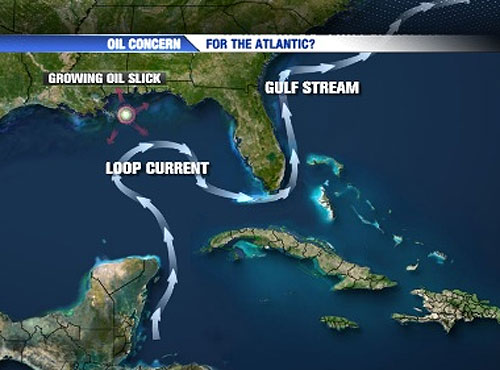
"Atlantic coast now under threat as current spreads Gulf oil slick"

From the Guardian.co.uk:

There was mounting evidence last night that the scale of the oil spill disaster in the Gulf of Mexico has grown beyond all the initial worst-case scenarios, as thousands of gallons of oil continued to gush from the sea floor.

On the island of Key West, south of Florida, coastguard officials said about three tar balls an hour were washing up on the beaches of a state park. They said the globs of concentrated oil suggest leaking crude has now become caught up in the powerful loop current and could move from the gulf up to the Atlantic coast.

Meanwhile, an oceanographic research ship reported sighting a 10km (six-mile) plume lurking at depths below 1,000 metres and invisible from the surface.

The evidence of spreading environmental damage grew even more compelling with the release of fresh video showing thick clouds of oil billowing from the ruptured well.

The Obama administration responded by doubling the no-fishing zone to 19% of the waters in the gulf.

Fighting the spill is risky. Lisa Jackson, head of the Environmental Protection Agency, acknowledged that authorities were relying heavily on Corexit, a chemical banned in the UK because of its effects on limpets and other sea life.

"There has been a real reliance on them, maybe more than anybody thought would ever happen," she told the Senate environment and public works committee.

The mounting evidence forced administration officials to admit for the first time yesterday that they had underestimated the risks of offshore drilling.

In two highly charged hearings in the Senate, Ken Salazar, the interior secretary, conceded there had been failures in oversight by the agency responsible for policing offshore drilling. "We need to clean up that house," he said...

The White House this week intensified its efforts to limit the potential political damage on November's mid-term elections by backing an independent commission to investigate the disaster. In testimony yesterday defensive actions also included dogged resistance by administration officials to senators' demands to provide estimates of the size of the spill.

The stonewalling went beyond the Senate hearings. For the past 48 hours, officials have resisted reports by scientists that the spill could have entered the loop current, or downplayed their significance.
___________

There are quite a few news stories claiming that the tar balls are not from this spill. But they don't say where they are from. If there haven't been tar balls and now there are - that is rather a stretch (wishful thinking?) to say they are not from "Deepwater Horizon".

Monday, May 17, 2010

"ADHD in kids linked to pesticide exposure"

The Montreal Gazette:

MONTREAL – Children exposed to common pesticides used on fruits and vegetables could have a higher risk of attention-deficit/hyperactivity disorder, a new study has found.

The risk is present even at very low exposure, said lead author Maryse Bouchard of the Université de Montréal, a post-doctoral student at Harvard University.

Apart from a handful of studies on the subject that looked at specific groups with high exposure – for example, children of agricultural workers or living near crop fields – there previously was little data about pesticides and children’s health, Bouchard said.

“This is the average American child ... with no particular source of exposure that we know of,” Bouchard said of the study published in the journal Pediatrics Monday.

Bouchard’s findings show exposure is harmful even at levels commonly found in children’s environment.

Children are uniquely sensitive to pesticides – even small amounts can affect brain development. Pound for pound of body weight, infants and children eat, drink and breathe more than adults.

Bouchard and her colleagues looked at a sample of 1,139 children between 8 and 15 years and their measures of urine for metabolites of pesticides known as organophosphates.

The compounds turned up in the urine of 94 per cent of the children.

Those with higher residues of pesticide in their urine were at higher risk of attention-deficit/hyperactivity disorder – for which they were taking medication, Bouchard said.

Parents said their children had learning difficulties and behaviour problems including inattention, hyperactivity, and impulsivity.

The surprise, Bouchard said, was that the effect was noted at really low levels of pesticides.

“They had double the risk compared to those with no detectable levels of pesticide,” Bouchard said.

Organophosphate compounds have been used as insecticides in agriculture and in chemical warfare.

Some pesticides persist in the body. But not organophosphates. These are metabolized and eliminated quickly, which means that if found in urine, exposure had occurred within a few days, explained Robin Walker of the Canadian Institute of Child Health and chair of the pediatric health unit for the Canadian Pediatrics Society.

“That means that the children who had the highest levels probably were ingesting the pesticide in a fairly continuous fashion,” said Walker, who did not participate in the study.

“That’s worrisome. We’re not talking about acute toxicity. We’re much more concerned about the impact on the developing organism of low-level, continuous exposure.”

While earlier studies have shown links between pesticides and a broad range of neurdevelopmental issues, Bouchard’s team honed in on ADHD, behaviour and cognitive function.

The study does not prove pesticides cause ADHD but the link is significant, Walker said.

Also, the study did not determine how children were exposed, but researchers speculate the major source is diet and the environment.

Researchers noted high concentrations of pesticide were previously found in frozen blueberries, strawberries and celery.

Children are smaller, shorter, closer to the ground. Also, they tend to play in grass and dirt, and put toys and hands in their mouths, activities that can significantly increase their exposure to pesticides.

Plus, their bodies are not fully developed and they may not be able to excrete toxins like adults do.

People can limit pesticide exposure by eating organically grown foods, washing fruits and vegetables before eating them and reducing the use of pesticides in their homes and gardens.

The study is further proof that provinces should follow Quebec’s lead in banning lawn and garden pesticides, Walker said.

The Gulf Oil Spill Disaster / Gulf Stream Loop Current


From Weather.com: