Sunday, August 06, 2006

Art These Days


It's probably no coincidence that that it was a photographer - Stieglitz - who decided to exhibit DuChamp's Fountain (actually a urinal) in 1917. Photography itself was a major leap in detaching the artist from the hand work of creating. Making pictures became more of a scientific process with chemicals.


_____


Harold "Doc" Edgerton - an engineer/professor at MIT - made some amazing scientific photographs with strobe lights that have wonderful artistic properties. The "Milk Drop", for example. Other photos include a bullet blasting through an apple - a football being compressed by a kick, a bird in flight, etc.

_____

Now we have people saying that rat brain cells are making "art" via electrodes.

From robots.net -

The rat brain cells are kept on a glass slide in some goo that keeps them alive and are connected to a robot arm via electrodes that allows the cells to draw with three colored markers and to see the art it's making. ... There's no eraser for the rat brain cells so if it makes a mistake, perhaps it would exclaim, "rats!" The robot will be one of the participants of the Artbots Robotic Talent Show in New York.


From the "creators" -

“MEART – The Semi Living Artist” is a geographically detached, bio-cybernetic research and development project exploring aspects of creativity and artistry in the age of new biological technologies.

It was developed and hosted by SymbioticA? - The Art & Science Collaborative Research Lab, University of Western Australia.

MEART is an installation distributed between two (or more) locations in the world. Its “brain” consists of cultured nerve cells that grow and live in a neuro-engineering lab...

"This work explores questions such as: What is creativity? What creates value in art? "
From an historical context, artists have always been concerned with imitating life and with giving life/animating qualities to non-living entities. Technology has also joined forces with art forms to create more sophisticated types of artificial life systems and “intelligent” machines....


___

Art? and Science. I would agree that there is science involved - I'm not so convinced about the art and esp. creativity on the part of the electrodes. There is certainly creativity on the part of the people who developed this whatever it is. And it is interesting for considering the intersection of art and science. And at the SymbioticA Lab - it's interesting to see that artists are working with scientists.

SymbioticA is the first research laboratory of its kind, in that it enables artists to engage in wet biology practices in a biological science department. Developments in science and technology, in particular in the life sciences, are having a profound effect on society, its values, belief systems and treatment of individuals, groups and the environment. The interaction of art, science, industry and society is recognized internationally as an essential avenue for innovation and invention, and as a way to explore, envision and critique possible futures. Science and Art both attempt to explain the world around us in ways that are profoundly different but which can be complementary to each other.

___

Einstein saw art and science as performing a similar function...

"How can cosmic religious feeling be communicated from one person to another if it can give rise to no definite notion of a God and no theology? In my view, it is the most important function of art and science to awaken this feeling and keep it alive in those who are receptive to it."

Saturday, August 05, 2006

People for Peace

I should have taken a camera - it was quite a picture. People from various sectors of the Bloomington, Indiana community came together for a peace walk/prayer gathering/singing. Most of us were dressed in white - which made everyone seem more connected. Plus everybody had a flower.

The majority appeared to be either Jewish or Muslim. Some identified their affilitation with a yamaka or a t-shirt. I recognized some Quakers, a UU minister, people from the Bloomington Peace Community, others. There were people of all ages and one darn cute puppy.

The event was put together by a new group calling itself "Bloomington Muslims and Jews for Peace and Justice". That group includes people from The Islamic Center of Bloomington and the Jewish Alliance for Justice and Peace.

There were prayers. Carrie Newcomer sang (she is affilated with the Bloomington Friends Meeting) - with the crowd singing the chorus. She looked like she was about to cry - it did all seem so sad and beautiful at the same time.

I was thinking how nice it is to live somewhere where people do not go to war over land, or water (though Bloominton was not happy that a company from Indianapolis wanted to pipe Lake Monroe to Indy), or whatever.

Cynical me. The people asked God to stop the violence. It seems to me that is mostly up to Olmert. Hezbolla has been saying that they would honor a ceasefire. The new UN "deal" involves "a demilitarisation of the south, between the border and the Litani River - an area about 20 miles deep into Lebanon". So it's basically giving Israel access to the Litani. (See my post yesterday,
"Water Issues in the Middle East" for more on that).

If things go as usual - the US press will try to make out like America and Israel are for an agreement - while Hezbolla and/or Lebanon are not. As if the Lebanese are being unreasonable because they don't want to give away their land and water. It's not much of a peace agreement. Though I don't think that Bolton (our "Peace" ambassador) ever wanted peace anyway - saying things like "I don't think that the use of force by Israel is excessive". (July 20th)

Sea Urchins Dying Off California Coast


Hundreds of dead or dying purple sea urchins have washed up into tide pools at a Southern California marine refuge center in recent days, but no one is certain what is killing them.

"On Monday there were 200 or 300 that littered just the tide pool area," said Amy Stine, a supervisor at the Little Corona Marine Life Refuge. Normally, she said, she sees at most three urchin shells a day. "Most of them that are now left on the shore are dead. The sea gulls are having a heyday with them," Stine said....


_____

It would be nice to have a grasp of how much more frequent and severe these things are. When I was at the beach a couple months ago - one day there were a few starfish and a couple jellyfish - another day - not much to speak of. It can be interesting for those of us who get to the beach infrequently to see a few of these things - when it seems natural. When the sealife is dying by the hundreds - that's something else again. Though as the article mentions, it's good for the seagulls (unless the urchins were poisoned somehow - see "Dark Tides, Ill Winds" for more about that).

Buying Stuff

I was browsing around and came upon the site of the Ethical Consumer.

It's based in the UK - and yet there is a page dedicated to the Boycott Bush campaign. Of course the Bush policies affect people all over the world.

I rarely buy "things" anymore. But there are food choices to make (I went vegetarian a few months back), and there is shampoo and such, gasoline, and art supplies. And if I want to sell art - I can't very well discourage people from buying it.

Recently more people have been consciousIy choosing not to buy stuff at all - or at least not new stuff. I found this article on The Compact - a grassroots effort - to encourage people to not buy things. (Like most articles on news sites - it is surrounded by ads imploring people to buy things).

It began as a simple, or simply terrifying, pledge taken by a small group of friends feeling overwhelmed by all the things in their lives. Over a potluck dinner two years ago, they made a pact: Buy nothing new except food, medicine and toiletries for six months.

The effort lasted a year before falling victim to the demands of modern life. But the commercial craziness of the Christmas season brought the group back together a few months ago.


And as the article notes:

Religious groups such as the Shakers, the Mennonites, the Amish and some Quakers have long embraced the notion of living a simpler life. Writer and philosopher Henry David Thoreau idealized it.

And there are religious people of all sorts who have abandoned things throughout the ages - like some gnostics, sufis, and yogis. The wikipedia page on Asceticism mentions "starving artists" and "hackers" as examples of people who choose to do without stuff for reasons other than religion. The Compact group - does not seem to be motivated by religion but a desire to not be controlled by things. Though the results may be similar.

There are many things to consider about consuming ethically. But buying less - whether it is less food, less clothes, less whatever it is, means less energy is used in production, in shipping, which means less junk in the oceans, in the air. Buy local - when possible.

And if you are going to buy things - buy art. :) That would be original, one of a kind, handmade art - not reproductions that are created halfway around the world. (That could be a handmade mug at the local art gallery/craft store/art fair - I'm not suggesting that the only art people buy cost thousands of dollars).

Friday, August 04, 2006

Water Issues in the Middle East


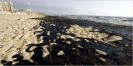
As part of the destruction of Lebanon, Israel bombed the Jiyyeh power station on the Lebanese coast creating an oil spill which will mean massive environmental destruction for decades. The spill is comparable in size to the Valdez Oil spill in Alaska. (more info)


According to the country’s environment minister:

“Chances are, our whole marine ecosystem facing the Lebanese shoreline is already dead,” Sarraf said. “What is at stake today is all marine life in the eastern Mediterranean.”

The oil so far has slicked about one-third of Lebanon’s coast, a 50-mile stretch centered on the Jiyeh plant 12 miles south of Beirut, said the country’s environment minister, Yaacoub Sarraf. It has also drifted out into the Mediterranean, already hitting neighboring Syria.


______

There has been speculation that the bombing of Lebanon is a all about the water. From an article at ENN"Where Are the World's Looming Water Conflicts?" (With a nod to Hecate for the find).

Israel, the Palestinian territories and Jordan rely on the River Jordan, which is fed by 3 rivers on the Syria-Lebanon border.

Disputes over diverting the river have spilled over into war in the past. Former Israeli Prime Minister Ariel Sharon said the 1967 Arab-Israeli war was started by Syrian plans to divert water from Israel. In 2002 he said the issue may start a new war.


The Jordon River has a tributary 5 km from the Litani River - and right now - it's the Litani River that Israel is going for.

More about the "Litani River Dispute":

Israel has considered diverting the Litani southward, first proposed in 1905 because it seemed "the waters of the Jordan basin would be insufficient for the future needs of Palestine."The Litani, because of its water, was suggested to become part of the "national Jewish entity" in 1919 but this was rejected by the League of Nations, and the Litani became part of Lebanon....

The entire basin of the Litani River is located within the borders of Lebanon. The river rises in the central part of the northern Biqa'a Valley, a short distance west of Baalbek and flows between the Lebanon mountain to the west and the anti-Lebanon mountains to the east, running south and southwestardly at its own pace. The river enters a gorge at Qarun, flows through it about 30 kilometers and, near Nabatiya and the Beaufort Castle, abruptly turns right (to the west), to break through the mountain range to the right, and continues to flow through the hilly terrain of the al-Amal region. North of Tyre, it empties into the Mediterranean.

The Litani River flows not far from Israel. The nearest part of the Litani to Israel is where the river turns by Nabatiya, four kilometers from Israel's border. The river's proximity to Israel may make it even more tempting for Israel to exploit. The Litani River is 170 kilometers long, with a basin of 2,290 square kilometers. A narrow ridge about 5 kilometers wide separates the Litani from the Hasbani River, a tributary of the Jordan River.

The US is like a dysfunctional family.

The problems are hidden from view. The corporate media does not talk about what is going on honestly between our countries and other countries. Or within our own.

It's stressful to live in dysfunctional families. The pretence that everything is OK - when you know that it isn't. The emotional dishonesty.

And yet everyone goes about playing the game. We pretend that we are free. We pretend that people have equal opportunites. We pretend that the violence that our country commits or supports is self-defense. We pretend that we are good and that others are bad.

It may be that the majority of people in the US live comfortably - in a physical sense. Needs are met. Life goes on. People focus on trivialities. Meanwhile, the US engages in "techniques of world control". (more here).

Thursday, August 03, 2006

Clouds Over Antarctica


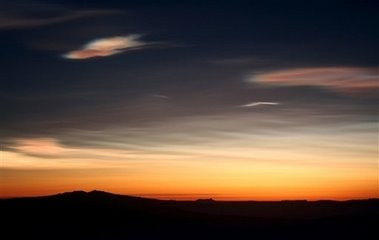
I don't think I'll be seeing these any time soon. They sound like an inspiration, though. Go to the link for a slideshow.

The clouds only occur at high polar latitudes in winter, requiring temperatures less than minus 176 degrees Fahrenheit. A weather balloon measured temperatures at minus 189 degrees Fahrenheit on the day the photos were taken.

Resembling airborne mother-of-pearl shells, the clouds are produced when fading light at sunset passes through water-ice crystals blown along a strong jet of stratospheric air more than six miles above the ground.

On Art and Decoration

A seminar for artists about marketing has me thinking about art and decoration.

One artist was very upset about the idea that people would buy a piece of art to go with their couch. And yet if someone bought a piece of art and it looked horrible hanging over the couch - then that doesn't seem like a good thing either. For the art or the couch.

But the question really seems to be more of whether the art does anything other than provide color, style, and something to fill up wall space. For the decorator - art may just be one more piece of the puzzle - a design element. For the artist - it may or may not mean a lot more.

Art can be something that inspires, that encourages people to see things in a new way, appreciate nature, something that evokes emotion. People can choose what sorts of emotions or ideas they wish to be surrounded with.

Advertisers use as a tool - the arousal of emotion. Some modern art is mostly provocative - some created to disturb. The more disturbing - the more likely to be noticed. Like advertising.

A recent trend in art was photographs that showed human suffering in various places around the world. While I am not one to shy away from bad news - having disturbing images on my walls is not what I would choose.

I am interested in creating art that accesses deeply felt spiritual and emotional connections. Art that evokes positive emotions. It's ironic that some of the artists who express that the best seem to have been depressed individuals. Like Van Gogh. Like Jackson Pollack.


There are museums full of religious art with the divine symbolized as Jesus. Islamic art does not depict the divine in human form - patterns are used. In China and Japan, art and nature and spirituality have been more connected.


I create art using colors and textures and inspiration from nature. Jackson Pollack once said, "I am nature" - in that he felt so connected to it. There was also a writer 2000 years ago, Apuleius, who wrote, "I am Nature, the universal Mother... primordial child of time..." That is the sort of spirituality I wish to express.

If people end up putting my paintings over their couch - that's ok - better there than my closet.

"A Chemical Imbalance"

Part 5 in the LA Times series - Altered Oceans.

Snips:

...Scientists report that the seas are more acidic today than they have been in at least 650,000 years. At the current rate of increase, ocean acidity is expected, by the end of this century, to be 2 1/2 times what it was before the Industrial Revolution began 200 years ago. Such a change would devastate many species of fish and other animals that have thrived in chemically stable seawater for millions of years.

Less likely to be harmed are algae, bacteria and other primitive forms of life
(like Jellyfish) that are already proliferating at the expense of fish, marine mammals and corals.

In a matter of decades, the world's remaining coral reefs could be too brittle to withstand pounding waves. Shells could become too fragile to protect their occupants. By the end of the century, much of the polar ocean is expected to be as acidified as the water that did such damage to the pteropods aboard the Discoverer.

Some marine biologists predict that altered acid levels will disrupt fisheries by melting away the bottom rungs of the food chain — tiny planktonic plants and animals that provide the basic nutrition for all living things in the sea....

The oceans have been a natural sponge for carbon dioxide from time immemorial. Especially after calamities such as asteroid strikes, they have acted as a global safety valve, soaking up excess CO2 and preventing catastrophic overheating of the planet.

If not for the oceans, the Earth would have warmed by 2 degrees instead of 1 over the last century, scientists say. Glaciers would be disappearing faster than they are, droughts would be more widespread and rising sea levels would be more pronounced....

By comparing these measurements to past levels of carbon dioxide preserved in ice cores, the researchers determined that the average pH of the ocean surface has declined since the beginning of the Industrial Revolution by 0.1 units, from 8.16 to 8.05.

If CO2 emissions continue at their current pace, the pH of the ocean is expected to dip to 7.9 or lower by the end of the century — a 150% change.

The last time ocean chemistry underwent such a radical transformation, Caldeira said, "was when the dinosaurs went extinct."

Wednesday, August 02, 2006

Woman's Equality and Global Thinking

"Women's Deliberation" by B. Meltz...Summed up at The Philosopher's magazine as: "Philosopher Urges Women to Act Like Equals Gets a death threat as a result. In the US."

Hirshman first became controversial when she wrote an article last year for the liberal American Prospect magazine website saying it's a mistake for women to quit their jobs to stay at home with children. ...In a piece last month in the Washington Post, she didn't back down. Then came her book, just out, provocatively titled, ``Get to Work: A Manifesto for Women of the World".

See also "The Motherhood Manifesto" for another point of view....

For example, the option of flextime would make a world of difference for Renee and her family. "Flextime would make a huge difference in my life because with my job function, there are busy days and late days. As long as I'm there forty hours a week and get my job done, then I don't know why anyone would care. I don't understand why there's such an 8 am to 5 pm 'law' in my workplace."

...Studies show that this mommy wage gap is directly correlated with our lack of family-friendly national policies like paid family leave and subsidized childcare. In countries with these family policies in place, moms don't take such big wage hits.

...Amy Caiazza, from the Institute for Women's Policy Research, notes, "If there wasn't a wage gap, the poverty rates for single moms would be cut in half, and the poverty rates for dual earner families would be cut by about 25 percent."


In the article, "Legal Weapon", Nussbaum considers Catharine MacKinnon's book, Are Women Human?

Inequality on the basis of sex is a pervasive reality of women's lives all over the world. So is sex-related violence. Rape by strangers and acquaintances, rape within marriage, domestic violence, trafficking into sex work, the abuse of women and girls in the pornography industry: In all these ways, argues Catharine MacKinnon, women suffer aggression and exploitation, "because we are women, systemically and systematically."

...Despite the prevalence of these crimes, they have not been well addressed under international human rights law--if, indeed, they have been addressed at all. Typically, there has been what MacKinnon calls a "double-edged denial": The abuse is considered either too extraordinary to be believed or too ordinary to constitute a major human rights violation. Or, as MacKinnon says, "If it's happening, it's not so bad, and if it's really bad, it isn't happening."

...MacKinnon sometimes comes quite close to saying that the modern state is a sexist relic that has had its day. Surely, however, the state is the largest unit we know of so far that is decently accountable to people's voices, and thus it is bound to be of critical importance for women seeking to make their voices heard. I think there is also a moral argument for the state: It is a unit that expresses the human choice to live together under laws of one's own choosing. Once again, it is the largest unit we yet know that expresses this fundamental human aspiration.

____________________________________________________________

I see feminism as tied to global warming in a global thinking kind of way. It's not like there shouldn't be modern states - but the whole world needs to start thinking differently. Some people like to think of the world as having one mind - and maybe it just needs to start talking to itself (and esp. to the women).

One thing is that with modern technology - people can and should have fewer children - 1 or 2 -for the people having children at all - if we are going to have a sustainable world. So of course that means that mothers will not be spending as much of their life consumed with the bearing and raising of children. And it's not surprising that there would be expectations that if women are not spending their lives raising children that they will be spending their lives more as men (who have not been raising children) have. And that women will expect and demand equal consideration in ways that they have not always had.

It's a problem - balancing the raising of children with having a career. There are still a lot of forces in society that keep women in service roles of one sort or another. It seems that our economy is based on it. And I agree with Hirshman that once women stop taking their career seriously in exchange for what seems like security - it is difficult to regain what has been lost. Even though raising children can be taken as seriously as any job.

It seems that Europe has been moving forward in this area - with more help for parents in raising children and staying in ones career. It seems that the US is moving backward - just as Hirshman gets death threats for her views and MacKinnon wonders if woman are "human" yet. That doesn't mean - are we "men" yet - but rather that the world is ready to allow women's talents and abilities and contributions to be considered equally with men's.

And the world needs quit fighting and start sharing. Listen to the voices of the mothers.

And I need to get to work.

"It's a Caribbean heat wave" (In Canada)

So much for going to Canada in the Summer to cool off. We were up there last August - and there was a similar heat wave then.

...Due to a high pressure system lingering over parts of the Great Lakes, Southern Ontario and northeastern parts of the United States have effectively taken on the tropical heat of the Gulf of Mexico, says Environment Canada's senior meteorologist Geoff Coulson....
"As the cool air descended, the surrounding air in the upper troposphere -- the lower part of the atmosphere -- filled up the extra space, which caused higher pressure at the surface. The higher-pressure air at the surface then started flowing outward, but as it did, the rotation of the Earth turned the wind to the right, which pulled the air from the Gulf of Mexico."
Typically, these high pressure systems are blown away by the jet stream, but over the past few days the upper troposphere winds have been very light.
"It's really the jet stream that directs these systems, but because the winds are so light, this system just keeps pulling in more humid air from the Gulf," Mr. Coulson said....

Warning Signs

A collection of some global indicators...

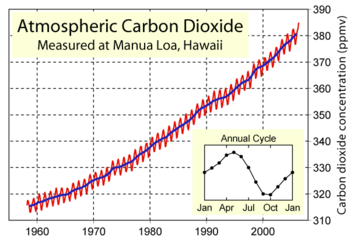
Mauna Loa Curve (Keeling Curve)


"The increasing amount of CO2 in the atmosphere from the burning of fossil fuels has become a serious environmental concern. Central to this concern is the question whether a rise in CO2 constitutes a peril to man by raising world temperatures, as many scientists now claim. That a rise in CO2 is occurring is unquestionable, however. Mauna Loa Observatory (MLO) data are providing dramatic evidence of that: they show amounts more than 10% over amounts recorded before the Industrial Revolution, and a rise of 6% in the last 19 years alone."
___

Amazon rainforest 'could become a desert'


The vast Amazon rainforest is on the brink of being turned into desert, with catastrophic consequences for the world's climate, alarming research suggests. And the process, which would be irreversible, could begin as early as next year.
Studies by the blue-chip Woods Hole Research Centre, carried out in Amazonia, have concluded that the forest cannot withstand more than two consecutive years of drought without breaking down.
Scientists say that this would spread drought into the northern hemisphere, including Britain, and could massively accelerate global warming with incalculable consequences, spinning out of control, a process that might end in the world becoming uninhabitable.

___

The Gulf Stream is Weakening. (As reported last year)


...They have found that one of the “engines” driving the Gulf Stream — the sinking of supercooled water in the Greenland Sea — has weakened to less than a quarter of its former strength.
The weakening, apparently caused by global warming, could herald big changes in the current over the next few years or decades. Paradoxically, it could lead to Britain and northwestern and Europe undergoing a sharp drop in temperatures.
...“Until recently we would find giant ‘chimneys’ in the sea where columns of cold, dense water were sinking from the surface to the seabed 3,000 metres below, but now they have almost disappeared,” he said.
“As the water sank it was replaced by warm water flowing in from the south, which kept the circulation going. If that mechanism is slowing, it will mean less heat reaching Europe.”
...The Gulf Stream transports 27,000 times more heat to British shores than all the nation’s power supplies could provide, warming Britain by 5-8C.

"Plague of Plastic Chokes the Seas"

Part 4 in the LA Times series - Altered Oceans. If you go to the article you can see graphics that show the "Eastern Garbage Patch" swirling off the coast of California and the "Western Garbage Patch" by Japan.

Snips:

...thousands of cargo containers fall overboard in stormy seas each year, spilling their contents. One ship heading from Los Angeles to Tacoma, Wash., disgorged 33,000 blue-and-white Nike basketball shoes in 2002. Other loads lost at sea include 34,000 hockey gloves and 29,000 yellow rubber ducks and other bathtub toys.

The debris can spin for decades in one of a dozen or more gigantic gyres around the globe, only to be spat out and carried by currents to distant lands. The U.N. Environment Program estimates that 46,000 pieces of plastic litter are floating on every square mile of the oceans. About 70% will eventually sink.

...An estimated 1 million seabirds choke or get tangled in plastic nets or other debris every year. About 100,000 seals, sea lions, whales, dolphins, other marine mammals and sea turtles suffer the same fate.

The amount of plastic in the oceans has risen sharply since the 1950s. Studies show a tenfold increase every decade in some places. Scientists expect the trend to continue, given the popularity of disposable plastic containers. The average American used 223 pounds of plastic in 2001. The plastics industry expects per-capita usage to increase to 326 pounds by the end of the decade....

Tuesday, August 01, 2006

"Dark Tides, Ill Winds"

Part 3 on Altered Oceans

...About 60,000 people in the United States are poisoned each year by algae blooms. Most get sick by eating fish and shellfish that concentrate neurotoxins from the vast quantities of algae they consume.

The Centers for Disease Control and Prevention estimates that only 2% to 10% of all cases are reported to health authorities — usually those that involve numbness, paralysis, coma or other severe symptoms. Cases of nausea, cramping and diarrhea tend to go unreported.

Estimates of algae-related illness don't include the many thousands of people in Florida and other Gulf Coast states who suffer from inhaling airborne brevetoxin.

Nearly every coastal region has outbreaks of harmful algae or bacteria.

...When you look at it statistically, red tides are 10 times more abundant than they were 50 years ago," Brand said. Once, "the peak time was in the fall…. Now we have blooms continuing on and lasting into the winter and spring."

The highest concentrations of algae, he said, were along heavily developed shorelines and around the mouths of rivers that disgorge nutrient-laden waters from sugar-cane fields and sediment from phosphate mines.

Brand said that was no coincidence. It reflects "a huge increase in sewage, runoff from lawns and golf courses, mining and agriculture," he said.

...Red tides have become a staple of the daily reports on surf conditions posted on the lifeguard tower. The sign read: "Some Red Tide = Coughs. Sneezes. Dead Fishes." A few extra words were scribbled in chalk in the margin: "Can't do anything about [it]."


Some of the toxins:

Saxitoxin accumulates in mussels, clams, oysters and other shellfish, as well as in sardines, herring and puffer fish, without harming them. The toxin can poison seabirds, marine mammals and humans who eat contaminated fish or shellfish.

Domoic acid accumulates in clams, mussels, oysters, crabs, anchovies and sardines. It can sicken or kill seabirds, sea otters, sea lions, dolphins, whales and humans.

Brevetoxin accumulates in shellfish and sea grasses without harming them, but it poisons fish, manatees, dolphins, sea turtles and seabirds, as well as humans who inhale the neurotoxin or eat contaminated seafood.

Ciguatoxin is picked up by smaller algae-eating fish and passed up the food chain to predators such as barracuda, snapper, jacks, grouper and kingfish. Although the toxin doesn't appear to harm these fish, it can sicken people who eat them.

Sources: "Harmful Algal Research and Response: A National Environmental Science Strategy 2005-2015," Bigelow Laboratory for Ocean Science, Woods Hole Oceanographic Institution. Graphics reporting by Kenneth R. Weiss.

Heatwave Hell

An article in the Timesonline.uk, Heatwave with a global grip , has a summary of the world's weather.

In France there have been 64 deaths. (In 2003 - the heatwave was associated with 15,000 deaths). "Last week Spain and France, hit by temperatures 7-9C above average, had to shut down nuclear power stations as the rivers supplying water for cooling became too warm."

In Spain, the heatwave was accompanied by jellyfish keeping people out of the water. "The Red Cross has treated more than 10,000 jellyfish stings this summer so far in the eastern region of Catalonia... Nearly a third of those have been in the past week."

Temperatures are also up in South America, the Middle East and China. About the only place they are down is in Western Russia, Korea and Japan.

Nearly the entire US lower 48 (except the very west coast - above San Francisco) has been having a heatwave for a couple of weeks. California had 130 heat related deaths. Power stations were overloaded leaving some people without power for days. "“One hundred twenty-six degrees (52C) in Death Valley last week; Sacramento had 11 days at or above 100 degrees (38C), their old record was nine. We’re seeing some impressive records out there to be sure and unfortunately this is taking a human toll.”

Now it's getting worse in the Midwest and East. Yesterday it was 99 in Chicago. Today and tomorrow is expected to be over 100 in New York City. The city plans to keep its 383 cooling centers (opened for a recent blackout in Queens) and pools open longer.

And then there are droughts and wildfires.

Global Warming Fuels U.S. Forest Fires