"Resistance is Illogical" From Juan Cole, 10.18
Bush and a supine, cowardly Congress shredded the US Constitution on Tuesday, abolishing the right of a court review (habeas corpus) for some classes of suspect. Suspect, mind you, not proven criminal.
In other words, we have to be confident that George W. Bush is so competent, all-knowing, and inherently just that we can just trust him. If he says someone is an enemy combatant, then he or she is. No need to check with a judge about why he or she is being held. And then Bush can have the suspect tortured to make him confess, and can convict him on the basis of the coerced confession, all in secret...
Basically, Bush can issue them what the French kings used to call lettres de cachet.:
' In French history, lettres de cachet were letters signed by the king of France, countersigned by one of his ministers, and closed with the royal seal, or cachet. They contained orders directly from the king, often to enforce arbitrary actions and judgements that could not be appealed. . .'
We Americans made a revolution against such arbitrary practices of the French and other Empires. (more)
______
Meanwhile Bush Paraguay Land Grab Incites Unease (nearly 100,000 acres).
______
Wednesday, October 18, 2006


Tuesday, October 17, 2006
Guilin Chinese Painting Academy

There is a wonderful art exhibition at the IU Art Museum from painters from the Guilin Chinese Painting Academy.
I especially liked the paintings of Xu Fang. They are quite traditional in style - but there was something that seems modern about them - the colors maybe (the tall painting here - only the colors aren't right). She wrote that she was painting "the subtlety of heaven and earth" and expressing the "vitality of nature". And "I am devoted to to painting wildflowers, plants, birds and insects." I wish there had been translations of the calligraphy on the paintings.
Some of the other painters had more modern aspects incorporated into their style. There was quite a variety. The show is up until December 17, 2006.
A clip from the press release:
Against long odds, Guilin artists seek to find an authentic voice for contemporary China
The artists of the Guilin Chinese Painting Academy, who will stage a historic exhibition at the Indiana University Art Museum later this month, are devoted to carrying on the more than 300-year tradition in China of influential Guilin painting.
They're also seeking to give life to a contemporary school that merges traditional Chinese painting techniques with Western art styles that didn't emerge in China until the country opened its doors to outside influences in the 1980s....
The self-selected artists of the Guilin Academy explore the human condition and a rapidly changing China through a fusion of Chinese painting techniques and ideas of Western self-expression, said Judy Stubbs, the Pamela Buell Curator of Asian Art and the coordinating curator of Conspiring with Tradition. Their work includes silk scroll, traditional ink and calligraphic paintings.
"While many of these paintings are lovely to look at, it is wise to remember that at one time, not so long past, art of this nature would have been seen as subversive and even dangerous," she said.
For about 30 years -- from the founding of Communist China in 1949 to the "opening" of the country in 1979 -- Chinese artists were limited in what art they could view and create. Landscapes, birds, flowers and portraits were viewed with suspicion by the government, and paintings affiliated with the country's imperial past were labeled as corrupt, Stubbs said....

The artist of this piece, Bai Xiaojun, says in his statement, "The spirit of ink and wash painting connects with the universe. The movement of ink and wash on paper best demonstrates the yin/yang and solid/void of the universe ...".
__________________________
From the Herald Times (subscription) article about this Brush with tradition: Landscape has been a crucial aspect of Chinese art for generations. The revolution in China interrupted this tradition by favoring social realist painting, depicting scenes of smiling, hardworking peasants and factory workers.
It a heck of a thing when painting wildflowers in considered subversive. Maybe it's that connection to the universe and all.
Monday, October 16, 2006
Wind Turbines Making Headway
It's been quite the windy day here today - so it was interesting to come across these two articles about Wind Turbines - one for home use and the other for use on commercial buildings. I have long thought that it makes far more sense to install wind turbines where the energy is actually being used - like on or near buildings - instead of far out in the water or on top of remote hills.
Home wind turbines turn fashionable in Britain
A mere breath of a breeze disturbs the quiet of autumn in south London and the wind turbine on the gable of Donnachadh McCarthy's home turns lazily....
"I have exported 20 percent more electricity than I've imported this year," he said. "The average carbon footprint is 8.5 (metric) tons in the (European Union), whereas mine is less than half a ton."
McCarthy has long tried to stay at the forefront of British green power generation.
Last November, he made a small media splash as the first Londoner to gain permission to put a turbine on a house that already boasted an array of renewable energy devices.

The UK company Windsave is selling these online for home-use at Do-it-yourself stores.
From their website - the UK Government is offering these incentives:
Grants are available for renewable energy projects (up to 30% of the installed cost of a wind turbine or solar water heating panels). You can find out more about these at www.lowcarbonbuildings.org.uk.
There are also Governmentfunded schemes providing up to £2,700 to households on certain benefits to improve their heating and energy efficiency. The scheme is known as ‘Warm Front’ in England, ‘Warm Homes’ in Northern Ireland, ‘Warm Deal’ in Scotland and ‘Home Energy Efficiency Scheme’ in Wales (see www.direct.gov.uk for more information).
_________________
'Micro' wind turbines are coming to town
Rather than build farms of towering wind turbines in rural areas, some companies are designing "micro," or small-scale, turbines that fit on top of buildings. The idea is to generate electricity from wind in urban or suburban settings.
"We want to integrate these small wind turbines on buildings in plain sight," said Paul Glenney, director of energy initiatives at Monrovia, Calif.-based AeroVironment. "We think this can really communicate the generation of clean electricity."

Home wind turbines turn fashionable in Britain
A mere breath of a breeze disturbs the quiet of autumn in south London and the wind turbine on the gable of Donnachadh McCarthy's home turns lazily....
"I have exported 20 percent more electricity than I've imported this year," he said. "The average carbon footprint is 8.5 (metric) tons in the (European Union), whereas mine is less than half a ton."
McCarthy has long tried to stay at the forefront of British green power generation.
Last November, he made a small media splash as the first Londoner to gain permission to put a turbine on a house that already boasted an array of renewable energy devices.

The UK company Windsave is selling these online for home-use at Do-it-yourself stores.
From their website - the UK Government is offering these incentives:
Grants are available for renewable energy projects (up to 30% of the installed cost of a wind turbine or solar water heating panels). You can find out more about these at www.lowcarbonbuildings.org.uk.
There are also Governmentfunded schemes providing up to £2,700 to households on certain benefits to improve their heating and energy efficiency. The scheme is known as ‘Warm Front’ in England, ‘Warm Homes’ in Northern Ireland, ‘Warm Deal’ in Scotland and ‘Home Energy Efficiency Scheme’ in Wales (see www.direct.gov.uk for more information).
_________________
'Micro' wind turbines are coming to town
Rather than build farms of towering wind turbines in rural areas, some companies are designing "micro," or small-scale, turbines that fit on top of buildings. The idea is to generate electricity from wind in urban or suburban settings.
"We want to integrate these small wind turbines on buildings in plain sight," said Paul Glenney, director of energy initiatives at Monrovia, Calif.-based AeroVironment. "We think this can really communicate the generation of clean electricity."

The Sun

By way of Cosmic Variance:
This is a photo of the sun. Not taken with the usual medium for viewing the sun (photons), but taken with neutrinos. Partly at night. Through the earth. It was photographed by the Super-Kamiokande experiment in Japan with 503.8 days and nights of exposure.
"Making a Difference in the World"
I saw Sheila Watt-Cloutier being interviewed on UCTV. She was very impressive in her vision and her demeanor. She talked of educating and influencing and treaties that she has worked on getting countries to ratify.
"Sheila Watt-Cloutier is an Inuk, the first female President of the Inuit Circumpolar Conference and an international activist on climate change."
Ms. Watt-Cloutier has also been involved with the issue of toxins (persistent organic pollutants, or POPs) in the arctic environment. There has been an increasing problem with seal meat - and other meats that are hunted in the arctic.
From an article from the CBC:
Research done by the federal department of Indian and Northern Affairs shows that Inuit women throughout the territory of Nunavut have DDT levels in their breast milk that is nine times higher than what it is in southern Canadian women.
The UN's Craig Boljkovac says Meeka and other women have every reason to be worried about the food they eat. Over the past few years, he's read and reread the studies on persistent organic pollutants, many of which were done by Canada's federal government. The most recent one was done by the Environmental Protection Agency in the United States.
The studies all conclude that the vast majority of POPs are coming from places much further south. In the case of DDT, most of it originates in tropical areas of Africa, Asia and Central America.
There, DDT is still used in large quantities to control malaria, which kills more than a million people a year. DDT was banned in Canada, the United States and most developed countries in 1972. But poorer countries still rely on it. They see it and other chemicals, such as PCBs, as a way to develop their societies and improve their economies...
In the capital of Nunavut, Iqaluit, the problem of DDT poses a painful dilemma for Sheila Watt-Cloutier. She's the president of the Inuit Circumpolar Conference in Canada....
Although DDT was never used in large quantities in Canada's Arctic, there are other persistent organic pollutants that are to this day being released into the environment here. They're called dioxins and furans. At the Iqaluit garbage dump, ravens and seagulls pick at the bits of food and anything else that's remotely edible. The smoke never seems to drive them away...
Garbage is being intentionally burned, space is at a premium in the Iqaluit dump, but you can repeat that scene in every community in the North and very many in the south as well. The problem with that is every time you burn plastic in an open fire, if it contains chlorine, and most plastics do, you create POPs...
_____
Articles about Ms. Watt-Cloutier winning the Sophie Prize in relation to her activism are here and here.
This is her answer to a question at the COMMONWEALTH NORTH FORUM ALASKA WORLD AFFAIRS COUNCIL about the Inuits changing their lifestyle:
Well, the thing with climate change, when people say well, you'll have to adapt to the situation, the problem with that is that we are adapting. We already are adapting to situations, many of our hunters are and so on. But changes are going to happen so fast that there won't be that adaption period. We can't go from meat eaters to weed eaters overnight or growing from hunting, subsistence to becoming farmers. That's just not a reality that anybody can deal with.
And already us Inuit of the arctic, what has taken many people about 350 years to adjust to this new way of life, some like in our region, as I say I grew up on a dog team the first 10 years of my life, many of my people were still living in snow houses and iglooiuks (ph) when I was born. And to think that in the 52 years since I was born we felt as though we've lived three lifetimes in that. It's happened so quickly. And we're reeling from that change. And my worry is that this next wave of tumultuous change to our climate could have potential to wipe us out very quickly, not just in terms of us the people, but our wildlife.
We don't know the body burdens of toxins in the polar bear. We don't know the body burdens of toxins in our marine mammals. And with global warming coming and adding to that do we know a tipping point? How much of our animal and wildlife and our flora and fauna can take such rapid change?
And so we the people, too, I mean we might be able and we already are adjusting to many changes, but you know, even our systems and the way our body is we have enzymes that are meant to be eating meat. You know, not certain other foods that we don't ingest well. That's the way that we're all made under this universe. And that's why we live in certain areas of the world. Certain things we can adjust to, other things we can't, not that rapidly.
And so it's the rapidity of the fast way in which things are happening that worries me more than anything because are, in essence, a very adaptable people. We're a hunting people who have adjusted and adapted to seasons and to different settings for a long, long time. And that's our strength, but in situations like this there's going to be tipping points, I believe, that will start to happen very quickly that we should be aware of. And that window in which to make drastic cuts is about 10 to 15 years. Let's do it now because international communities take that much time to do something effectively, to make changes to their policies.
"Sheila Watt-Cloutier is an Inuk, the first female President of the Inuit Circumpolar Conference and an international activist on climate change."
Ms. Watt-Cloutier has also been involved with the issue of toxins (persistent organic pollutants, or POPs) in the arctic environment. There has been an increasing problem with seal meat - and other meats that are hunted in the arctic.
From an article from the CBC:
Research done by the federal department of Indian and Northern Affairs shows that Inuit women throughout the territory of Nunavut have DDT levels in their breast milk that is nine times higher than what it is in southern Canadian women.
The UN's Craig Boljkovac says Meeka and other women have every reason to be worried about the food they eat. Over the past few years, he's read and reread the studies on persistent organic pollutants, many of which were done by Canada's federal government. The most recent one was done by the Environmental Protection Agency in the United States.
The studies all conclude that the vast majority of POPs are coming from places much further south. In the case of DDT, most of it originates in tropical areas of Africa, Asia and Central America.
There, DDT is still used in large quantities to control malaria, which kills more than a million people a year. DDT was banned in Canada, the United States and most developed countries in 1972. But poorer countries still rely on it. They see it and other chemicals, such as PCBs, as a way to develop their societies and improve their economies...
In the capital of Nunavut, Iqaluit, the problem of DDT poses a painful dilemma for Sheila Watt-Cloutier. She's the president of the Inuit Circumpolar Conference in Canada....
Although DDT was never used in large quantities in Canada's Arctic, there are other persistent organic pollutants that are to this day being released into the environment here. They're called dioxins and furans. At the Iqaluit garbage dump, ravens and seagulls pick at the bits of food and anything else that's remotely edible. The smoke never seems to drive them away...
Garbage is being intentionally burned, space is at a premium in the Iqaluit dump, but you can repeat that scene in every community in the North and very many in the south as well. The problem with that is every time you burn plastic in an open fire, if it contains chlorine, and most plastics do, you create POPs...
_____
Articles about Ms. Watt-Cloutier winning the Sophie Prize in relation to her activism are here and here.
This is her answer to a question at the COMMONWEALTH NORTH FORUM ALASKA WORLD AFFAIRS COUNCIL about the Inuits changing their lifestyle:
Well, the thing with climate change, when people say well, you'll have to adapt to the situation, the problem with that is that we are adapting. We already are adapting to situations, many of our hunters are and so on. But changes are going to happen so fast that there won't be that adaption period. We can't go from meat eaters to weed eaters overnight or growing from hunting, subsistence to becoming farmers. That's just not a reality that anybody can deal with.
And already us Inuit of the arctic, what has taken many people about 350 years to adjust to this new way of life, some like in our region, as I say I grew up on a dog team the first 10 years of my life, many of my people were still living in snow houses and iglooiuks (ph) when I was born. And to think that in the 52 years since I was born we felt as though we've lived three lifetimes in that. It's happened so quickly. And we're reeling from that change. And my worry is that this next wave of tumultuous change to our climate could have potential to wipe us out very quickly, not just in terms of us the people, but our wildlife.
We don't know the body burdens of toxins in the polar bear. We don't know the body burdens of toxins in our marine mammals. And with global warming coming and adding to that do we know a tipping point? How much of our animal and wildlife and our flora and fauna can take such rapid change?
And so we the people, too, I mean we might be able and we already are adjusting to many changes, but you know, even our systems and the way our body is we have enzymes that are meant to be eating meat. You know, not certain other foods that we don't ingest well. That's the way that we're all made under this universe. And that's why we live in certain areas of the world. Certain things we can adjust to, other things we can't, not that rapidly.
And so it's the rapidity of the fast way in which things are happening that worries me more than anything because are, in essence, a very adaptable people. We're a hunting people who have adjusted and adapted to seasons and to different settings for a long, long time. And that's our strength, but in situations like this there's going to be tipping points, I believe, that will start to happen very quickly that we should be aware of. And that window in which to make drastic cuts is about 10 to 15 years. Let's do it now because international communities take that much time to do something effectively, to make changes to their policies.
Countdown to 300,000
As of this moment - the US population is estimated at 299,993,825 (12:27) - see: U.S. POPClock Projection.
There is a net gain of one person every 11 seconds.
Tomorrow morning is when it turns to 300,000,000 - rather like a car's odometer turning over.
It was 250,000,000 just back in 1991.
200,000,000 in 1968.
150,000,000 in 1950 and
100,000,000 back in 1914.
The future projection for 400,000,000 is app. 2045 - here. Though if we maintained a similar gain - of 50,000,000 over 15 years - it would be more like 1935. Depending on population growth and immigration, disease and whatnot.
An article on the 300,000,000 milestone @ ENN.
There is a net gain of one person every 11 seconds.
Tomorrow morning is when it turns to 300,000,000 - rather like a car's odometer turning over.
It was 250,000,000 just back in 1991.
200,000,000 in 1968.
150,000,000 in 1950 and
100,000,000 back in 1914.
The future projection for 400,000,000 is app. 2045 - here. Though if we maintained a similar gain - of 50,000,000 over 15 years - it would be more like 1935. Depending on population growth and immigration, disease and whatnot.
An article on the 300,000,000 milestone @ ENN.
Sunday, October 15, 2006
Great (Film) Expectations
I guess I am expecting too much - to want to see movies that show women as people in equal proportion to men - who are actors in their lives. Esp. when looking for mainstream movies - but even at the local Cinema store. I suppose there are some there - if a person looks hard enough. As it is - 95% of the Directors in their featured "Director" section are men (I guess that is not surprising since "only 5% of Hollywood features are directed by women").
We tend to get the less big-name movies - but I still notice time and time again that the vast majority of the actors are males - and it is men who are the people whose lives the movie revolves around. The woman are often either goofs - or the conquest - or the token shrill. This isn't news to anyone who has been paying attention - it's just that lately I have been paying more attention.
Movies that I have watched lately include "The Big Lebowski" and "Clerks". In the "The Big Lebowski" - you have the bowling group - which included the laid back Dude and the instigator. "Clerks" had a similar scenerio - with the laid back "dude" and the instigator/provocateur. In both - the women seemed to be there mostly to create problems - though in "Clerks" - there was some exploration of relationships - not all that different from any of the mainstream so-called "chick flicks". It's so normal for movies to be mostly centered on men - that when they are not - some people have to use a derogatory term to describe them (so that there are even less successful?).
I also watched "Million Dollar Baby". By mainstream standards - it's a very good movie - won the academy award for best picture. About a woman boxer. I suppose someone could say that the reason there were so few women in the film was to show that she was a lone woman boxer in a man's world. And it did have that feel to it. At the end - even though the movie was supposed to seem empowering about carrying out ones dream - she was turned into a helpless victim - dependent on her father figure.
Another movie we watched recently was "Familia". It's in the genre of Art/Foreign and Drama and didn't follow the typical American patriarchal script. It's nice to have a library that carries that sort of thing. But even though it was a woman centered movie - it was largely about women being victims - sometimes from themselves - but mostly from men. Through rape, intimidation, men who impregnate and run, have mutliple wives. So the men didn't look so good. They mostly presented problems to overcome (not so unlike the "Clerks" movie in reverse).
The New York Times had an article yesterday, Wall Street Woos Film Producers, Skirting Studios. It's about successful producers working directly with the financers who won't be concerning themselves with artistic content. No doubt - they won't concern themselves with how women are represented - as long as it sells. A result for moviegoers is that they could begin to see even more thrillers, comedies and horror movies at the multiplex — the types of movies Wall Street favors, because of their more predictable payoff.
This does not sound good at all for movies that treat women as people equally to men. Esp. when you have this mainstream attitude that movies with mostly men are normal movies - whether they are thrillers, comedies and horror movies or dramas - and movies where women account for a reasonable portion of the people/power in the movie are considered "chick flicks".
Anyway - all of this inspired me to see what I could find online. Among other things - I found Women Make Movies, Flicker (with independent movies online) and Jump Cut (who critique movies for their social and political context). And the site of filmmaker Jennifer Proctor Nanoramas that I linked to - as well as from her site a great site on sounds -> Acoustic Ecology that links to all kinds of great sound sites.
It's time to search out more independent filmmakers - esp. those who are able to cast women in a favorable light. The filmmakers who are all about the money are not the ones to do it. With the sort of system that we have - women who make movies that even when "equal" - sell less - will never be the power brokers in the culture. The culture is stacked against equality.
We tend to get the less big-name movies - but I still notice time and time again that the vast majority of the actors are males - and it is men who are the people whose lives the movie revolves around. The woman are often either goofs - or the conquest - or the token shrill. This isn't news to anyone who has been paying attention - it's just that lately I have been paying more attention.
Movies that I have watched lately include "The Big Lebowski" and "Clerks". In the "The Big Lebowski" - you have the bowling group - which included the laid back Dude and the instigator. "Clerks" had a similar scenerio - with the laid back "dude" and the instigator/provocateur. In both - the women seemed to be there mostly to create problems - though in "Clerks" - there was some exploration of relationships - not all that different from any of the mainstream so-called "chick flicks". It's so normal for movies to be mostly centered on men - that when they are not - some people have to use a derogatory term to describe them (so that there are even less successful?).
I also watched "Million Dollar Baby". By mainstream standards - it's a very good movie - won the academy award for best picture. About a woman boxer. I suppose someone could say that the reason there were so few women in the film was to show that she was a lone woman boxer in a man's world. And it did have that feel to it. At the end - even though the movie was supposed to seem empowering about carrying out ones dream - she was turned into a helpless victim - dependent on her father figure.
Another movie we watched recently was "Familia". It's in the genre of Art/Foreign and Drama and didn't follow the typical American patriarchal script. It's nice to have a library that carries that sort of thing. But even though it was a woman centered movie - it was largely about women being victims - sometimes from themselves - but mostly from men. Through rape, intimidation, men who impregnate and run, have mutliple wives. So the men didn't look so good. They mostly presented problems to overcome (not so unlike the "Clerks" movie in reverse).
The New York Times had an article yesterday, Wall Street Woos Film Producers, Skirting Studios. It's about successful producers working directly with the financers who won't be concerning themselves with artistic content. No doubt - they won't concern themselves with how women are represented - as long as it sells. A result for moviegoers is that they could begin to see even more thrillers, comedies and horror movies at the multiplex — the types of movies Wall Street favors, because of their more predictable payoff.
This does not sound good at all for movies that treat women as people equally to men. Esp. when you have this mainstream attitude that movies with mostly men are normal movies - whether they are thrillers, comedies and horror movies or dramas - and movies where women account for a reasonable portion of the people/power in the movie are considered "chick flicks".
Anyway - all of this inspired me to see what I could find online. Among other things - I found Women Make Movies, Flicker (with independent movies online) and Jump Cut (who critique movies for their social and political context). And the site of filmmaker Jennifer Proctor Nanoramas that I linked to - as well as from her site a great site on sounds -> Acoustic Ecology that links to all kinds of great sound sites.
It's time to search out more independent filmmakers - esp. those who are able to cast women in a favorable light. The filmmakers who are all about the money are not the ones to do it. With the sort of system that we have - women who make movies that even when "equal" - sell less - will never be the power brokers in the culture. The culture is stacked against equality.
Friday, October 13, 2006
Orbital Debris - Graphics
From the NASA Photo Gallery...
LEO images
LEO stands for low Earth orbit and is the region of space within 2,000 km of the Earth's surface. It is the most concentrated area for orbital debris.

____________________________________________________
GEO images
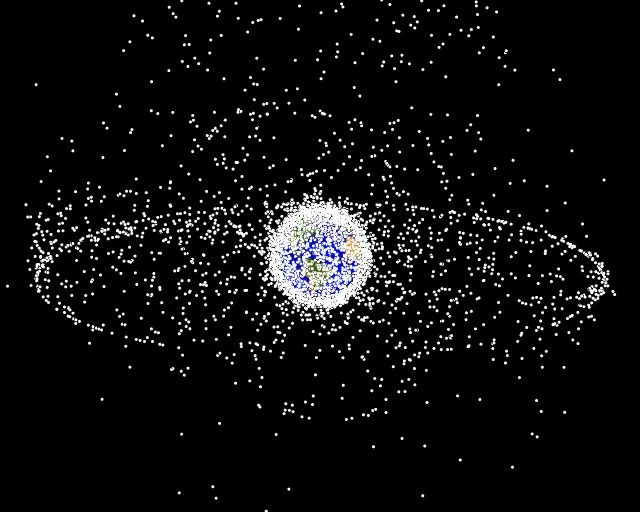
The GEO images are images generated from a distant oblique vantage point to provide a good view of the object population in the geosynchronous region (around 35,785 km altitude). Note the larger population of objects over the northern hemisphere is due mostly to Russian objects in high-inclination, high-eccentricity orbits.

____________________________________________________
It's weird to think about people creating a "ring" for the earth - sort of like Saturn, only different. But that is certainly what it looks like.
LEO images
LEO stands for low Earth orbit and is the region of space within 2,000 km of the Earth's surface. It is the most concentrated area for orbital debris.

____________________________________________________
GEO images
The GEO images are images generated from a distant oblique vantage point to provide a good view of the object population in the geosynchronous region (around 35,785 km altitude). Note the larger population of objects over the northern hemisphere is due mostly to Russian objects in high-inclination, high-eccentricity orbits.
____________________________________________________
It's weird to think about people creating a "ring" for the earth - sort of like Saturn, only different. But that is certainly what it looks like.
"Imagine Earth without people"
This article at NewScientist looks at how the earth would recover if all of a sudden there were no more people living on earth. It would be the end of light pollution, energy production, excess CO2 and various pollutants. Various ecosystems would be able to recover. The article talks of some species, like house sparrows, that would no longer be supported, others would thrive in their place. Here are just a few snips...
Humans are undoubtedly the most dominant species the Earth has ever known. In just a few thousand years we have swallowed up more than a third of the planet's land for our cities, farmland and pastures. By some estimates, we now commandeer 40 per cent of all its productivity. And we're leaving quite a mess behind: ploughed-up prairies, razed forests, drained aquifers, nuclear waste, chemical pollution, invasive species, mass extinctions and now the looming spectre of climate change. If they could, the other species we share Earth with would surely vote us off the planet.
..."The sad truth is, once the humans get out of the picture, the outlook starts to get a lot better," says John Orrock, a conservation biologist at the National Center for Ecological Analysis and Synthesis in Santa Barbara, California.
...All things considered, it will only take a few tens of thousands of years at most before almost every trace of our present dominance has vanished completely. Alien visitors coming to Earth 100,000 years hence will find no obvious signs that an advanced civilisation ever lived here.
...But these will be flimsy souvenirs, almost pathetic reminders of a civilisation that once thought itself the pinnacle of achievement. Within a few million years, erosion and possibly another ice age or two will have obliterated most of even these faint traces. If another intelligent species ever evolves on the Earth - and that is by no means certain, given how long life flourished before we came along - it may well have no inkling that we were ever here save for a few peculiar fossils and ossified relics. The humbling - and perversely comforting - reality is that the Earth will forget us remarkably quickly.
___
I was thinking recently how up to now - it's been the sign of "great" civilizations that left lasting monuments to themselves. It would be interesting if the opposite mentality took hold. The less stuff left for future archaeologists, the better.
Humans are undoubtedly the most dominant species the Earth has ever known. In just a few thousand years we have swallowed up more than a third of the planet's land for our cities, farmland and pastures. By some estimates, we now commandeer 40 per cent of all its productivity. And we're leaving quite a mess behind: ploughed-up prairies, razed forests, drained aquifers, nuclear waste, chemical pollution, invasive species, mass extinctions and now the looming spectre of climate change. If they could, the other species we share Earth with would surely vote us off the planet.
..."The sad truth is, once the humans get out of the picture, the outlook starts to get a lot better," says John Orrock, a conservation biologist at the National Center for Ecological Analysis and Synthesis in Santa Barbara, California.
...All things considered, it will only take a few tens of thousands of years at most before almost every trace of our present dominance has vanished completely. Alien visitors coming to Earth 100,000 years hence will find no obvious signs that an advanced civilisation ever lived here.
...But these will be flimsy souvenirs, almost pathetic reminders of a civilisation that once thought itself the pinnacle of achievement. Within a few million years, erosion and possibly another ice age or two will have obliterated most of even these faint traces. If another intelligent species ever evolves on the Earth - and that is by no means certain, given how long life flourished before we came along - it may well have no inkling that we were ever here save for a few peculiar fossils and ossified relics. The humbling - and perversely comforting - reality is that the Earth will forget us remarkably quickly.
___
I was thinking recently how up to now - it's been the sign of "great" civilizations that left lasting monuments to themselves. It would be interesting if the opposite mentality took hold. The less stuff left for future archaeologists, the better.
"Clean Coal" ?
I heard Brian Schweitzer speaking at the National Press Club (through CSPAN). The topic was the Energy Supply.
It was nice to hear someone with a plan besides going to war. He was pretty clear that Americans can either figure out how to be energy sufficient or we will be fighting for oil in the Middle East for years to come. The idea that any use of fossil fuels would ever be clean sounds like a pipe dream, though. Conservation and alternatives (outside of oil, gas, coal, and nuclear) seem like the way to go.
This article @ Plenty Magazine sums up some of his ideas:
Brian Schweitzer, governor of Montana, believes the U.S. can decrease its dependence on foreign oil, and reduce the amount of greenhouse gases pumped into the air, through conservation, bio-fuels, and clean coal. Montana has 35 percent of the nation’s coal—120 billion tons, which Schweitzer says could fuel America’s needs for 35 years—which will likely be in greater demand as oil prices refuse to drop. Therefore, Schweitzer is interested in using technologies that minimize CO2 emissions from coal combustion and building an infrastructure to safely sequester the gas underground.
Today, coal-fired power-plants produce more than half the country’s power and emit a third of our CO2. To combat the pollution, some new coal plants are being built as integrated gasification combined cycle power facilities, which allow coal to be converted into a gas to fuel electric turbines and produce a fraction of the smog, soot and mercury emissions of a traditional plant. A couple of these are planned for Montana, and one is being built in West Virginia, another big coal state represented at the meeting.
__________
It's a dang mess - what has been happening in West Virginia. What with tearing down mountains to get the coal. I suppose that that would be part of the plan - he didn't mention it.
It was nice to hear someone with a plan besides going to war. He was pretty clear that Americans can either figure out how to be energy sufficient or we will be fighting for oil in the Middle East for years to come. The idea that any use of fossil fuels would ever be clean sounds like a pipe dream, though. Conservation and alternatives (outside of oil, gas, coal, and nuclear) seem like the way to go.
This article @ Plenty Magazine sums up some of his ideas:
Brian Schweitzer, governor of Montana, believes the U.S. can decrease its dependence on foreign oil, and reduce the amount of greenhouse gases pumped into the air, through conservation, bio-fuels, and clean coal. Montana has 35 percent of the nation’s coal—120 billion tons, which Schweitzer says could fuel America’s needs for 35 years—which will likely be in greater demand as oil prices refuse to drop. Therefore, Schweitzer is interested in using technologies that minimize CO2 emissions from coal combustion and building an infrastructure to safely sequester the gas underground.
Today, coal-fired power-plants produce more than half the country’s power and emit a third of our CO2. To combat the pollution, some new coal plants are being built as integrated gasification combined cycle power facilities, which allow coal to be converted into a gas to fuel electric turbines and produce a fraction of the smog, soot and mercury emissions of a traditional plant. A couple of these are planned for Montana, and one is being built in West Virginia, another big coal state represented at the meeting.
__________
It's a dang mess - what has been happening in West Virginia. What with tearing down mountains to get the coal. I suppose that that would be part of the plan - he didn't mention it.
The New Excuse
I saw something like this coming - but this is an amazing demonstration of blatantly imperialistic arrogance (as seen quoted at Informed Comment 10.12)
' On Wednesday, George W. Bush again laid out his rationale for declining to consider a drawdown of U.S. forces. . . Bush added, "We can't tolerate a new terrorist state in the heart of the Middle East with large oil reserves that could be used to fund its radical ambitions or used to inflict economic damage on the West."
IOW - so now that the Bush administration has managed to inflame violence in Iraq (I think this was the goal all along) - and since Iraq has such vast resources - we must control those resources - so the "bad" guys don't. Amazing.
And if anyone falls for that line of thinking - that is really sad.
' On Wednesday, George W. Bush again laid out his rationale for declining to consider a drawdown of U.S. forces. . . Bush added, "We can't tolerate a new terrorist state in the heart of the Middle East with large oil reserves that could be used to fund its radical ambitions or used to inflict economic damage on the West."
IOW - so now that the Bush administration has managed to inflame violence in Iraq (I think this was the goal all along) - and since Iraq has such vast resources - we must control those resources - so the "bad" guys don't. Amazing.
And if anyone falls for that line of thinking - that is really sad.
Thursday, October 12, 2006
Snow Crab down 85 % in 6 years.
I think that is a frightening statistic. One solution is that more people could stop eating (as much) wildlife. That's not the answer that the fishermen are looking for - but it may be the best answer for the planet and sea-life in the long term.
Ecological upheaval on the edge of the ice
From the Bering Sea - As the research vessel Thomas G. Thompson steamed toward St. Paul Island, crab fisherman Wayne Baker was holed up in the tiny Alaskan harbor, waiting for a break in the weather.
It hadn't been a great season so far.
"I've never seen so many blanks," said Baker, who set pots for four days without pulling up a single crab.
St. Paul is a speck of land in the Bering Sea, the treacherous expanse of water that separates Siberia and Alaska near the top of the world.
Since Russian fur-traders came seeking otter pelts in the 1700s, this northernmost reach of the Pacific Ocean has created fortunes and claimed the lives of mariners drawn by its astounding bounty of marine life. Whales, walruses, seals - one species after another was slaughtered to the verge of extinction, yet a wealth of living resources remained untapped.
Today the Bering Sea yields half of all seafood harvested in the United States. The annual catch is valued at $1.7 billion. The bulk of that money goes into the pockets of fishermen and processing companies based in Seattle - a 12-day sail from St. Paul.
But the nation's richest ocean ecosystem is in the midst of a major upheaval, and scientists suspect global warming is at least partly to blame. Researchers like those who spent a month this spring on the University of Washington's Thompson are trying to figure out what the future holds for the region called America's "fish basket."
Crabbers like Baker are already feeling the effects.
In the past six years, snow crab catches have dropped 85 percent. Most other crab species are in a similar slump. Overfishing is probably a factor - but not the only one. Biologists also have documented a northward shift of crab populations, away from warming waters in the traditional fishing grounds of the southern Bering Sea.
Fur seal numbers are dwindling, despite a 20-year-old ban on commercial hunting. Stellar sea lions were declared endangered in 1997. Seabirds that once flocked to the region by the millions are in precipitous decline.
The changes coincide with rising water temperatures and shrinking sea ice cover.
"In the Bering Sea ... rapid climate change is apparent, and its impacts significant," scientists concluded in the 2004 Arctic Climate Impact Assessment.
...For creatures adapted to a frozen world, the loss of ice can be catastrophic.
Walruses and so-called ice seals haul out on floes to give birth and rear their pups. As the area that freezes each year shrinks, the animals are forced farther north and into deeper water. More walrus pups are being abandoned - a possible sign that adults can't reach the bottom anymore to fetch clams.
Short-tailed shearwaters migrate more than 9,000 miles from Australia, trusting the normal interplay of ice, sunlight and water temperatures will guarantee a feast of tiny shrimp when they arrive. In 1997, a half-million of the albatrosslike birds starved to death because off-kilter weather triggered a chalky algae bloom that obscured their prey.
Fish also are highly selective about temperature, which varies with the amount of ice.
"It only takes a little bit of warming to change from a place with seasonal ice cover to no ice cover," Hunt said. "That's why these high latitudes are expected to be the places where long-term global warming shows up first and has its most profound impacts."
The Alaskan Arctic is replete with evidence of global warming, from forest fires to melting permafrost and shifting whale migrations. But those changes mainly affect local residents. What happens in the Bering Sea reaches into the Seattle economy and world seafood markets.
..."They're very aware that global warming could have significant impacts, but the scientists aren't able to give them any firm predictions," he said. "The industry is focused on the here and now."
Over the past few years, scientists have discussed what climate change might mean for fishing worldwide. But concrete answers remain elusive because marine ecosystems are still so poorly understood.
Even in Alaska, where the fisheries are considered the best-managed in the world, biologists can't predict how a tug on one part of the ecological web will reverberate through the others....
Ecological upheaval on the edge of the ice
From the Bering Sea - As the research vessel Thomas G. Thompson steamed toward St. Paul Island, crab fisherman Wayne Baker was holed up in the tiny Alaskan harbor, waiting for a break in the weather.
It hadn't been a great season so far.
"I've never seen so many blanks," said Baker, who set pots for four days without pulling up a single crab.
St. Paul is a speck of land in the Bering Sea, the treacherous expanse of water that separates Siberia and Alaska near the top of the world.
Since Russian fur-traders came seeking otter pelts in the 1700s, this northernmost reach of the Pacific Ocean has created fortunes and claimed the lives of mariners drawn by its astounding bounty of marine life. Whales, walruses, seals - one species after another was slaughtered to the verge of extinction, yet a wealth of living resources remained untapped.
Today the Bering Sea yields half of all seafood harvested in the United States. The annual catch is valued at $1.7 billion. The bulk of that money goes into the pockets of fishermen and processing companies based in Seattle - a 12-day sail from St. Paul.
But the nation's richest ocean ecosystem is in the midst of a major upheaval, and scientists suspect global warming is at least partly to blame. Researchers like those who spent a month this spring on the University of Washington's Thompson are trying to figure out what the future holds for the region called America's "fish basket."
Crabbers like Baker are already feeling the effects.
In the past six years, snow crab catches have dropped 85 percent. Most other crab species are in a similar slump. Overfishing is probably a factor - but not the only one. Biologists also have documented a northward shift of crab populations, away from warming waters in the traditional fishing grounds of the southern Bering Sea.
Fur seal numbers are dwindling, despite a 20-year-old ban on commercial hunting. Stellar sea lions were declared endangered in 1997. Seabirds that once flocked to the region by the millions are in precipitous decline.
The changes coincide with rising water temperatures and shrinking sea ice cover.
"In the Bering Sea ... rapid climate change is apparent, and its impacts significant," scientists concluded in the 2004 Arctic Climate Impact Assessment.
...For creatures adapted to a frozen world, the loss of ice can be catastrophic.
Walruses and so-called ice seals haul out on floes to give birth and rear their pups. As the area that freezes each year shrinks, the animals are forced farther north and into deeper water. More walrus pups are being abandoned - a possible sign that adults can't reach the bottom anymore to fetch clams.
Short-tailed shearwaters migrate more than 9,000 miles from Australia, trusting the normal interplay of ice, sunlight and water temperatures will guarantee a feast of tiny shrimp when they arrive. In 1997, a half-million of the albatrosslike birds starved to death because off-kilter weather triggered a chalky algae bloom that obscured their prey.
Fish also are highly selective about temperature, which varies with the amount of ice.
"It only takes a little bit of warming to change from a place with seasonal ice cover to no ice cover," Hunt said. "That's why these high latitudes are expected to be the places where long-term global warming shows up first and has its most profound impacts."
The Alaskan Arctic is replete with evidence of global warming, from forest fires to melting permafrost and shifting whale migrations. But those changes mainly affect local residents. What happens in the Bering Sea reaches into the Seattle economy and world seafood markets.
..."They're very aware that global warming could have significant impacts, but the scientists aren't able to give them any firm predictions," he said. "The industry is focused on the here and now."
Over the past few years, scientists have discussed what climate change might mean for fishing worldwide. But concrete answers remain elusive because marine ecosystems are still so poorly understood.
Even in Alaska, where the fisheries are considered the best-managed in the world, biologists can't predict how a tug on one part of the ecological web will reverberate through the others....
The Cypress Mulch Problem
It's one of those things that seems so innocuous - cypress mulch - used in gardening as a groundcover. It cuts down on weeds - the use of herbicides, etc. But because of the damage being done through it's harvesting - as this essay describes - people need to find an alternative.
The problem as described in Mulch Madness (from the New York Times):
Towering cypress once covered much of southern Louisiana — 1,000-year-old trees darkened ancient, moss-laden, water-saturated forests. These wetlands not only gave the bayou its flavor, its culture and its mystery, they also acted as critical natural “speed bumps” for major storms.
It’s been estimated that every 2.7 square miles of wetlands reduces storm surge by a foot, and yet over the last century Louisiana has stripped away 1,900 square miles of swamp, an area the size of Delaware. Evidence shows that such improper land management, reducing the cypress-tupelo swamps to a small fraction of their original grandeur, worsened flooding in New Orleans during Hurricanes Katrina and Rita.
Yet at a time when the nation should be investing billions to restore the Gulf Coast’s wetlands for protection against future storms, these cypress swamps continue to face many challenges, including development, saltwater flowing in and rising water levels. The most dangerous threat of all, however, may be garden mulch — the stuff that gardeners usually use to protect their plants.
As they exhaust the cypress forests along Florida’s coast, mulch companies are moving into Louisiana with shady operators among them grinding up entire cypress forests, 70 percent to 80 percent of which will never grow back. This is hurricane protection lost forever — habitat and flood control converted to quick cash, one bag of mulch at a time.
The Environmental Protection Agency has finally begun to require permits for logging in southern Louisiana, which has still not stopped the wholesale clear-cutting of cypress forests....
So in the meantime, the safety of our nation’s already depleted wetlands comes down to sellers and consumers of cypress mulch.
Big mulch retailers — like Lowe’s, Home Depot and Wal-Mart — have been slow to take real action about the mulch in their stores. But all three companies should put into place formal, meaningful policies that guarantee their cypress mulch comes from sustainable sources rather than the imperiled swamps of the Gulf Coast. Many retailers have done so with lumber and they can do it for cypress mulch.
Until then, consumers would do best to avoid cypress mulch altogether, switching instead to mulches made from pine bark, pine needles or straw. These work just as well and do not have the same environmental impact.
The problem as described in Mulch Madness (from the New York Times):
Towering cypress once covered much of southern Louisiana — 1,000-year-old trees darkened ancient, moss-laden, water-saturated forests. These wetlands not only gave the bayou its flavor, its culture and its mystery, they also acted as critical natural “speed bumps” for major storms.
It’s been estimated that every 2.7 square miles of wetlands reduces storm surge by a foot, and yet over the last century Louisiana has stripped away 1,900 square miles of swamp, an area the size of Delaware. Evidence shows that such improper land management, reducing the cypress-tupelo swamps to a small fraction of their original grandeur, worsened flooding in New Orleans during Hurricanes Katrina and Rita.
Yet at a time when the nation should be investing billions to restore the Gulf Coast’s wetlands for protection against future storms, these cypress swamps continue to face many challenges, including development, saltwater flowing in and rising water levels. The most dangerous threat of all, however, may be garden mulch — the stuff that gardeners usually use to protect their plants.
As they exhaust the cypress forests along Florida’s coast, mulch companies are moving into Louisiana with shady operators among them grinding up entire cypress forests, 70 percent to 80 percent of which will never grow back. This is hurricane protection lost forever — habitat and flood control converted to quick cash, one bag of mulch at a time.
The Environmental Protection Agency has finally begun to require permits for logging in southern Louisiana, which has still not stopped the wholesale clear-cutting of cypress forests....
So in the meantime, the safety of our nation’s already depleted wetlands comes down to sellers and consumers of cypress mulch.
Big mulch retailers — like Lowe’s, Home Depot and Wal-Mart — have been slow to take real action about the mulch in their stores. But all three companies should put into place formal, meaningful policies that guarantee their cypress mulch comes from sustainable sources rather than the imperiled swamps of the Gulf Coast. Many retailers have done so with lumber and they can do it for cypress mulch.
Until then, consumers would do best to avoid cypress mulch altogether, switching instead to mulches made from pine bark, pine needles or straw. These work just as well and do not have the same environmental impact.
Wednesday, October 11, 2006
Mirror Neurons
I think this is an example of how technologically obsessive our culture is - when we need "scientific proof" that people empathize with each other and exactly which neurons are responsible for that. At the same time - it is pretty interesting.
From the article, Friends for Life: An Emerging Biology of Emotional Healing
Mirror neurons track the emotional flow, movement, and even intentions of the person we are with, and replicate this sensed state in our own brain by stirring in our brain the same areas active in the other person.
Mirror neurons offer a neural mechanism that explains emotional contagion, the tendency of one person to catch the feelings of another, particularly if strongly expressed. This brain-to-brain link may also account for feelings of rapport, which research finds depend in part on extremely rapid synchronization of people’s posture, vocal pacing and movements as they interact. In short, these brain cells seem to allow the interpersonal orchestration of shifts in physiology.
I have long had the sense that if family or friends support what I do (or not) - even, or esp. the verbally unexpressed - that that can have an effect on what I do and what I feel about what I do. People are told that they have to own their feelings - and that is true - but people also have to be aware that what they think and feel about people who are close to them - has an effect - both positive and negative - as the case may be.
I noticed Hecate saw mirror neurons as explaining what people think of as "magic" or "energy work." It's also about emotional support that people feel in illness or other trying times. The act of praying (no matter what one's religion) could be a means of bringing people together - getting each others neurons on the same page - a positive page. And if people are led by those who are feeling positive as opposed to negative - that can make a huge difference.
I have found that the Quaker meetings can be powerful experiences - there is much time spent when people are silently focused on "God" - which can mean basically - the positive and positive possibilities. When there are core people who embrace a sort of harmony and that is communicated - it makes a difference - and I think that others who are open to it can benefit from it. I think that this study would support the idea of having small, religious groups where people know each other pretty well - so that they can have more of a positive effect on each other. Like the coven that Hecate talks about. Friends can also fill that role for each other.
From the article, Friends for Life: An Emerging Biology of Emotional Healing
Mirror neurons track the emotional flow, movement, and even intentions of the person we are with, and replicate this sensed state in our own brain by stirring in our brain the same areas active in the other person.
Mirror neurons offer a neural mechanism that explains emotional contagion, the tendency of one person to catch the feelings of another, particularly if strongly expressed. This brain-to-brain link may also account for feelings of rapport, which research finds depend in part on extremely rapid synchronization of people’s posture, vocal pacing and movements as they interact. In short, these brain cells seem to allow the interpersonal orchestration of shifts in physiology.
I have long had the sense that if family or friends support what I do (or not) - even, or esp. the verbally unexpressed - that that can have an effect on what I do and what I feel about what I do. People are told that they have to own their feelings - and that is true - but people also have to be aware that what they think and feel about people who are close to them - has an effect - both positive and negative - as the case may be.
I noticed Hecate saw mirror neurons as explaining what people think of as "magic" or "energy work." It's also about emotional support that people feel in illness or other trying times. The act of praying (no matter what one's religion) could be a means of bringing people together - getting each others neurons on the same page - a positive page. And if people are led by those who are feeling positive as opposed to negative - that can make a huge difference.
I have found that the Quaker meetings can be powerful experiences - there is much time spent when people are silently focused on "God" - which can mean basically - the positive and positive possibilities. When there are core people who embrace a sort of harmony and that is communicated - it makes a difference - and I think that others who are open to it can benefit from it. I think that this study would support the idea of having small, religious groups where people know each other pretty well - so that they can have more of a positive effect on each other. Like the coven that Hecate talks about. Friends can also fill that role for each other.
Extinction Report

From Newsweek.
It's odd that this
is the Cover story
for Europe, Asia,
and Latin America
- while the US edition
has a photo of Bush
looking stupid.
Everyone should
know by now that
Bush is ridiculous
(actually that is too
nice of a term for him).
I would rather learn
about the frogs.
(You can also see the National Geopgraphic article from last January - Frog Extinctions Linked to Global Warming)
_____
Why the Frogs Are Dying
Climate change is no longer merely a matter of numbers from a computer model. With startling swiftness, it is reordering the natural world.
Draped like a verdant shawl over Costa Rica's Tilarán Mountains, the Monteverde cloud forest has long been a nature lover's idyll. Hidden birds flirt to the whisper of rushing streams and epiphytes tumble from the mist, while delicate flowers bloom impossibly from the jungle's maw. With luck you might even catch the iridescent flash of the resplendent quetzal, the elegant symbol of the Central American rain forest.
There's one member of this pageant that won't be turning up, however: the Monteverde harlequin frog. Named after its palette of yellow, red and black, this miniature amphibian—a member of the genus Atelopus—had thrived in these Costa Rican mountains for perhaps a million years. Yet the last time
J. Alan Pounds, an ecologist who has studied the cloud forest's wildlife for 25 years, spotted one in Monteverde was in 1988. Its cousin, the golden toad, went missing about the same time. Indeed, the more scientists search, the grimmer the situation looks. A study by 75 scientists published earlier this year in the journal Nature estimated that two thirds of the 110 known species of harlequins throughout Central and South America have vanished.

...The trouble at Monteverde only heightened a mystery that had scientists stumped for years: why do whole species of wildlife disappear in apparently pristine parks and nature preserves? There had been no shortage of theories to explain the demise of the harlequins, from acid rain to an overdose of ultraviolet rays. By the late nineties, attention shifted to the chytrid fungus outbreaks, which many amphibian experts concluded were the smoking gun. But Pounds wasn't satisfied. After all, it wasn't just harlequins, but all kinds of amphibians that were dying. And if the chytrid disease was killing the frogs, what was behind the deadly outbreak?
In time, Pounds learned that the fungus flourished in the wet season and turned lethal in warm (17 to 25 degrees Celsius) weather—exactly the conditions that climate change was bringing to the cloud forest. More important, he found that 80 percent of the extinctions followed unusually warm years. "The disease was the bullet killing the frogs, but climate was pulling the trigger," says Pounds. "Alter the climate and you alter the disease dynamic."
...On the ground, Pounds's team has noticed a dramatic decline in the population of lizards, and some snakes like the cloud-forest racer and the firebellied snake, which once fed on the harlequin frogs. The loser, again, looks to be the quetzal, which is already capturing fewer frogs and lizards—a key protein and calcium source for its nestlings. "When interactions between species are disrupted, the outcome can sometimes be devastating," says Pounds.
...Pests are the big winners in a warming world. A parasite called the nemotode, which dies off in the heat, has compensated by breeding faster, which causes fertility to plunge, or even death, among infected wild musk oxen. A kidney disease has flourished in the warming streams of Switzerland, ravaging trout stocks. Meanwhile, the oyster parasite, a scourge to shell fishermen in Chesapeake Bay, has crept all the way to Maine because of milder winters. Though there's little hard science linking climate change to farm pests, most agricultural experts say it's a matter of connecting the dots. "There is good evidence that warmer conditions favor more invasive species," says David Pimentel, who studies invasive plants and pests at Cornell University. "Invasive plants can compete with native varieties and cause extinctions."
...One of the most besieged of all the specialists is the polar bear, which hunts seal from floating chunks of sea ice. Warmer currents in the Arctic Ocean have hastened the breakup of ice floes and forced the bears to swim greater distances for their meals, putting them at risk of drowning or starving. Already bear watchers say the average weight of polars in Hudson Bay has dropped from 295kg to 230kg—near the threshold below which they stop reproducing. Polar bears now top most green groups' endangered lists.
More than polar bears will be in trouble if atmospheric temperatures rise two more degrees—far from the worst-case climate forecasts. The Greenland ice shelf would melt, posing a threat to a whole web of life that depends on ice, including plankton, which feed fish, which are eaten by seals, which are meals for both polar bears and Inuk hunters. In the Southern Hemisphere, many researchers have already linked sharp declines in penguins like the rock hopper, Galápagos, blackfoot, Adélie and the regal emperor to warmer ocean currents, which have flushed away staple food supplies like krill, a coldwater crustacean.
The loss of creatures is alarming enough. What about losing an entire ecosystem? For most of the last two decades, Stephen Williams, a tropical ecologist at James Cook University in Australia, has been studying the evolutionary biology of the Australian rain forests. The sprawling experiment was meant to plot how wildlife evolved in the mountainous cloud forests along the coast of northeast Queensland, where thousands of unique animal and plant species have thrived for 5 million years. But when Williams ran his data through a computer model, testing for a modest rise in world temperatures (3.5 degrees Celsius over a century), he was floored. By 2100, his team concluded, up to 50 percent of all species would be gone. "I expected to see an impact, but this was shocking," says Williams.
(The same issue has a related article - Oceans: Last Chance for Fish)
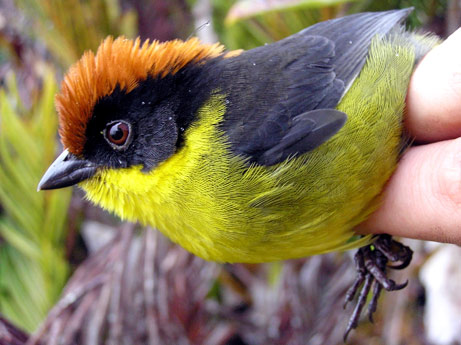 Meanwhile - this new bird species was found in Columbia. Dubbed the Yariguíes brush finch, the small bird was first found in 2004 in an isolated region of the eastern Andes mountain range known as the Serranía de los Yariguíes.
 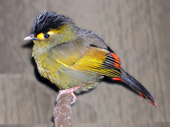 And one in India. Named Bugun liocichla, the small bird is described as a type of babbler, a diverse family of birds that usually live in tropical forests.
_____________________________
It's a small thing - but we just finished our frog ponds. When we moved into this place 3+ years ago - (it having been abandoned) there were hundreds of tadpoles and one big frog in the bottom of the old above-ground pool. We didn't want to mess around with a pool - but I liked the idea of having the frogs - so we got rid of the pool and replaced it with frog ponds. There is one frog there now - I'll be curious to see how it goes next year.
Subscribe to:
Posts (Atom)