Wednesday, October 11, 2006

Eisner's Color-copier Images

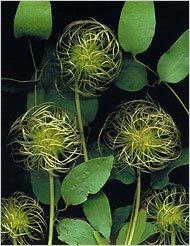
Biologist/naturalist, emeritus professor from Cornell, Thomas Eisner's color-copied arrangements. He has some shell arrangements, also. I like the wildflowers. A scanner would also work.


Now commonly available, the copier, he writes in an e-mail message, “can serve for the inventive generation of imagery, for composition of novel pictorial arrangements, and in that capacity find use in the expression of fantasy.”


How did these images come to be? “I simply imagined how the component parts of a given arrangement might fit together,” Dr. Eisner writes, “and laid out the parts in accord with the vision. It was like playing with a Lego set. There were only two provisos. Parts had to be laid out upside down on the copier’s stage, because the copier ‘sees’ the stage from beneath, and the arrangements, once composed, had to be covered with a black velvet cloth to exclude ambient light from the picture.”

Tuesday, October 10, 2006

Our "Way of Life"

One thing that keeps popping into my mind is how George Bush likes to say that he is about "protecting our way of life". As in,

"In truth, it is a struggle for civilization. We are fighting to maintain the way of life enjoyed by free nations."

I was listening to the radio recently and someone was talking about alternative actions that we should be doing. It's really about how our society is set up that is not sustainable - it seems anti-sustainable. It is so sad that so many of our resources are going into these ridiculous wars - mostly started by the Bush administration but supported by many Democrats as well.

The radio person made quite a case about how US power is fading - what with our oil reserves diminishing and our debts increasing. I rather suspect that the politicians and policy makers - whether they say so or not - think that they are plotting a course to regain/maintain our power through wars. To me - we lose power through wars - esp. these wars. Wars where we have come to be seen as an aggressive nation. If a country truly has power - there is no need for all of this bullying and fighting. (It's interesting to get the perspective of the far side of the world - see: Not a major planet ).

Iraq deaths put at 655,000+ in a new report released today. So we have to wonder how many people will die to "protect our way of life."

"Protecting our way of life" seems to be "protecting our ability to waste resources". A more thoughtful approach would be to use our resources more wisely - and make adaptations to our society so that more people could have a reasonably nice way of life. One that was not as dependent on using fossil fuels.

The amount of money that has been wasted on the wars ($500,000,000,000 +"The House approved a record $448 billion in defense spending for 2007") could have gone a long way toward creating more localized economies, alternative energy sources and more efficient systems of moving people and goods. There are a lot of people out there who have been working on these types of ideas - but these ideas are not discussed by most politicians. Meanwhile - the subsidizing of the ineffiecient energy sources makes it easier for us to stay dependent on them.

Mostly the news is about how afraid we should be about one thing or another - usually so-called terrorists. Democrats are afraid to appear "wimpy" - the fearsome insult thrown around by the Republicans as if this is a grade-school playground. I think that they should all be afraid to appear short-sighted - that in the long run they are not providing any solutions to what will be the problems of the near and distant future.

Afghanistan and the US backed Pakistani Taliban

Interesting interview on Democracy Now! today with Sarah Chayes.She provides more reasons to question the whole US/Pakistan alliance - and it's purpose. NPR did not run this story.

Chayes is a former NPR correspondent who covered the US invasion of Afghanistan - among other things. She has also written a book - "The Punishment of Virtue: Inside Afghanistan After the Taliban."Now she runs the Arghand cooperative - Hand-crafted products from Kandahar. "The idea of Arghand ... to add value to Kandahar's legendary fruit crops, to transform them into something stable and light, suitable for export." Also - "It’s about grassroots. It’s about building democracy on whatever level you can in a cooperative, where there are good relations with producers, where there’s a collective decision-making process, and where we can honor a lot of the traditional licit crops that Kandahar has been known for for millennia."

Sarah Chayes on Life in Afghanistan After the Taliban and Why She Left NPR

SARAH CHAYES: ...And the problem has been that we didn't really provide to Afghanistan what we said we would. We said that -- we, the U.S. leading an international coalition -- said that we were there to not only dismantle the Taliban, but begin to lay the foundations of a respectful democratic country that would carry Afghanistan forward into the community of nations, as it were.

But what happened was that our other motivations of the so-called war on terror ended up trumping those goals, so that instead of supporting thoughtful, educated leaders and helping bring them to power and helping develop that capacity for leadership, we basically recruited thugs, who were supposedly helping us in the war on terror and were meanwhile abusing, robbing their own citizens. And so, what you see now is just a terrible disaffection. It’s not an ideological opposition to the United States as a Western country. It’s just exasperation with the government that we ushered into power.

...there were U.S. Special Forces that were embedded in a group, a kind of tribal militia, which was directed to put pressure on Kandahar from the south. President Karzai also had U.S. Special Forces with him. He was coming down toward Kandahar from the north. The Taliban surrendered to him. They left. Al-Qaeda left the city. The city was in the hands of President Karzai and his chosen representative, and then these U.S. Special Forces urged this warlord to take the city by force from President Karzai.

...I knew that President Karzai had designated a certain person whose name is Mullah Naqib to be governor of Kandahar. And then, suddenly this warlord is in the city. And then, there’s this huge and angry standoff, which is being played out on the airwaves of the BBC actually, of their Pashto Service, and this warlord is saying, “No, I’m going to be governor of Kandahar.”

...The Karzai appointee...said, “Okay, this other guy is going to be governor. I’m too old to be governor.” And I knew that something had happened. And then I rode into the city maybe two days after this with somebody who had been with this warlord, so I asked him, “Well, how did it go? How did you guys happen to go and take Kandahar? And He was a very young kid, you know, so he’s kind of all excited and enthusiastic. You know -- Speed! Speed! -- we went up the road, you know. And then I said, “Well, what What about the Americans who were with you?” He said, “The Americans? They told us to do it.” I thought, “You have to be kidding me.”

And that, I thought, was a really emblematic story to tell that would help show us the direction this thing was going in, because it seemed to me -- remember, this was before Iraq, Afghanistan was it -- and I saw the eyes of the world riveted on how we were going to operate in Afghanistan, how Afghanistan was going to turn out, was going to be crucial to what happened in the next decade or the next half-century even, you know.

AMY GOODMAN: So, he’s saying the U.S. Special Forces had put this other warlord up against the U.S.-backed Hamid Karzai.

SARAH CHAYES: Right, exactly. So the United States was working at cross purposes with itself, number one. Number two, you’re already constraining the power of the person that you have designated to be president. You’re saying, “Okay, you can be president, but you can’t name -- you don’t have the power to name your own governor.” And this dogged President Karzai for the first two years of his administration, when he was trying to limit the powers of some of these warlord governors that we had brought, we had allied with them.

AMY GOODMAN: The U.S. government had.

SARAH CHAYES: The U.S. government, that’s right, had allied with these guys, supposedly in the interest of the war on terror, and President Karzai was trying to limit their power and constrain them or even remove them, and he was told repeatedly that he couldn’t do that. And so, now he’s pretty much given up trying.

...I’m not sure we were working with the Taliban, but we were clearly working hand-in-hand with the Pakistani government, which had created the Taliban movement. And that was another piece of massive self-contradiction in our policy.

...So if we work hand-in-hand with Pakistan, we’re actually working with a government that is bent on undermining Afghanistan.

AMY GOODMAN: And, though it’s not your subject, Pakistan providing nuclear material to North Korea.

SARAH CHAYES: Of course, of course. To North Korea and to Iran, I believe, also. I mean, A.Q. Khan, the guy who’s considered to be the father of the bomb in Pakistan, it’s manifest that he has been involved. I mean, the whole nuclear trail leads back to him, and there is no way he is a rogue actor acting on his own. Pakistan doesn’t function that way. The Pakistani government is a very closed system in the hands of the military, basically, I would say, military and military intelligence establishment.

Nukes Around the World


Red - Five "nuclear weapons states" from the NPT
Orange - Other known nuclear powers
Purple - States formerly possessing nuclear weapons
Gold - States suspected of being in the process of development
Pink - States which at one point had nuclear weapons and/or research

Graphic and stats from Wikipedia

~Nuclear weapons states~

Country Warheads ~ active/total* ~ Year of first test

United States ~ 5,735/9,960 ~ 1945

Russia (as USSR) ~ 5,830/16,00 ~ 1949

United Kingdom ~ <200 ~ 1952

France ~ 350 ~ 1960

PR of China ~ 130 ~ 1964

India ~ 200-700 ~ 1974

Israel ~ 75-200 ~ none or 1979 (see Vela Incident)

Pakistan ~ 65-90 ~ 1998

North Korea ~ 1-05 ~ 2006
____________________________________________________

North Korea announced that they tested a Nuclear bomb yesterday. There has been some disagreement about the "success" of the test...

Russia estimated that it was a relatively large - equivalent to the force that would be unleashed by 5,000-15,000 tons of the conventional high-explosive TNT.

But France and others had far lower estimates, ranging from 500-1,000 tons of TNT, prompting the French defense minister to comment ``that there could have been a failure.''

...While there is evidence that North Korea got Pakistani help with its nuclear program, the isolated, communist country also has had to figure out a lot of technical bomb-making details itself - another likely factor in a possible failed test, said Vladimir Orlov of the PIR Center, a nonproliferation think-tank.

``Both intellectually, technologically and financially, they are really in practical isolation, which is relatively good news,'' said Orlov.

The apparent low yield, he added, ``indicates that the North Koreans really have trouble making what ordinary people would call a nuclear bomb, they really have a primitive nuclear device.''


____________________________________________________

One thing that I was thinking about in relation to all this - is that the idea that has been pushed is that "only the good countries should have nukes" and that "bad" countries should not be allowed. But "good" was defined (or so I thought) as countries who practiced diplomacy and restraint - who didn't go bombing people out of malice or some other such reason.

And here the USA is threatening, intimidating, and torturing people, and bombing and invading countries whether those people have actually done anything to harm us or not. North Korea is considered a threat just for possessing and testing a bomb. If they are a threat - what does that make the US? And what about Pakistan - they seem to be the terrorist capital of the world? ("Oh - but they work with us" - so that makes it ok ??? )

Meanwhile, the World Net Daily (right-wing nuts) was alleging a year ago that "Al-Qaida nukes already in U.S." If that's the case (and I'm not assuming that it is) - I don't know what "Al-Qaida" is waiting for. Maybe - for the Bush administration to decide that it's time to bomb Iran? (It's so much easier to sell a war when you can make the other guys look like the aggressors).
____________________________________________________

The creators of "The End of the World are going to have to update their flash video - what with North Korea in the mix. Though it's pretty much the same story.

Monday, October 09, 2006

All Over the Map

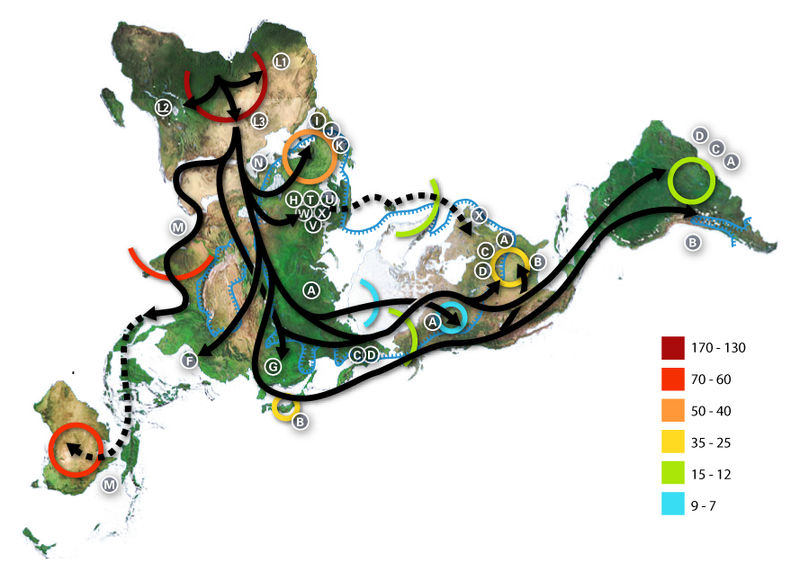
DNA mapping is interesting as far as considering how people spread out over the world - as in the Map-of-human-migrations.


(This map is from the point of view of the north pole).

Humanity has been divided up into haplogroup groups as seen on this map - whose DNA has been tracked. The DNA shows that it has been 500,000 years since modern humans shared a common ancestor with Neandertals - but that they lived in the same areas as people up until 30,000 years ago.

This paper (esp. Figure 3) has some interesting maps showing where various H groups thrived in Europe. The study title is Y-Chromosonal Diversity in Europe is Clinal and Influenced Primarily by Geography, Rather than language. The authors are saying that people did not move around as much as historians have normally taught - but that culture and language spread through populations.

These explorations led me to: Atlas of the Human Journey "A Genographic Project" at National Geographic. It is quite a nice graphic/Flash with the DNA/genetics info combined with other known history (though it disagrees with itself at times).

It shows R going up to Europe around 50,000 years ago - then splitting off into K, U, & U5. Also some time around 30,000+ m/l years ago - A, B, C & D go off (maybe some chasing mammoths)- some stopping in Asia or going down to Australia (some of the B's along with some M's by a different route) - others going on into the Americas - as far down as the tip of South America (esp. B's). Also some M's (followed by X's) went to the Americas as well as going throughout Europe, Africa and Asia.

The Sahara becoming more dry would have cut some people off from returning. There was ice covering Northern Europe and much of North America - reaching down into Indiana. The oceans were about 300 feet lower leaving a land mass they are calling "Beringia" exposed.

Aurignation Period - Art from Slovakia to Spain - 35,000-30,000 years ago. Venus figures - cave paintings with shading. And 20,000 years ago - Magdelanian Culture (area now France) "advanced skills" Lascaux cave paintings (It looks like both of these are associated with the Gravettian group and some later became the Vikings - Rb1 (M343) ).

Catal Huyuk (now Turkey) 6300 - 5500 years ago. Pottery, obsidean blades and mirrors - goddess-like figurines. (Also seem to be associated with J groups - from the map.)

(One problem with the emphasis on groups - and with the emphasis on the idea the people are associated with just one group is the possiblility of "my group is better than your group" mentality. It may be that some groups engaged in more art making (that survived) than other groups - and this is read as their society being more "advanced". It may be that certain groups had the priority of creating a lasting record of their group - some people might have had other priorities - not necessarily less "advanced". Like if the people made paper - and drew on that - as opposed to caves.)

_____

But then the Genographic people want to sell you something that will trace one line of your DNA - through just the women or just the men - for $100. (As if that would mean something).

oxfordancestors.com (associated with Prof Sykes’) will give you the same thing for $180. They say: Our MatriLine™ service gives you the opportunity to establish the personal link between you and your ancestral clan mother. If you are of European descent, then there is a 95% chance that you will be related to one of the clan mothers described in Prof Sykes’ book “The Seven Daughters of Eve”. If you are not of European descent, then we will be able to tell you from which of the other 29 clan mothers you are descended. There are currently 36 identified clan mothers who cover the whole of humanity.

I probably have as ancestors Ursula, Helena, Velda, Tara and maybe Ulrike and Katrine. And probably Jasmine, too. See The European Clans – The Seven Daughters of Eve

It seems like this oxfordancestors (like the National Geographic site) is trying to suggest that it is more significant to trace back your DNA to one person. But that is nonsense - because everyone has thousands of lines besides mother to mother to mother to mother, etc. As this entry put it "At 10 generations back, an individual has 1024 ancestors and a Y-DNA or mtDNA test is only studying one of those 1024 ancestors."

This group is correlating surnames to DNA lines.

This all strikes me as a patriarchal way of looking at things that has no relevance to real life.

Sunday, October 08, 2006

Art from Urnes

I know very little about "Viking Art". I came across photos of the Urnes Stave Chruch today - a "World Heritage Site". I think the style of wood carving is awesome.


This reminds me of "Art Nouveau" - the art movement popular around 1900 ("Art Nouveau was characterized by writhing plant forms"...). Art Nouveau was supposedly "new" and different. The Urnes style metal piece here would be quite at home in an Art Nouveau collection. The Urnes style seems to be the parent (or great-grandparent) of that style. So it seems that Art Nouveau is not new at all (but very few art styles are).

From a site on Viking Art:

Urnes 1040 - 1150 AD - The last and most widely spread of the ornamentation styles.

Wood-carvings on a stave church in Urnes, Norway, has given the name for this style.

Motifs:

The animals are curvaceous, often including one or more snakes.
The spiral hip is still used but not as big and pronounced as in earlier styles.
The animals often bites each other.
Big almond shaped eyes.
A true Scandinavian style with few influences from abroad.

This style is also called rune-stone style because it is used mainly on rune stones in Sweden. It is a style that has been perfected for carving in stone or wood though it is based on long curves without to many details. The style was widely spread in the Viking World and can easily be said to be the most popular af all Viking ornamentation styles.

________________________

I wonder if Urnes Stave Church had anything to do with Urnenfelder (meaning urnfield carriers) which were a people who utilized cremation as opposed to inhumation (interment of dead). I came across this about "Urnenfelders" when I was looking into things, today:

A new vision of life had arisen; its centre was Lausitz, a land between Germany and Poland. Worship of forces of nature gradually evolved towards certain forms of monotheism and generated the faith in afterlife and a profound respect of dead....

Ancient historians identified these peoples by the name Veneti, referring to them as the people who conquered peacefully half of Europe, not by force but by means of their shining spiritual energy...

We know of the ancient Veneti's social structure that it was based on village (or town) community and that woman's position was equal to male -- unlike a typical patriarchate of other Indo-Europeans. As it is usually the case, the best records of a civilization are left to us by the remains of burials and same is true for Veneti...

The primigenial religion of the ancient Veneti preserved this sense of harmony among the Universe's elements, likewise the oriental religions.

Saturday, October 07, 2006

The "Language of the Universe"

Galileo Galilei is reported to have said "Mathematics is the language with which God wrote the universe"

Considering beauty from a mathematical and/or an artistic perspective....From a wikipedia article on Mathematical beauty:

Most mathematicians derive aesthetic pleasure from their work, and from mathematics in general. They express this pleasure by describing mathematics (or, at least, some aspect of mathematics) as beautiful. Sometimes mathematicians describe mathematics as an art form or, at a minimum, as a creative activity. Comparisons are often made with music and poetry.

Bertrand Russell expressed his sense of mathematical beauty in these words:

Mathematics, rightly viewed, possesses not only truth, but supreme beauty — a beauty cold and austere, like that of sculpture, without appeal to any part of our weaker nature, without the gorgeous trappings of painting or music, yet sublimely pure, and capable of a stern perfection such as only the greatest art can show. The true spirit of delight, the exaltation, the sense of being more than Man, which is the touchstone of the highest excellence, is to be found in mathematics as surely as poetry. (The Study of Mathematics, in Mysticism and Logic, and Other Essays, ch. 4, London: Longmans, Green, 1918.)

Paul Erdős expressed his views on the ineffability of mathematics when he said "Why are numbers beautiful? It's like asking why is Beethoven's Ninth Symphony beautiful. If you don't see why, someone can't tell you. I know numbers are beautiful. If they aren't beautiful, nothing is."


I can see where people see mathematics as beautiful - truth, simplicity, perfection. I take issue with the notion that art is an appeal to "part of our weaker nature" - or that to express that which cannot be easily put into an equation (or words) is somehow "less than". I think it is a failure or our society to not value that which has not been quantified - and esp. to denigrate positive emotions and attempts to describe Nature in various ways - as if the emotions and the expression of them are a form of "weakness".

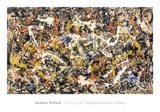
I found this article, Fractal Expressionism, a mathematical analysis of Jackson Pollock's paintings, linked from the wikipedia page on Mathematics and Art.

I think it's funny that for some people - Pollock's paintings have value because they are able to quantify them - there is some formula that they fit into. As if people are unable to see something and know truth and beauty when they see it - to know whether something "speaks" to them or not. But maybe it's just a matter of knowing the language. They learned the language of mathematics - so they see things with that language. I learned the language of art - so I see things with that language. (Though I think that for me - the language that I recognize in art is esp. that language in which people are inspired by Nature).

Based on the analysis of Pollock's paintings - apparently he was able to "speak" in multiple languages - a language that can be understood by math and science, as well as art.

Example: Finally we note that, because D follows such a distinct evolution with time, the fractal analysis could be employed as a quantitative, objective technique to both validate and date Pollock's drip paintings. In conclusion, Pollock's contribution to the evolution of art is secure. He described Nature directly. Rather than mimicking Nature, he adopted its language - fractals - to build his own patterns.

I think this is similar to what I have been trying to do. And to use the language of Nature - you can't copy someone else - you have to find it for yourself. But that people are inspired by/learn from others. That's how I see it anyway.
__________________________________________________

As I was writing this - someone else in the house was playing a recording of Huun-Huur-Tu (Tuvan throat-singing). That could also be a "language of the universe" - that the Tuvans tapped into - and express in their own way. The description of their music is "This world-famous ensemble from Tuva uses the vocal technique to create high and low notes at the same time, imitating the natural world of the Central Asian steppes."

I think it's just a matter of recognizing it - the "Language of the Universe" (and people's various expressions of it) when you see or hear it. Some people do - some people don't. Some people recognize it when they hear/see/read it one way - some people do another way. Some people may be disconnected and are not trying to hear/see/read about it in any form. Or maybe some people just have a completely different idea of the essence of the universe and truth. That could be what.

An "Off-Switch" for Greed

Study Spots the Brain's Selfishness 'Off-Switch'
(article seen on Yahoo - published in the Oct. 6 issue of Science)

Civil society may hinge on a tiny piece of tissue at the front of the human brain, a new study suggests.

Experiments involving a "fairness" game show that the right side of this region -- called the dorsolateral prefrontal cortex -- helps people suppress selfish urges in obviously unjust situations, even at their own expense.

When researchers used a mild electric current to temporarily short-circuit this area, the law of the jungle quickly reasserted itself.

People with disabled right-side dorsolateral prefrontal cortexes grabbed whatever money they could from lopsided transactions -- even when they knew the deal they were getting was grossly unfair.

"They understood the unfairness of it all, but they simply couldn't inhibit their need for getting the money," said Paul Sanberg, director of the Center of Excellence for Aging and Brain Repair at the University of South Florida College of Medicine in Tampa....

The Swiss and American team behind this research noted that, despite a long history of crime, wars and rapaciousness, human beings are innately cooperative. In fact, Homo sapiens is the only species to exhibit "reciprocal fairness" -- the punishment of others' unfair behaviors, even in situations where doing so hurts the punisher....

The experiment shows that this part of the cortex "is clearly very important for our social behavior, our societal evolution," Sanberg said. The right side of the DLPFC helps people resist those strong urges for sex, money and general acquisitiveness that come from more primitive sites outside the cortex, he said.

"It provides modulation of those urges, so that you can have control over them," Sanberg added. "As we evolved, we somehow developed this control over our basic needs."

One intriguing line of research is whether the right-side DLPFC functions similarly in everyone -- even hardened criminals or sociopaths.

"This is a very interesting question which we are just exploring now," Fehr said. "Preliminary results suggest that the right DLPFC has very different activation across individuals."

The Moon and Colors

Full moon tonight. I went out at midnight - the sky is clear - and it is as bright as it could be in the middle of the night - without artificial light. Strong shadows.

I read recently that conventional wisdom is that you can only see in black & white in moonlight - but that some people can see colors. I was glad to read that because I knew that I had seen colors with moon light. And I knew that I wasn't imagining it.

I can see colors tonight. Like the leaves of the coleus plants. Some are bright green, some medium, some burgundy. The burgundy colors are harder to see without direct moonlight. There are also some yellow petals on some volunteer flowers in a pot. Can't make out the color of the centers so much - mostly that they are dark.

I can't make out the colors of things (like flowers that I know to be colorful) from much of a distance. I seem to have to be within 10-15 feet m/l.

The article that I read said that it has to do with ones rods and cones and some people's rods and cones are more sensitive than others.

There was an owl out there howling in the moonlight also - too far away - I couldn't see it. Mostly it was quiet.
_______________________________

P.S. I went out the next night - when the moon was supposed to be at 98% - but it was another cloudless night - and it was noticably more difficult to see colors. The yellower colors seemed to show up more than others.

Friday, October 06, 2006

Jellyfish News

Schools of huge
Echizen jellyfish
...

off Wakasa Bay
in Maizuru,
Kyoto Prefecture.


Numbers of the jellyfish, which has an umbrella measuring about one meter in diameter, began increasing off the bay after Typhoon No. 13 passed over the Sea of Japan in mid-September.

______________________________________________

Meanwhile - off of the coast of California -

Giant turtle noshing jellyfish off Point Reyes

Sea turtles the size of sports cars are swimming off the Marin County coast, chowing down on jellyfish...

Leatherback turtles typically visit the California coast in the fall and congregate around Monterey Bay. This year, however, the turtles could be zeroing in on the Marin Coast instead.

The leatherback, an extremely rare reptile that tolerates waters too chilly for other sea turtles, can grow up to 9 feet long and weigh a ton. It's unclear why it's showing up so far north.

"You usually start hearing of sightings sometime in late summer or early fall," he said. "Last year, they were off the San Mateo coast, and now they appear to be north of the Golden Gate. Wherever they go, they're looking for jellyfish."

At least one large leatherback recently was spotted fairly close to the Point Reyes Peninsula, gobbling jellyfish the size of dinner plates....


______________________________________________

And in Canada (Qualicum Beach, Vancouver Island, British Columbia) -

Rash of dead jellyfish washing up

Beachcombers should be on alert, as the annual completion of the Lion's Mane jellyfishes' life cycle means the gelatinous creatures are washing up on shores across the region.

"We're getting a lot more along the coast this year. I'm not sure why," says Mary Arai, a professor emeritus at the University of Calgary who specializes in the aquatic creature. "If you handle them even after they're dead they will give you a rash."

The Lion's Mane ranges from the Arctic to Mexico and lives in Atlantic and Pacific waters. Their bells can reach more than two metres across with tentacles that trail as much as 30 metres. Juveniles are pink with colouring changing towards reddish brown or purple as they age.

In April, bottom dwelling polyps bud off of baby jellyfish. By July, juveniles have become full size. Adult males release sperm, where it's gathered by females who brood the eggs internally then release beings no larger than a pin, which drift to the bottom.

Most adults die by October due to bacterial infection or depleted plankton supplies. Arai says jellyfish on the beach aren't unusual.

"It's a matter of the life cycle. After they spawn they die and wash up on shore."

"War Responsibility"

I stumbled across this account of the "Showa War" (WWII). I thought it was pretty interesting. The typical war patterns - the hype and all. I've pieced together a few snips from various editions.

WAR RESPONSIBILITY - What should we learn from Showa War?

The War Responsibility series, which started in August last year in The Yomiuri Shimbun, covered the period from the Manchurian Incident of 1931 (sixth year in the Showa era) until the end of the fighting in 1945 (20th year in Showa era).

In the early years of the Showa era, or late 1920s and '30s, election-related corruption, including bribes and treating voters, was routine. These acts amplified voters' distrust in political parties and created room for the government to interfere in elections....

The starting point of the Showa War was the Manchurian Incident that took place in September 1931. Who should be blamed for having caused the incident? The main instigators of the incident were Kanji Ishihara and Seishiro Itagaki, staff officers of the Kwantung Army, a unit of the Imperial Japanese Army.

Determined to conspire together to grab power and lead the country, they became the masterminds of the act of aggression into Manchuria (currently part of northeastern China) and literally dragged the nation into a series of wars....

As it was for the Japanese government and military, the Manchurian Incident of September 1931 also was a major turning point for the media.

After the incident, each newspaper sent many correspondents to China and reported each action by the military in detail. The reports inflamed the Japanese people, who subsequently became increasingly hawkish.

Public opinion that Manchuria and Inner Mongolia should be protected by all means because they were the empire's lifeline became entrenched thanks to the media coverage.

Each newspaper followed developments such as the concept of establishing Manchukuo as an independent nation, the Lytton Report produced by a League of Nations commission to resolve the Manchurian Incident and Japan's withdrawal from the League of Nations....

After the Sino-Japanese War started after the Feb. 26 Incident, the government rapidly tightened its media controls. After the Marco Polo Bridge Incident, the cabinet of Fumimaro Konoe, which by then had decided to dispatch troops to northern China, brought together representatives of media organizations and asked them to cooperate for the sake of national unity. The government focused on a strategy to publicize its propaganda and newspapers went along with the plan.
__
Oppression of human rights also tightened domestically. Backed by fears of terrorism and coups that emerged in the public after the Feb. 26 Incident in 1936, politics buttressed by military police dominated the nation.

People who criticized the war or did not actively cooperate with the government and the military were quickly suppressed by the military police. Politicians, liberal theorists, social critics and scholars were targeted.

Writers were not allowed to publish their works unless they demonstrated that they believed the war would be won and they were willing to cooperate with the government and the military.

"On Creation"

In his recent book... E.O. Wilson (Harvard research professor "the father of sociobiology and biophilia" - "the most acute student of ants among contemporary scholars")...

Hopes Christians Will Join in Preserving All God's Creation


...He'll reach out to anyone if he thinks they can help the natural world -- that many-splendored universe that long ago, as he roamed fields and swamps of the Gulf Coast, replaced religion as a focus for his spiritual impulses.

He summons a favorite saying from Camus that evokes a lifetime's quest: "A man's work is nothing but this slow trek to rediscover, through the detours of art, those two or three great and simple images in whose presence his heart first opened."

"Pastor, we need your help," Wilson writes. "The Creation -- living Nature -- is in deep trouble." At the present rate of destructive human activity, "half the species of plants and animals on Earth could be either gone or at least fated for early extinction by the end of the century.

...By 2050, according to estimates Wilson cites, climate change alone could account for "extinction of a quarter of the species of plants and animals on the land." And that's without factoring in other causes of species loss: habitat destruction, invasive species, pollution, human overpopulation and overharvesting.

One consequence of inaction, Wilson notes, is that in less than 20 years, the decline in freshwater ecosystems could leave 40 percent of the world's population facing chronic water scarcity. Peter Seligmann, CEO of Conservation International -- on whose board Wilson sits -- outlines another this way: "Loss of forest means loss of insects; loss of insects means loss of pollinators; loss of pollinators means loss of food, crops . . . "

The good news? Much progress could be made by protecting what conservation biologists call "hot spots," those areas -- covering less than 3 percent of the Earth's surface -- where endangered species are most highly concentrated.

The bad news? As a threat, biodiversity loss is much harder to explain than climate change (though the science behind biodiversity hasn't generated as much controversy). This complexity makes it more difficult to get people's attention.

Haze from Indonesia fires...

...chokes region, spreads across Pacific

A worsening acrid haze from land-clearing fires in Indonesia on Thursday shut more schools here, disrupted travel in Malaysia and drifted thousands of kilometres across the Pacific, officials said.
The annual illegal burn-off in Indonesia, which officials have been accused of doing little to stop, sees choking smoke billow across the region, with Malaysia, Singapore and southern Thailand usually worst affected.

But on Thursday, the haze had spread 3,600 kilometres (2,250 miles) to smother islands in the western Pacific, authorities there said....

The fires have been raging on jungle-clad Kalimantan, the Indonesian portion of Borneo island, and Sumatra, closing schools in Indonesia, delaying flights and forcing residents to don face masks as they cope with the bad air.

Satellite images taken over Borneo on Wednesday showed that although the number of hotspots -- large areas with high temperatures indicating fires -- had dropped in West and Central Kalimantan to 395, the number in South Kalimantan had more than quadrupled from a day earlier to 561.

"The governor has ordered all schools, from kindergarten to high school, to close as of today (Thursday) and only reopen Monday," said West Kalimantan local official Emmy Putrimas, from the provincial capital Pontianak.

Putrimas said people were wearing masks that were being distributed on the streets to try to cope with the deterioration in air quality...

Thursday, October 05, 2006

Planets Found

This is an image of one-half of the Hubble Space Telescope field of view in the Sagittarius Window Eclipsing Extrasolar Planet Search (SWEEPS). The field contains approximately 150,000 stars, down to 30th magnitude....The green circles identify 9 stars that are orbited by planets with periods of a few days. Planets so close to their stars with such short orbital periods are called "hot Jupiters." These are considered "candidate" exoplanets because most of them are too faint to allow for spectroscopic observations that would allow for a precise measure of the planet's mass.

From physorg.com.

The planet bonanza was uncovered during a Hubble survey, called the Sagittarius Window Eclipsing Extrasolar Planet Search (SWEEPS). Hubble looked farther than has ever successfully been searched for extrasolar planets. Hubble peered at 180,000 stars in the crowded central bulge of our galaxy 26,000 light-years away. That is one-quarter the diameter of the Milky Way's spiral disk. The results will appear in the Oct. 5 issue of the journal Nature.

Five of the newly discovered planets represent a new extreme type of planet not found in any nearby searches. Dubbed Ultra-Short-Period Planets (USPPs), these worlds whirl around their stars in less than one Earth day. ...

The planets are called "candidates" because astronomers could only obtain follow-up mass measurements for two of them due to the distance and faintness of these systems.... The planet candidate with the shortest orbital period, named SWEEPS-10, swings around its star in 10 hours. Located only 740,000 miles from its star, the planet is among the hottest ever detected. It has an estimated temperature of approximately 3,000 degrees Fahrenheit.

"This star-hugging planet must be at least 1.6 times the mass of Jupiter, otherwise the star's gravitational muscle would pull it apart," said SWEEPS team member Mario Livio. "The star's low temperature allows the planet to survive so nearto the star."

"Ultra-Short-Period Planets seem to occur preferentially around normal red dwarf stars that are smaller and cooler than our sun," Sahu explained. "The apparent absence of USPPs around sun-like stars in our local neighborhood indicates that they might have evaporated away when they migrated too close to a hotter star."

The Nobel Prize in Physics (2006)...

goes to John C. Mather and George F. Smoot "for their discovery of the blackbody form and anisotropy of the cosmic microwave background radiation". (From physorg.com)

US space scientists John Mather and George Smoot were awarded the Nobel Physics Prize on Tuesday for a pioneering space mission which supports the "Big Bang" theory about the origins of the Universe.

The pair were the key minds behind a NASA mission to measure the aftershock of the cataclysmic explosion that occurred some 13.7 billion years ago and gave birth to the cosmos.

The unmanned spacecraft, the Cosmic Background Explorer (COBE) satellite, not only gave flesh to the skeletal notion of the "Big Bang," which had developed in academic circles in the late 1940s, but also offered clues as to how and when the first galaxies came into being.

The results from COBE were "the greatest discovery of the century, if not all times," the British physicist Stephen Hawking has said.

- Gunnar Öquist (L), permanent secretary of the Royal Academy of Sciences, and Per Carlson, chairman of the Nobel committee "These measurements... marked the inception of cosmology as a precise science," the Nobel jury said in its citation.

Mather, 60, is a senior astrophysicist at NASA's Goddard Space Flight Center in Maryland, while Smoot, 61, is a professor of physics at the University of California at Berkeley.

Mather was lauded for his work on so-called blackbody radiation -- a telltale pattern in the energy spectrum which comes from a body that is cooling down.

At its birth, the Universe was 3,000 degrees Celsius (5,432 degrees Fahrenheit). Since then, according to the Big Bang theory, the radiation has gradually cooled as the Universe has expanded.

This so-called cosmic microwave background (CMB) radiation -- the shockwave of energy that issued from the blast and is still radiating across the expanding skies as limits of the Universe are pushed back -- is barely 2.7 degrees above absolute zero, which is minus 273 degrees Celsius.

COBE was launched in November 1989.

The first results were received after nine minutes of observations, providing "a perfect blackbody spectrum," in other words -- as predicted -- a temperature profile of the Universe at that point after the Big Bang, the Nobel panel said.

When the curve was later shown at an astronomy conference, the results received a standing ovation.

"There really is not a good alternative explanation for having such a perfect black body spectrum. Many people looked, but no good explanation was found, so the Big Bang theory is confirmed by that spectrum," Mather said Tuesday in an interview with the Nobel Foundation.

Smoot's prize was for measuring tiny variations in the temperature of this radiation, thus proving the direction of the force of the Big Bang and the still-continuing expansion of the Universe.

These temperature differences also amount to fingerprints for cosmic sleuths, as they are the thresholds at which the matter in the infant Universe comes together.

Without this aggregation, nothing in today's Universe -- the galaxies, stars, life itself -- would exist....