Showing posts with label glaciers. Show all posts

Tuesday, August 28, 2012

Unprecedented snow melt and heat in the European Alps


The recent heat wave in Europe has especially been anomalous at higher altitudes resulting in some of the highest Alpine peaks in Europe being snow-free for the first time on record including the iconic peak Matterhorn.

Early snow melt and record temps at mountain-top stations in the Alps

On August 19th the temperature at Jungfraujoch, Switzerland (the highest railway station in Europe) reached 12.8°C (55.0°F) the warmest temperature ever measured at this site where records began in 1937. This observatory is located at an elevation of 3580m (11,745’) just above the famous railway station. 

The significance of this is that this site has been studied by European climatologists for 75 years and is considered a 'bell-weather' location because of its long POR and isolation from surrounding possible human-induced influence. 


The Jungfraujoch Observatory of Switzerland  (not a recent photo)

The Jungfraujoch Observatory has the longest (since  1937) temperature time series of any high-altitude (3000m+) weather station in Europe. Graphic and caption from Meteo Swiss.


Another site on the border of Switzerland and Italy near the summit of Mt. Rosa (2nd highest mountain in the Alps after Mt. Blanc) named Capanna Regina Margherita (also known as Mt. Signalkuppe) and located at an elevation of 4554m (14,940’) registered a record temperature of 8.3°C (47.0°F) on August 20th. This surpassed its previous record high of 7.2°C (45.0°F) although records have only been kept here for about 15 years. The minimum temperature at the site that day was -0.1°C (31.8°F), also a record. This is the highest weather station in Europe. The Plateau Rosa near here is snow-free for the first time on record.

Aguille du Midi, a mountain in the Mt. Blanc massif in the French Alps, with an elevation of 3842m (12,605’) registered a high of 13.4°C (56.1°F) and low of 4.7°C (40.5°F) on August 19th, both records for the site since it was built in 1955. The peak is accessible by a cable car from the ski resort of Chamonix, France. Chamonix (elevation 1035m/3,396’) also recorded its all-time record warmest temperature on August 20th with a 34.4°C (93.9°F) reading. For the first time on record the peak of Aguille du Midi is now snow-free.

(not a recent photo)

For the first time in memory many of the highest Alpine peaks, including the iconic Matterhorn, have lost their entire snow cover (aside from glaciers). Sonnblick Observatory in Austria (located at 3030 m/9,940’) had its earliest snow melt on record this summer when the last of the winter snow disappeared by July 31st. The previous earliest snow melt (since records began here in 1886) was August 12th, 2003, the year of the famous European heat wave.


Alpine Glacier Melt


The Pasterze Glacier in Austria as photographed in 1875 (top) and then again in 2004 (bottom). Bottom photo by Gary Braasch.

It has been widely recognized (and researched) that most of Europe’s Alpine glaciers have been in retreat for the past 60 years or so. How much of this is due to solar radiation and how much to Global Climate Change remains a center of debate although it would seem that the two are related. An article in Geophysical Research Letters (Vol. 36, 2009) by M. Huss et al studied a 94-year time series of annual glacier melt at four high elevation sites in the Alps and found that the first massive melt off occurred in the late 1940s when “global shortwave radiation over the summer months was 8% above the long-term average and significantly higher than today”. Dimming of solar radiation from the 1950s until the 1980s reduced glacial melt rates. In the 1990s to the current time solar radiation has increased again but this time (since 2000) has also been accompanied by warmer summertime surface temperatures. Thus the glacial melt rates have exponentially increased in the past decade.

NASA released this statement at the annual AGU (American Geophysical Union) meeting in San Francisco last December (2011):

“Dec. 12, 2011: A new glacier inventory of the French Alps produced by Marie Gardent and colleagues at the University of Savoie has found that 100 square kilometers of glacier area has been lost between the early 1970s and today—a 26 percent loss. Using Landsat data together with historical aerial photography and maps, Gardent was able to evaluate and compare historic and contemporary glacier surface area.”

Thursday, July 19, 2012


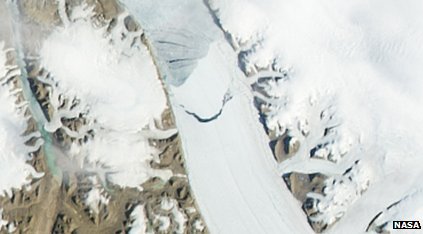
Iceberg twice the size of Manhattan breaking off the Peterman Glacier in Greenland. AP/NASA image.

Friday, December 31, 2010

"Mount Everest's Sherpas Ring Warning Bell on Global Warming "

(2010 Top Environment Alert From www.stumbleupon.com)


When sherpas ring the warning bell on climate change the world should listen: Mount Everest is becoming increasingly dangerous to climb because global warming is melting glacier ice along its slopes, according to Apa, a Nepalese Sherpa who grew up in the foothills to Mount Everest, reached the 29,035-foot (8,850-metre) summit on Saturday for the 20th time, breaking his own previous world record for 19 ascents.Rising temperatures have melted much of the ice on the steep trail to the summit and climbers are struggling to get traction on the exposed rock surface.

A recent report by scientists at University College London said the Himalayan glaciers are retreating faster than many others around the world, at rates ranging from 10 to 60 metres per year. Professor Steve Edwards, an earth scientist who coauthored the report, titled "The Waters of the Third Pole," said the effects of glacial melting posed a real risk to climbers.

“The general trend shows that the Himalayan glaciers as a whole are melting faster than many others. It is probably the fastest rate of melting in the world,” he said.

“The result is that in the summer months there is going to be a lot of slush on the ice fields. There is also the risk of glacial outburst floods, where the meltwater tops the bank of sediment left behind by the glacier during a period of intense melting and crashes down the river valley, destroying everything in its path.”

The melting ice has also exposed deep crevasses which climbers could fall into, and experts have warned that people scaling the mountain risk being swept away by “outburst floods” from rising volumes of glacial meltwater.

After returning to Kathmandu on Tuesday, Apa said: "The rising temperature on the mountains has melted much ice and snow on the trail to the summit. It is difficult for climbers to use their crampons on the rocky surfaces." He said there was hardly any exposed rock on the trail to the summit when he first climbed Everest in 1989, but now the slopes are dotted with bare rocks.

Climbing-mount-everest-10 The world’s highest mountain is becoming an increasingly popular tourist destination, with a procession of novice climbers scaling the summit with the help of highly expert Sherpas like Apa. But experts have warned that many amateur climbers may not be aware of the risks they face in tackling Everest.

.Casey Kazan via The Telegraph

Wednesday, August 11, 2010

Huge Ice "Island" breaks off of Greenland


AP - STOCKHOLM – An island of ice more than four times the size of Manhattan is drifting across the Arctic Ocean after breaking off from a glacier in Greenland.

Potentially in the path of this unstoppable giant are oil platforms and shipping lanes — and any collision could do untold damage. In a worst case scenario, large chunks could reach the heavily trafficked waters where another Greenland iceberg sank the Titanic in 1912.

It's been a summer of near biblical climatic havoc across the planet, with wildfires, heat and smog in Russia and killer floods in Asia. But the moment the Petermann glacier cracked last week — creating the biggest Arctic ice island in half a century — may symbolize a warming world like no other.

"It's so big that you can't prevent it from drifting. You can't stop it," said Jon-Ove Methlie Hagen, a glaciologist at the University of Oslo.

Few images can capture the world's climate fears like a 100-square- mile (260-sqare-kilometer) chunk of ice breaking off Greenland's vast ice sheet, a reservoir of freshwater that if it collapsed would raise global sea levels by a devastating 20 feet (6 meters).

The world's newest ice island already is being used as a powerful emblem in the global warming debate, with U.S. Rep. Edward Markey of Massachusetts suggesting it could serve as a home for climate change skeptics.

Researchers are in a scramble to plot the trajectory of the floating ice shelf, which is moving toward the Nares Strait separating Greenland's northwestern coast and Canada's Ellsemere Island.

If it makes it into the strait before the winter freeze — due to start next month — it would likely be carried south by ocean currents, hugging Canada's east coast until it enters waters busy with oil activities and shipping off Newfoundland...

Since 1970, temperatures have risen more than 4.5 degrees (2.5 degrees C) in much of the Arctic — much faster than the global average. In June the Arctic sea ice cover was at the lowest level for that month since records began in 1979, according to the National Oceanic and Atmospheric Administration.

Wednesday, April 07, 2010

"2 more glaciers gone from Glacier National Park"

BILLINGS, Mont. (AP) – Glacier National Park has lost two more of its namesake moving icefields to climate change, which is shrinking the rivers of ice until they grind to a halt, a government researcher said Wednesday.

Warmer temperatures have reduced the number of named glaciers in the northwestern Montana park to 25, said Dan Fagre, an ecologist with the U.S. Geological Survey. He warned the rest of the glaciers may be gone by the end of the decade.

"When we're measuring glacier margins, by the time we go home the glacier is already smaller than what we've measured," Fagre said.

From the Himalayas to Alaska, glacier melting has accelerated in recent decades as global temperatures increased. The meltoff shows the climate is changing, but does not show exactly what is causing temperatures to go up, Fagre said.

The park's glaciers have been slowly melting since about 1850, when the centuries-long Little Ice Age ended. They once numbered as many as 150, and 37 of those glaciers eventually were named.

A glacier needs to be 25 acres to qualify for the title.

If it shrinks any smaller, it does not always stop moving right away. A smaller mass of ice on a steep slope would still continue to grind its way through the mountains, but eventually disappears completely.

The latest two to fall below the 25 acre threshold were Miche Wabun and Shepard. Each had shrunk by roughly 55 percent since the mid-1960s. The largest remaining glacier in the park is Harrison Glacier, at about 465 acres.

Smaller glaciers and warmer temperatures could lower stream flows, which in turn prompt fishing restrictions and hobble whitewater rafting businesses, said Denny Gignoux, who runs an outfitting business in West Glacier. Tourism is a $1 billion a year industry in the area.

"What happens when all these threats increase?" Gignoux asked. "We're losing a draw to Glacier."

Two environmental groups released a report Wednesday highlighting the threat to tourism of fewer glaciers. The report by the Rocky Mountain Climate Organization and Natural Resources Defense Council included an analysis of weather records that showed Glacier was 2 degrees hotter on average from 2000 to 2009, compared with 1950 to 1979.

Thursday, August 13, 2009

"Antarctic glacier 'thinning fast'"

From the BBC:

One of the largest glaciers in Antarctica is thinning four times faster than it was 10 years ago, according to research seen by the BBC.

A study of satellite measurements of Pine Island glacier in west Antarctica reveals the surface of the ice is now dropping at a rate of up to 16m a year.

Since 1994, the glacier has lowered by as much as 90m, which has serious implications for sea-level rise.

The work by British scientists appears in Geophysical Research Letters.

The team was led by Professor Duncan Wingham of University College London (UCL).

Calculations based on the rate of melting 15 years ago had suggested the glacier would last for 600 years. But the new data points to a lifespan for the vast ice stream of only another 100 years.

The rate of loss is fastest in the centre of the glacier and the concern is that if the process continues, the glacier may break up and start to affect the ice sheet further inland.

One of the authors, Professor Andrew Shepherd of Leeds University, said that the melting from the centre of the glacier would add about 3cm to global sea level.

"But the ice trapped behind it is about 20-30cm of sea level rise and as soon as we destabilise or remove the middle of the glacier we don't know really know what's going to happen to the ice behind it," he told BBC News.

"This is unprecedented in this area of Antarctica. We've known that it's been out of balance for some time, but nothing in the natural world is lost at an accelerating exponential rate like this glacier."

Pine Island glacier has been the subject of an intense research effort in recent years amid fears that its collapse could lead to a rapid disintegration of the West Antarctic ice sheet.