Wednesday, June 19, 2013

Heat Records Broken in Alaska

From Climate Central:


A massive dome of high pressure, sometimes referred to as a "heat dome," has set up shop over Alaska, bringing all-time record temperatures just a few weeks after parts of the state had a record cold start to spring. In some cases, towns in Alaska were warmer on Monday and Tuesday than most locations in the lower 48 states.
Forecast temperature anomalies on June 19 from the GFS computer model.
Click image to enlarge. Credit: WeatherBell.com.
For example, Talkeetna set an all-time high temperature record of 96°F on Monday, smashing its previous mark of 91°F set a day earlier, and previously set in June of 1969. In fact, it was warmer in Talkeetna, which is about 110 miles north of Anchorage, than it was in Miami, based on data from the National Weather Service (NWS). (As Weather Underground's Christopher Burt notes, there was an unofficial observation of 98°F on Monday, which would rank among the hottest all-time temperature records for the state.)
In Valdez, which sits along the cool waters of Prince William Sound, the temperature reached a remarkable 90°F Monday, beating the previous all-time mark of 87°F. And in Seward, another coastal port, the temperature hit 88°F, breaking the previous all-time high of 87°F that was set on July 4, 1999.
Extreme heat was also felt across the interior of Alaska, where hot temperatures are expected to continue this week until the large high pressure area, or ridge in the jet stream, weakens and moves away. The heat, combined with low relative humidity and the chance for thunderstorms, is raising the risk of wildfires across parts of Alaska.
A map of the upper level air flow at about 18,000 feet. The bright red area over Alaska corresponds to an unusually strong area of High Pressure bringing warmer-than-average temperatures.
Credit: WeatherBell.com.


Alaska is one of the fastest-warming states in the U.S., largely because the nearby Arctic region is warming rapidly in response to manmade global warming and natural variability. In recent years, Alaska has had to content with large wildfires, melting permafrost, and reduced sea ice, among other climate-related challenges.

Thursday, June 06, 2013

"Severe flooding inundates parts of Central Europe"

An aerial view of the flooding in Passau, Germany, 03 June 2013. The floodings in Bavaria continue to worsen. (Peter Kneffel - AP)
An aerial view of the flooding in Passau, Germany, 03 June 2013. The floodings in Bavaria continue to worsen. (Peter Kneffel – AP)

From the Washington Post:
The village of Aschau, Bavaria recorded an impressive 405.1 mm of rainfall (15.9 inches) in just four days, of which 6.71” fell in 24 hours

Large areas of central Europe are experiencing their worst flooding in decades after heavy rainfall last week pushed rivers beyond their banks.

At least 21 people have died across Germany, Austria, and the Czech Republic, and thousands have been forced to evacuate their inundated homes. Preliminary estimates suggest the flooding has caused several billion dollars in damage.

In Passau, Germany – along the confluence of the Danube and Inn rivers – floodwaters rose to their highest levels in over 500 years. The city declared a state of emergency after swollen rivers cut off outside road access. Soldiers from the German army are being sent to flooded areas in southeastern Germany to provide disaster relief.

An aerial view of flood water in the city of Melk, Lower Austria, Austria, 03 June 2013. (Roland Schlager - EPA)

An aerial view of flood water in the city of Melk, Lower Austria, Austria, 03 June 2013. (Roland Schlager – EPA)

A expansive area of low pressure parked over eastern Europe is to blame for the excessive rainfall. Warm, moist Mediterranean air colliding with colder Atlantic air was lifted over the north side of the Alps. A stationary front then formed, bringing an extended period of unsettled weather.

While this pattern setup is not unusual in the central Alps, the amount of precipitation measured in some locations was historically significant.


Rainfall totals (in millimeters) recorded across Austria and southeastern Germany, May 30 – June 3. (Austrian Institute for Meteorology and Geodynamics)


Monday, June 03, 2013

Massive tornado - Moore, Oklahoma


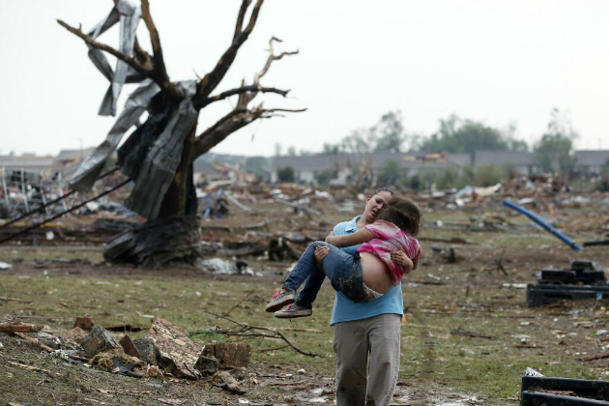
A woman carries a child through a tornado-ravaged neighborhood in Moore, Okla., May 20, 2013. (Sue Ogrocki/AP)

Massive tornado rips through Moore, Oklahoma


A devastating, mile-wide tornado touched down near Oklahoma City on Monday, killing dozens of people—including children—decimating homes, businesses and a pair of elementary schools in the suburb of Moore.


The tornado left a debris field 20 miles long and several miles wide. According to the National Weather Service in Norman, Okla., the tornado was on the ground for approximately 40 minutes, and a tornado warning was in effect for 16 minutes before the twister developed.
Weather officials estimated the strength of the storm to be an F4 or F5 on the Fujita Scale—the highest rating a tornado can achieve. The National Weather Service said the tornado's preliminary classification was an F4, with winds up to 200 mph.
The devastated area was an estimated 30 square miles.
__________
24 people killed, 377 injured.

Thursday, May 16, 2013

CO2 Concentrations Reach 400 PPM Milestone


May 10, 2013


Contact: John Ewald, 240-429-6127
NOAA's Mauna Loa Observatory after a snowstorm. Courtesy of Mary Miller, Exploratorium.NOAA's Mauna Loa Observatory after a snowstorm. Courtesy of Mary Miller, Exploratorium
On May 9, the daily mean concentration of carbon dioxide in the atmosphere of Mauna Loa, Hawaii, surpassed 400 parts per million (ppm) for the first time since measurements began in 1958. Independent measurements made by both NOAA and the Scripps Institution of Oceanography have been approaching this level during the past week. It marks an important milestone becauseMauna Loa, as the oldest continuous carbon dioxide (CO2) measurement station in the world, is the primary global benchmark site for monitoring the increase of this potent heat-trapping gas.

Carbon dioxide pumped into the atmosphere by fossil fuel burning and other human activities is the most significant greenhouse gas (GHG) contributing to climate change. Its concentration has increased every year since scientists started making measurements on the slopes of the Mauna Loa volcano more than five decades ago. The rate of increase has accelerated since the measurements started, from about 0.7 ppm per year in the late 1950s to 2.1 ppm per year during the last 10 years.

“That increase is not a surprise to scientists,” said NOAA senior scientist Pieter Tans, with the Global Monitoring Division of NOAA’sEarth System Research Laboratory in Boulder, Colo. “The evidence is conclusive that the strong growth of global CO2 emissions from the burning of coal, oil, and natural gas is driving the acceleration.” 

Before the Industrial Revolution in the 19th century, global average CO2 was about 280 ppm. During the last 800,000 years, CO2 fluctuated between about 180 ppm during ice ages and 280 ppm during interglacial warm periods. Today’s rate of increase is more than 100 times faster than the increase that occurred when the last ice age ended.
NOAA's Mauna Loa Observatory in Hawaii. Thursday, levels of the greenhouse gas carbon dioxide at Mauna Loa surpassed 400 parts per million for the first time since measurements began in 1958. Pre-industrial carbon dioxide levels were 280 parts per million. Mauna Kea is in the background. NOAA photo.NOAA's Mauna Loa Observatory in Hawaii. Thursday, levels of the greenhouse gas carbon dioxide at Mauna Loa surpassed 400 parts per million for the first time since measurements began in 1958. Pre-industrial carbon dioxide levels were 280 parts per million. Mauna Kea is in the background. NOAA photo.
It was researcher Charles David Keeling of the Scripps Institution of Oceanography, UC San Diego, who began measuring carbon dioxide at Mauna Loa in 1958, initiating now what is known as the “Keeling Curve.” His son, Ralph Keeling, also a geochemist at Scripps, has continued the Scripps measurement record since his father’s death in 2005.

“There’s no stopping CO2 from reaching 400 ppm,” said Ralph Keeling. “That’s now a done deal. But what happens from here on still matters to climate, and it’s still under our control. It mainly comes down to how much we continue to rely on fossil fuels for energy.”

NOAA scientists with the Global Monitoring Division have made around-the-clock measurements there since 1974. Having two programs independently measure the greenhouse gas provides confidence that the measurements are correct.

Moreover, similar increases of CO2 are seen all over the world by many international scientists. NOAA, for example, which runs a global, cooperative air sampling network, reported last year that all Arctic sites in its network reached 400 ppm for the first time. These high values were a prelude to what is now being observed at Mauna Loa, a site in the subtropics, this year. Sites in the Southern Hemisphere will follow during the next few years. The increase in the Northern Hemisphere is always a little ahead of the Southern Hemisphere because most of the emissions driving the CO2 increase take place in the north.
Once emitted, CO2 added to the atmosphere and oceans remains for thousands of years. Thus, climate changes forced by CO2 depend primarily on cumulative emissions, making it progressively more and more difficult to avoid further substantial climate change.  

Fish fleeing warmed waters


More consequences - study:

May 16 News: Fish Are Fleeing Climate-Warmed Waters And Heading For The Earth’s Poles


(Credit: TANAKA Juuyoh/Flickr)
For more than 30 years, ocean fish and mammals have migrated away from warming equatorial waters and toward the poles, providing more evidence climate change has already had broad global consequences. [Washington Post]
Fish and other sea life have been heading toward the Earth’s poles for more than three decades, a mass migration to cooler waters that provides more evidence of a rapidly warming planet and has repercussions for fish harvests around the globe, according to a first-of-its-kind study released Wednesday.
The study, in the journal Nature, found that significant numbers of 968 species of fish and invertebrates examined by University of British Columbia researchers moved to escape the warming waters of their original habitats. Previous studies had demonstrated the same phenomenon for specific places in the world’s oceans. The authors said their research is the first to assess the migration worldwide and to look back as far as 1970.
The research is more confirmation that “global change is real and has been real for a long time. It’s not something in the distant future. It is well underway,”said Boris Worm, a professor of marine biology at Dalhousie University in Halifax, Nova Scotia, who was not part of the study.

Saturday, February 16, 2013

Using Climate Change as an Excuse for Bad Policy

This is annoying:
"Fracking is the only way to achieve Obama climate change goals, says senior scientist" 


America will only achieve the ambitious climate change goals outlined by President Barack Obama last week by encouraging wide-scale fracking for natural gas over the next few years. That is the advice of one of the nation's senior scientists, Professor William Press, a member of thepresident's Council of Advisors on Science and Technology.

Fracking – known officially as hydraulic fracturing – involves pumping high-pressure water through underground rocks to release natural gas trapped deep underground. It is believed that there are vast reserves of these subterranean gas fields across the US.
Thousands of wells have already been drilled in Texas, leading to a substantial rise in the use of natural gas in the US and a major decline in the burning of coal, a far more serious cause of carbon pollution. However, fracking is also controversial. Environmentalists say it can lead to the contamination of underground water reservoirs and the pollution of the surface with chemicals used to help to release subterranean gas stores. They also point out that burning natural gas releases carbon dioxide.

....Greenpeace says no proper analysis has been done on gas leakage from fracking sites. In particular, there is a fear that methane – which is a far more dangerous greenhouse gas than carbon dioxide – may be escaping from wells and adding to the warming of the atmosphere. Campaigners also claim that there have been more than 1,000 cases of groundwater contamination in the US because of fracking and have urged a moratorium on underground drilling....
Yes - it would be great if to have coal companies stop tearing down mountains, It would be great to reduce emissions - but there are many problems with fracking. To say that 'Fracking' is the only way to solve our energy problems is to be blind to many other possibilities.

"How Fox Slants The Energy Debate"

From MediaMatters.org

I was scanning the radio on a recent commute and heard a Christian Fundamentalist 'Economist" slamming renewable energy.

I suppose conservatives have never been on board with this - but these days when Global Warming is so obvious and when these solutions seem so reasonable, it's hard for me to believe people are continuing to be so dense. 

Many conservatives seem to be getting on board as far as being anti-coal, pro-nuclear. Being afraid of emission taxes, cap & trade, or other consequences. Forbes.com pays James Conca to write pro-nuke pieces such as, "How Deadly Is Your Kilowatt? We Rank The Killer Energy Sources". 

The right wing doesn't want to acknowledge problems with nuclear waste or meltdowns. Fukushima either did not exist to them or there were no problems. Denial, denial, denial.

Thursday, January 10, 2013

Cold China / Hot Australia

China's icy weather shatters records Chinese officials blame global warming for causing the bitter cold front in their country. An unusually cold winter across China has some regions hitting their lowest average temperatures in more than 40 years, according to state media reports. The Chinese national meteorological agency said polar fronts caused by global warming are to blame for the frigid air. The freeze is the coldest winter in 28 years, the English-language newspaper China Daily reported. The national average temperature across China's vast territory was a chilly 25.2 degrees Fahrenheit (minus 3.8 degrees Celsius) since late November. In northeast China, which typically has snowy, cold winters, the average temperature was an icy 4.5 degrees Fahrenheit (minus 15.3 degrees Celsius), the lowest in 42 years. Temperatures have dropped down to minus 40 degrees Fahrenheit (minus 40 degrees Celsius) in eastern Inner Mongolia, northern Xinjiang and the Arctic reaches of northeast China. (Mohe, in northeast China, holds China's record low temperature of minus 62.1 F, or minus 52.3 C, set on Feb. 13, 1962). ....As of last week, about a thousand ships were stuck in ice in Laizhou Bay in the eastern Bohai Sea, according to China Daily. Some 10,500 square miles (27,000 square kilometers) of sea surface has frozen in Bohai Bay, the greatest ice extent since records began in 2008, according to the Chinese Meteorological Association. Northern India is also suffering from record cold winter temperatures, Weather Underground reported. In Uttar Pradesh, home to New Delhi, 175 people have died from the cold. The high on Jan. 2 was just 49.6 F (9.8 C), the coldest daily maximum in 44 years. Brutal cold is also shattering records across Russia. This winter is the coldest on record since 1938, and temperatures plunged as low as minus 58 F (minus 50 C) in some areas. ___________________________________
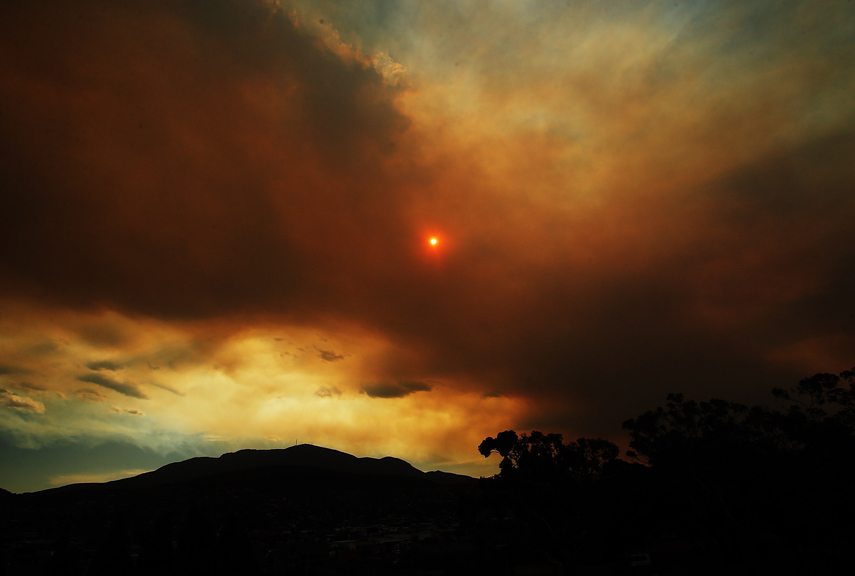
______________Photo: Mark Metcalfe/Getty Images __________ Australia, a country on fire A firefighter watches as a helicopter flies away to perform water-bombing operations against a bushfire that is scorching the Sandhills of Bungendore on Jan. 9 in New South Wales, Australia. In the midst of what could be one of Australia's hottest summers on record, thousands of firefighters are battling 140 bushfires ravaging New South Wales. Authorities have rated the string of bushfires as "catastrophic," meaning that the flames are fast, uncontained, uncontrollable and unpredictable. The weather is so hot and dry in the Land Down Under that the Australian Bureau of Meteorology was forced to add an entirely new color to its heat index maps. In the map below, the purple splotch reflects a record-breaking 129.2 degrees observed on Jan. 8. This new record temperature leaps 6 degrees above the previous record high of 123 degrees, which was recorded in 1960 at the Oodnadatta Airport in South Australia.

Saturday, December 22, 2012

Why Squid have been committing mass suicide

From Grist.org Thousands of squid beached themselves in California in the last week, essentially committing mass suicide. And it’s not an isolated incident. Scientists have been wondering for a long time what makes squid go through these occasional suicide events, and they think they might finally have an answer. The culprit is poisonous algae, which has been intoxicating the squid and causing them to become disoriented so that they come up on shore and die, instead of say, swimming and living, like you’d think they’d prefer. Well, “prefer” is perhaps a strong word given squid cognition, but at any rate most animals like to live. Each time the squid have all collectively bought the farm, there’s been a red tide, an algal bloom where the water gets so full of microorganisms that it turns red. So scientists though maybe there was a connection, and it looks like they’re probably right. It is possible that low levels of a chemical called domoic acid — the thing that makes human beings sick from eating shellfish when there’s a red tide — gets into the squid’s brains and essentially makes them drunk. Domoic acid makes humans develop a sort of amnesia, so this makes sense — since squid don’t really have enough going on in their lives to develop amnesia, they only thing they lose is the ability to distinguish between the depth of water that’s conducive to swimming, and the depth that’s conducive to dying.

Friday, November 30, 2012

"Can a Jellyfish Unlock the Secret of Immortality?"

From the New York Times By 

The "immortal jellyfish" can transform itself back into a polyp and begin life anew.


After more than 4,000 years — almost since the dawn of recorded time, when Utnapishtim told Gilgamesh that the secret to immortality lay in a coral found on the ocean floor — man finally discovered eternal life in 1988. He found it, in fact, on the ocean floor. The discovery was made unwittingly by Christian Sommer, a German marine-biology student in his early 20s. He was spending the summer in Rapallo, a small city on the Italian Riviera, where exactly one century earlier Friedrich Nietzsche conceived “Thus Spoke Zarathustra”: “Everything goes, everything comes back; eternally rolls the wheel of being. Everything dies, everything blossoms again. . . .”
Sommer was conducting research on hydrozoans, small invertebrates that, depending on their stage in the life cycle, resemble either a jellyfish or a soft coral. Every morning, Sommer went snorkeling in the turquoise water off the cliffs of Portofino. He scanned the ocean floor for hydrozoans, gathering them with plankton nets. Among the hundreds of organisms he collected was a tiny, relatively obscure species known to biologists as Turritopsis dohrnii. Today it is more commonly known as the immortal jellyfish.
Sommer kept his hydrozoans in petri dishes and observed their reproduction habits. After several days he noticed that his Turritopsis dohrnii was behaving in a very peculiar manner, for which he could hypothesize no earthly explanation. Plainly speaking, it refused to die. It appeared to age in reverse, growing younger and younger until it reached its earliest stage of development, at which point it began its life cycle anew.
Sommer was baffled by this development but didn’t immediately grasp its significance. (It was nearly a decade before the word “immortal” was first used to describe the species.) But several biologists in Genoa, fascinated by Sommer’s finding, continued to study the species, and in 1996 they published a paper called “Reversing the Life Cycle.” The scientists described how the species — at any stage of its development — could transform itself back to a polyp, the organism’s earliest stage of life, “thus escaping death and achieving potential immortality.” This finding appeared to debunk the most fundamental law of the natural world — you are born, and then you die.
One of the paper’s authors, Ferdinando Boero, likened the Turritopsis to a butterfly that, instead of dying, turns back into a caterpillar. Another metaphor is a chicken that transforms into an egg, which gives birth to another chicken. The anthropomorphic analogy is that of an old man who grows younger and younger until he is again a fetus. For this reason Turritopsis dohrnii is often referred to as the Benjamin Button jellyfish.
We now know, for instance, that the rejuvenation of Turritopsis dohrnii and some other members of the genus is caused by environmental stress or physical assault. We know that, during rejuvenation, it undergoes cellular transdifferentiation, an unusual process by which one type of cell is converted into another — a skin cell into a nerve cell, for instance. (The same process occurs in humanstem cells.) We also know that, in recent decades, the immortal jellyfish has rapidly spread throughout the world’s oceans in what Maria Pia Miglietta, a biology professor at Notre Dame, calls “a silent invasion.” The jellyfish has been “hitchhiking” on cargo ships that use seawater for ballast. Turritopsis has now been observed not only in the Mediterranean but also off the coasts of Panama, Spain, Florida and Japan. The jellyfish seems able to survive, and proliferate, in every ocean in the world. It is possible to imagine a distant future in which most other species of life are extinct but the ocean will consist overwhelmingly of immortal jellyfish, a great gelatin consciousness everlasting....


The genus, it turns out, is extraordinarily difficult to culture in a laboratory. It requires close attention and an enormous amount of repetitive, tedious labor; even then, it is under only certain favorable conditions, most of which are still unknown to biologists, that a Turritopsis will produce offspring.
In fact there is just one scientist who has been culturing Turritopsis polyps in his lab consistently. He works alone, without major financing or a staff, in a cramped office in Shirahama, a sleepy beach town in Wakayama Prefecture, Japan, four hours south of Kyoto. The scientist’s name is Shin Kubota, and he is, for the time being, our best chance for understanding this unique strand of biological immortality....
The world’s only captive population of immortal jellyfish lives in petri dishes arrayed haphazardly on several shelves of a small refrigerator in Kubota’s office. Like most hydrozoans, Turritopsis passes through two main stages of life, polyp and medusa. A polyp resembles a sprig of dill, with spindly stalks that branch and fork and terminate in buds. When these buds swell, they sprout not flowers but medusas. A medusa has a bell-shaped dome and dangling tentacles. Any layperson would identify it as a jellyfish, though it is not the kind you see at the beach. Those belong to a different taxonomic group, Scyphozoa, and tend to spend most of their lives as jellyfish; hydrozoans have briefer medusa phases. An adult medusa produces eggs or sperm, which combine to create larvae that form new polyps. In other hydroid species, the medusa dies after it spawns. A Turritopsis medusa, however, sinks to the bottom of the ocean floor, where its body folds in on itself — assuming the jellyfish equivalent of the fetal position. The bell reabsorbs the tentacles, and then it degenerates further until it becomes a gelatinous blob. Over the course of several days, this blob forms an outer shell. Next it shoots out stolons, which resemble roots. The stolons lengthen and become a polyp. The new polyp produces new medusas, and the process begins again.
Kubota estimates that his menagerie contains at least 100 specimens, about 3 to a petri dish. “They are very tiny,” Kubota, the proud papa, said. “Very cute.” It is cute, the immortal jellyfish. An adult medusa is about the size of a trimmed pinkie fingernail. It trails scores of hairlike tentacles. Medusas found in cooler waters have a bright scarlet bell, but more commonly the medusa is translucent white, its contours so fine that under a microscope it looks like a line drawing. It spends most of its time floating languidly in the water. It’s in no rush...
“The mystery of life is not concealed in the higher animals,” Kubota told me. “It is concealed in the root. And at the root of the Tree of Life is the jellyfish.”  (more)

Red algae closes beaches in Sydney

Dinoflagellates in at Clovelly beach in Sydney Australia

From the Herald Sun:

Red tide of algae strikes 10 more Sydney beaches


The Metropolitan Sydney, South Coast and Hunter Regional Algal Co-ordinating Committees yesterday said they had warned "communities along coastal beaches between Sydney and the Central Coast about algal blooms.
"This bloom has likely occurred as a result of the upwelling of nutrient-rich deep ocean water on to the continental shelf," they said.
"Testing of samples taken from Bondi beach have been identified as noctiluca scintillans, which appears as a pinkish to reddish discolouration in water."
"Upwellings create food sources for the predatory noctiluca scintillans - there's more bacteria and phytoplankton for them to eat," Dr Murray said.
...
"They live on the surface off the coast and are very buoyant, so they are at the mercy of wind and ocean currents. If you have the right mix they can be concentrated in dense groups and pushed on to the beaches.
"These two algal concentrations - on the northern and eastern beaches - would have come from the same offshore source.
"They aren't toxic but accumulate ammonia because of what they eat, which can be irritating to some people."

"Study Gives New Benchmark for How Much Ice is Melting"


From Climate Central by Michael Lemonick


The vast ice sheets that cover Greenland and Antarctica have begun melting and sliding into the ocean as heat-trapping greenhouse gases continue to build in the atmosphere. How much and how fast the ice is disappearing, however, has been poorly understood, because the satellites that measure it haven’t always agreed. But a report published Thursday in Science has cleared up much of the uncertainty.
A team of no fewer than 47 scientists from 36 laboratories, looking at data from 10 different satellites, has come up with numbers everyone is on board with: between 1992 and 2011, Greenland has lost 152 billion metric tons of ice, while Antarctica has shed 71 billion, contributing 11 millimeters to the rise in sea level over that period — about a fifth of the total (the rest has come from seawater expanding as it warms).

“The new estimates,” lead author Andrew Shepherd, of the University of Leeds, said in a press conference, “are the most reliable to date. They end 20 years of uncertainty.”

The estimates don't change projections about what’s likely to happen for the rest of this century. Scientists’ best estimate is that that the ocean, which has risen an average of 8 inches since 1900, should rise another 3 feet or so by 2100. But without a truly accurate record of how much melting has already occurred, it’s hard to know how good that projection is. It will also be hard to be certain if the melting starts to speed, or slow.
“This [study] provides a nice baseline. It’s really the start of the reliable record,” said co-author Ben Smith, of the University of Washington, at the press conference...
Scientists working on data from all 10 came together, and compared results from exactly the same time periods for exactly the same regions within Antarctica and Greenland. It was somewhat analogous to photographing a scene not with a single camera, but with 10 different cameras looking from 10 different perspectives: you get a much richer picture of what’s going on. 
In particular, Shepherd said, scientists can now start to pinpoint changes in ice region by region, and figure out what’s happening in each place.
For example, the ice sheet in East Antarctica, which holds by far the most ice, is actually growing slightly, because of an increase in snowfall. “That’s consistent with climate warming because you expect more evaporation and therefore more rain and snow,” Shepherd said.
By contrast, the smaller ice sheets in West Antarctic and the Antarctic Peninsula are losing ice more quickly. “In general,” said co-author Ian Joughin of the University of Washington in an interview, “this is due to heat from the ocean. We’re doing lots of work trying to understand the melting going on beneath ice shelves.”