From the Tyee.ca:
Given the regularity with which fisherman now catch deformed fish, Schindler suggested that a federally funded fish health study on the Athabasca River "should be a much higher priority [for Ottawa] than funding hockey rinks and new fighter jets." Aboriginal communities and leaders downstream of the oil sands have been calling for such studies for nearly a decade.
Of 27 whitefish, burbot and northern pike recently collected by Robert Grandjambe, a resident of Fort Chip, seven had deformities, lesions, curved spines and bulging eyes. No reliable data exists on the actual percentage of deformed fish being caught downstream from the oil sands. But it may range from two to 20 per cent, says Schindler....
Ladouceur, who has been fishing commercially for 53 years on the lake and has lost eight family members to cancer, said, "I never saw deformed fish in my younger days. We've been trying to get some help to figure this out."
"We are human beings. Alberta Premier Ed Stelmach treats his dogs better. Sorry to say, but we need help."
Toxic brew identified by scientists
Many industrial sources now pollute the Athabasca River, including pulp mills, agricultural run-off, abandoned uranium mines and municipal waste. But two studies published in the prestigious Proceedings of the National Academy of Sciences (PNAS) have also shown that industrial air pollution and watershed destruction directly caused by the oil/tar sands has contaminated the river with heavy metals and petroleum compounds called polycyclic aromatic hydrocarbons (PAHs).
However, both Ottawa and the Alberta government, which are dependent on oil sand taxes and royalties, claim that all the pollution in the river is naturally occurring based on proprietary data collected by an industry-funded group.
Yet a 2009 study by David Schindler and Erin Kelly found that oil sands air pollution now blackens the snow with thousands of tonnes of bitumen particulates and PAHS during the winter within a 50 kilometre radius of the industry upgraders, resulting in an annual 5,000 barrel oil spill on the river during spring run-off.
Last month another study by Erin Kelly and David Schindler showed that air pollution and watershed destruction by the oil sands industry directly adds a rich brew of heavy metals including arsenic, thallium and mercury into the Athabasca river and at levels up to 30 times greater than permitted by pollution guidelines. Many heavy metals can increase the toxicity of PAHs.
Furthermore several studies have also found high levels of PAHs in six billion barrels of oil sands mining waste (enough to stretch to the moon and back 12 times) now stored in huge dams covering an area larger than the city of Vancouver...
Fish can absorb PAHS from water and sediment via their gills, skin and stomach. Different PAHs can cause totally different diseases and deformities in different fish species, including cataracts, tumors of the skin and liver, weakened immune systems, deformities, bile duct cancers and heart troubles.
PAHs can persist and behave in unexpected ways. A 2003 high profile study in the journal Science found that weathered oil from 1989 Exxon Valdez oil spill, including PAHs, continued to poison and affect the lifespan of fish and sea otters at sublethal levels more than a decade later. Long term PAH exposure not only stunted the growth of young pink salmon embryos, for example, but decreased their lifespan by 50 per cent.
Showing posts with label oil. Show all posts
Showing posts with label oil. Show all posts
Monday, September 20, 2010


Sunday, July 18, 2010
BP Gulf Oil Well Finally Capped
It took 3 months - but BP finally managed to get a megaton cap on the leak (app. 100-200 million gallons of oil "spilled")
BP says it plans to keep gulf oil well cap closed
In a press conference Sunday morning, a BP executive said that a mechanical "cap" used to shut off the geyser still seems to be holding. As a result, he said, the company now plans to keep it closed permanently -- or at least for a few more weeks, until a "relief well" can plug the leak near its underground source.
"We're not seeing any problems, at this point, any issues with the shut-in," said Doug Suttles, BP's chief operating officer, referring to the closure of the well. Because of that, Suttles said, "we'll continue to leave the well shut in."
Suttles' announcement seemed to alter the strategy that Coast Guard Admiral Thad W. Allen (ret.), the federal government's point man in the disaster, had described on Saturday. Allen had extended a two-day "integrity test" on the well until Sunday. But, Allen said, when the test was eventually done, it would likely be re-opened and connected to pipes that would siphon the leak up toward ships on the surface.
But on Sunday, Suttles said that the process of fitting the well with those pipes would have allowed oil to flow into the gulf for perhaps three days. In effect, he said, the "test" of the closed cap would continue indefinitely.
"No one wants to see oil flowing back into the sea, and to initiate containment would require that to occur," he said. "Unfortunately, we would first have to open the flow back up into the Gulf of Mexico."
Hooking the well up to those pipes would have provided a key statistic: since all the well's oil would have been gathered, there would finally be a concrete measurement of how much oil was leaking.
This "flow rate," which has only been guessed at so far, will be a key figure in determining BP's liability for the spill.
Suttles' announcement came on the fourth day after remote-controlled submarines closed the last valves on a "three-ram capping stack" that had been fitted atop the well's leaking pipe.
Since then, company officials and the U.S. government had been on alert for leaks, taking seismic readings from the under-sea rock, and using scanning the sea-floor for bubbling gas or oil. They had also been studying readings of the massive pressures inside the pipe itself: if they rose, it would mean the reservoir had been successfully bottled up...
Officially, Suttles said the company will now continue the "integrity test" it has been performing since Thursday. But, if no problems appear, he said that this "testing" could last until the first "relief well" breaks through the runaway well's pipe, and plugs it up permanently with cement...
He said the closest relief well was now more than 17,000 feet below the sea floor: just 100 feet vertically, and only four feet laterally, from the point it needs to reach. But the next phase is slow, Suttles said, since engineers need to be certain their drill is on course toward its tiny target. They are aiming at a steel casing slightly less than 10 inches wide, with a seven-inch pipe inside.
That relief well could hit its target by the end of this month, Suttles said, though the process of "killing" the well might last until mid-August.
Some have trouble believing BP stopped oil leak
[AP] Many Gulf Coast residents don't believe it. Some accuse BP of making it up. And even those convinced that the oil leak has finally been stopped are tempered in their relief, aware that their environmental nightmare is far from over.
"It's a beautiful thing that it's shut off," trumpeter Shamarr Allen said as he stood on the sidewalk in the Musicians' Village in New Orleans' Upper Ninth Ward. "But there's still a lot of years of cleaning. There's going to be a lot of no fishing still. It's only the beginning of a long road that we have to travel. It's only the first step."
Reaction to the news that BP PLC had cut off the flow from the blown well nearly three months after an oil-rig explosion was marked with deep distrust of the oil giant. Gulf Coast residents have suffered from months of false starts and dashed hopes, failed "top kills" and abortive "junk shots," containment domes and "top hats," as they watched the biggest offshore oil spill in U.S. history foul their shores and eat into their livelihoods.
"It's a (expletive) lie," shouted Stephon LaFrance, one of several oil-stained oystermen standing around Delta Marina in marshy Plaquemines Parish. "I don't believe they stopped that leak. BP's trying to make their self look good."
Sitting on a boat, his cousin, Louie Randy Barthelemy, looked up and said: "BP's trying to manipulate the media."
"It doesn't mean anything," Craig St. Amant said as he tried to sell tours to passers-by on Bourbon Street in the French Quarter. "They tell you what they want you to hear. I don't think they're being truthful in saying what they're saying."
Even those who believed what they were seeing on the live video feeds from the school of submersibles surrounding the damaged well head were having a hard time getting excited about this milestone.
At a dock in Hopedale, La., Roy Campo's crew was unloading and boxing blue crabs — their first in about a week because of closures. When they heard the news, the most the men could muster was a nod.
"The oil's still out there, so it'll be a while," said Campo, 50, of St. Bernard.
"Let's wait to see what an outside source has to say about the leak," a man named Rick Cortez posted on the Facebook page called "The 1,000,000 people who wonder why BP's still in charge of the oil spill." "BP (equals) ZERO credibility!!"
Some of the doubts that the leak has really been stopped appear to have sprung from glitches in the live feed from the Gulf floor. Some people complained that the video went out just as the oil stopped flowing, but an Associated Press reporter in Houston was able to view live footage of the shutoff the moment it happened Thursday — 2:25 p.m. CT.
For several days surrounding the cap operation, the 15 undersea camera feeds available through a link on BP's website have worked intermittently, at best. Sometimes, the feeds were hazy or hard to see. Other times, they were blank altogether.
Buras bartender Amy Hooks stopped watching the feeds a long time ago.
"I used to watch it every day, all day," the 32-year-old said. "I'm tired of getting my hopes shot down. It really hurts. It hurts to see all the local people not being able to do what they love to do."
BP says it plans to keep gulf oil well cap closed
In a press conference Sunday morning, a BP executive said that a mechanical "cap" used to shut off the geyser still seems to be holding. As a result, he said, the company now plans to keep it closed permanently -- or at least for a few more weeks, until a "relief well" can plug the leak near its underground source.
"We're not seeing any problems, at this point, any issues with the shut-in," said Doug Suttles, BP's chief operating officer, referring to the closure of the well. Because of that, Suttles said, "we'll continue to leave the well shut in."
Suttles' announcement seemed to alter the strategy that Coast Guard Admiral Thad W. Allen (ret.), the federal government's point man in the disaster, had described on Saturday. Allen had extended a two-day "integrity test" on the well until Sunday. But, Allen said, when the test was eventually done, it would likely be re-opened and connected to pipes that would siphon the leak up toward ships on the surface.
But on Sunday, Suttles said that the process of fitting the well with those pipes would have allowed oil to flow into the gulf for perhaps three days. In effect, he said, the "test" of the closed cap would continue indefinitely.
"No one wants to see oil flowing back into the sea, and to initiate containment would require that to occur," he said. "Unfortunately, we would first have to open the flow back up into the Gulf of Mexico."
Hooking the well up to those pipes would have provided a key statistic: since all the well's oil would have been gathered, there would finally be a concrete measurement of how much oil was leaking.
This "flow rate," which has only been guessed at so far, will be a key figure in determining BP's liability for the spill.
Suttles' announcement came on the fourth day after remote-controlled submarines closed the last valves on a "three-ram capping stack" that had been fitted atop the well's leaking pipe.
Since then, company officials and the U.S. government had been on alert for leaks, taking seismic readings from the under-sea rock, and using scanning the sea-floor for bubbling gas or oil. They had also been studying readings of the massive pressures inside the pipe itself: if they rose, it would mean the reservoir had been successfully bottled up...
Officially, Suttles said the company will now continue the "integrity test" it has been performing since Thursday. But, if no problems appear, he said that this "testing" could last until the first "relief well" breaks through the runaway well's pipe, and plugs it up permanently with cement...
He said the closest relief well was now more than 17,000 feet below the sea floor: just 100 feet vertically, and only four feet laterally, from the point it needs to reach. But the next phase is slow, Suttles said, since engineers need to be certain their drill is on course toward its tiny target. They are aiming at a steel casing slightly less than 10 inches wide, with a seven-inch pipe inside.
That relief well could hit its target by the end of this month, Suttles said, though the process of "killing" the well might last until mid-August.
Some have trouble believing BP stopped oil leak
[AP] Many Gulf Coast residents don't believe it. Some accuse BP of making it up. And even those convinced that the oil leak has finally been stopped are tempered in their relief, aware that their environmental nightmare is far from over.
"It's a beautiful thing that it's shut off," trumpeter Shamarr Allen said as he stood on the sidewalk in the Musicians' Village in New Orleans' Upper Ninth Ward. "But there's still a lot of years of cleaning. There's going to be a lot of no fishing still. It's only the beginning of a long road that we have to travel. It's only the first step."
Reaction to the news that BP PLC had cut off the flow from the blown well nearly three months after an oil-rig explosion was marked with deep distrust of the oil giant. Gulf Coast residents have suffered from months of false starts and dashed hopes, failed "top kills" and abortive "junk shots," containment domes and "top hats," as they watched the biggest offshore oil spill in U.S. history foul their shores and eat into their livelihoods.
"It's a (expletive) lie," shouted Stephon LaFrance, one of several oil-stained oystermen standing around Delta Marina in marshy Plaquemines Parish. "I don't believe they stopped that leak. BP's trying to make their self look good."
Sitting on a boat, his cousin, Louie Randy Barthelemy, looked up and said: "BP's trying to manipulate the media."
"It doesn't mean anything," Craig St. Amant said as he tried to sell tours to passers-by on Bourbon Street in the French Quarter. "They tell you what they want you to hear. I don't think they're being truthful in saying what they're saying."
Even those who believed what they were seeing on the live video feeds from the school of submersibles surrounding the damaged well head were having a hard time getting excited about this milestone.
At a dock in Hopedale, La., Roy Campo's crew was unloading and boxing blue crabs — their first in about a week because of closures. When they heard the news, the most the men could muster was a nod.
"The oil's still out there, so it'll be a while," said Campo, 50, of St. Bernard.
"Let's wait to see what an outside source has to say about the leak," a man named Rick Cortez posted on the Facebook page called "The 1,000,000 people who wonder why BP's still in charge of the oil spill." "BP (equals) ZERO credibility!!"
Some of the doubts that the leak has really been stopped appear to have sprung from glitches in the live feed from the Gulf floor. Some people complained that the video went out just as the oil stopped flowing, but an Associated Press reporter in Houston was able to view live footage of the shutoff the moment it happened Thursday — 2:25 p.m. CT.
For several days surrounding the cap operation, the 15 undersea camera feeds available through a link on BP's website have worked intermittently, at best. Sometimes, the feeds were hazy or hard to see. Other times, they were blank altogether.
Buras bartender Amy Hooks stopped watching the feeds a long time ago.
"I used to watch it every day, all day," the 32-year-old said. "I'm tired of getting my hopes shot down. It really hurts. It hurts to see all the local people not being able to do what they love to do."
Tuesday, July 13, 2010
"Who Really Owns the Gulf of Mexico?"
By Michael Mechanic in Mother Jones:
 — Offshore magazine poster detail


Who owns the Gulf of Mexico? That's a question you have to ask while perusing Offshore magazine's 2010 poster of the Gulf—downloadable here as a large PDF, but well worth checking out. Where most people look at the Gulf, they see a vast marine ecosystem, wetlands, and, until recently, gorgeous beaches.
What energy executives see is a massive grid, tangled with scores of oil and gas pipelines and rival fields with macho names that sound like heavy metal bands, black-diamond ski runs, and weapons systems. (See "Quiz: What Do BP and Kurt Cobain Have in Common?") Here's a small detail, slightly blurry, but you get the point. (Red lines are gas pipelines and pink are gas fields, green lines are oil pipelines and green blurbs are oil fields.)
Next, here's another map detail from farther offshore. {I} circled the site of the ongoing BP Deepwater Horizon spill in yellow.

What these maps really show is the degree to which the Gulf has played host to a feeding frenzy by big energy interests that snap up drilling leases on the cheap. Each of these numbered squares represents a lease site. As you can see from this Offshore magazine chart, the highest bid for a lease this year was about $53 million. Which, when you consider the value of the oil coming out of the Gulf, is chicken feed.

You'll also note that bids are way down from their peak in 2007-2008, but making a strong comeback. As Offshore notes here (scroll down), 77 companies put in 642 bids on 468 tracts totalling more than 2.4 million acres. But the next lease sale, slated for August 18, is unlikely to go so swimmingly.
 — Offshore magazine poster detail

Who owns the Gulf of Mexico? That's a question you have to ask while perusing Offshore magazine's 2010 poster of the Gulf—downloadable here as a large PDF, but well worth checking out. Where most people look at the Gulf, they see a vast marine ecosystem, wetlands, and, until recently, gorgeous beaches.
What energy executives see is a massive grid, tangled with scores of oil and gas pipelines and rival fields with macho names that sound like heavy metal bands, black-diamond ski runs, and weapons systems. (See "Quiz: What Do BP and Kurt Cobain Have in Common?") Here's a small detail, slightly blurry, but you get the point. (Red lines are gas pipelines and pink are gas fields, green lines are oil pipelines and green blurbs are oil fields.)
Next, here's another map detail from farther offshore. {I} circled the site of the ongoing BP Deepwater Horizon spill in yellow.

What these maps really show is the degree to which the Gulf has played host to a feeding frenzy by big energy interests that snap up drilling leases on the cheap. Each of these numbered squares represents a lease site. As you can see from this Offshore magazine chart, the highest bid for a lease this year was about $53 million. Which, when you consider the value of the oil coming out of the Gulf, is chicken feed.

You'll also note that bids are way down from their peak in 2007-2008, but making a strong comeback. As Offshore notes here (scroll down), 77 companies put in 642 bids on 468 tracts totalling more than 2.4 million acres. But the next lease sale, slated for August 18, is unlikely to go so swimmingly.
Wednesday, June 09, 2010
The Dispersant Used on the Oil Gushing in the Gulf
From WarOnYou.com:
The Amount Of Neurotoxin Pesticide Corexit Sprayed By BP Tops 1 Million Gallons
BP’s latest oil spill response update for June 4th says the total amount of the dispersant used in the Gulf of Mexico more than 1,021,000 gallons.
But what most people don’t know is that the active ingredient of the toxic chemical dispersant, which is up to 60% by volume, being sprayed by BP to fight the Gulf oil spill is a is a neurotoxin pesticide that is acutely toxic to both human and aquatic life, causes cancer, causes damage to internal organs such as the liver and kidneys simply by absorbing it through the skin and may cause reproductive side effects.
In fact the neurotoxin pesticide that is lethal to 50% of life in concentrations as little as 2.6 parts per million has been banned for use in the UK since 1998 because it failed the UK “Rocky shore test” which assures that the dispersant does not cause a “significant deleterious ecological change” – meaning it can delete an ecology or more specifically delete the entire food chain.
Corexit has also earned the highest EPA warning label for toxicity which means the effects of the toxic chemicals to the eye are corrosive resulting in irreversible destruction of ocular tissue and other tissue with corneal involvement along with an burning that can persist for more than 21 days and effects to human skin are corrosive resulting in tissue destruction into the dermis and/or scarring.
Corexit was widely used after the 1989 Exxon Valdez spill and according to a literature review performed by the group the Alaska Community Action on Toxics was later linked with widespread long lasting health impacts in people including respiratory, nervous system, liver, kidney and blood disorders.
The “Human Health Hazards” are said to be “Chronic” for Corexit EC9527A according to the EPA.
So What Are These Dispersants Made Of That Makes Them Such a Powerful Neurotoxin Pesticide?
The main ingredients of Corexit is 2-Butoxyethanol which can make up to 60% of the dispersant and is known to be toxic to blood, kidneys, liver, and the central nervous system (CNS).
2-Butoxyethanol is also known to cause cancer, birth defects and has been found to cause genetic mutations and is a delayed chronic health hazard as well as an environmental hazardous material
Corexit also contains Arsenic, Cadmium, Chromium, Mercury, and Cyanide.
• Why allow the use of these toxic dispersants?
Well the EPA has ordered BP to stop using the dispersants but BP has refused.
The EPA justifies the use of dispersants because they are less toxic than oil and the cause less of an environment impact that oil along the coastline.
However the choice of using Corexit contradicts both of those justifications.
Corexit is lethal in as little as 2.6 parts per million where oil is lethal in 11 parts per million meaning that Corexit is over 4 times more toxic than oil.
Furthermore scientific studies show that oil dispersed with Corexit is 11 times more lethal than oil alone.
In fact the study referenced showed that crude oil was lethal at 4250 parts per million to killifish but combination of oil mixed with Corexit was lethal in as little as 317.7 ppm.
“Dispersed oils were more toxic than crude oils,” noted the report....
CAS Registry Number Chemical Name
57-55-6
1,2-Propanediol
111-76-2
2-butoxy-Ethanol
577-11-7
Butanedioic acid, 2-sulfo-, 1,4-bis(2-ethylhexyl) ester, sodium salt (1:1)
1338-43-8
Sorbitan, mono-(9Z)-9-octadecenoate
9005-65-6
Sorbitan, mono-(9Z)-9-octadecenoate, poly(oxy-1,2-ethanediyl) derivs.
9005-70-3
Sorbitan, tri-(9Z)-9-octadecenoate, poly(oxy-1,2-ethanediyl) derivs
29911-28-2
2-Propanol, 1-(2-butoxy-1-methylethoxy)-
64742-47-8
Distillates (petroleum), hydrotreated light
The have also been found to contain Arsenic, Cadmium, Chromium, Mercury, and Cyanide among other heavy metals
What are the Chronic Health effects of Corexit?
Here are some of the highlights from the MSDS for the active ingredient (2-butoxyethanol) – of Corexit (up to 60% by volume)
Severe over-exposure can result in death.
MUTAGENIC EFFECTS: Mutagenic for bacteria and/or yeast.
The substance may be toxic to blood, kidneys, liver, central nervous system (CNS).
Repeated or prolonged exposure to the substance can produce target organs damage.
Repeated exposure to highly (this) toxic material may produce general deterioration of health by an accumulation in one or many human organs.
Hazardous in case of skin contact (permeator), of ingestion, of inhalation.
May cause adverse reproductive effects (maternal and paternal fertility, fetoxicity)
May cause birth defects (teratogenic)
May cause cancer (tumorigenic)
Penetrates intact skin easily and can cause systemic effects and central nervous system depression
Inhalation: May cause irritation of the respiratory tract. May affect behavior (analgesia), behavior/central nervous system (headache, drowsiness, dizzness, stuttering, coma, weakness, ataxia, slurred speech, loss of coordination and judgement, personality changes, analgesia, blurred vision, tremor, excitement, somnolence), sense organs, the gastrointestinal tract (nausea, vomiting), metabolism (metabolic acidosis), respiration (dyspnea), urinary system (kidneys – hematuria, albuminuria, polyuria, oliguria, renal failure), liver (liver damage).
Exposure to high vapor concentration may also cause corneal or lens opacity of the eyes.
Ingestion: Causes gastrointestinal tract irritation with nausea, vomiting, diarrhea. May affect behavior/central
nervous system (see inhalation), respiration (dyspnea), metabolism, cardiovascular system.
Chronic Potential Health Effects: Inhalation and Ingestion: Prolonged or repeated inhalation or ingestion may affect the liver, blood (changes in red blood cell count, pigmented or nucleated red blood cells, microcytosis with or without anemia, erythropenia, reticulocytosis, granulocytosis, leukocytosis), urinary system (kidneys -hematuria), metabolism (weight loss), endocrine system (spleen, thymus, pancreas). Prolonged or repeated inhalation of high concentrations may also cause lung hemmorrhage, congestion, bronchopneumonia.
Classified in Canada as CLASS D-1A: Material causing immediate and serious toxic effects (VERY TOXIC).
Classified in Canada as CLASS D-2B: Material causing other toxic effects (TOXIC)
The EPA warning about human health affects says:
People working with dispersants are strongly advised to use a half face filter mask or an air-supplied breathing apparatus to protect their noses, throats, and lungs, and they should wear nitrile or PVC gloves, coveralls, boots, and chemical splash goggles to keep dispersants off skin and out of their eyes.
The Amount Of Neurotoxin Pesticide Corexit Sprayed By BP Tops 1 Million Gallons
BP’s latest oil spill response update for June 4th says the total amount of the dispersant used in the Gulf of Mexico more than 1,021,000 gallons.
But what most people don’t know is that the active ingredient of the toxic chemical dispersant, which is up to 60% by volume, being sprayed by BP to fight the Gulf oil spill is a is a neurotoxin pesticide that is acutely toxic to both human and aquatic life, causes cancer, causes damage to internal organs such as the liver and kidneys simply by absorbing it through the skin and may cause reproductive side effects.
In fact the neurotoxin pesticide that is lethal to 50% of life in concentrations as little as 2.6 parts per million has been banned for use in the UK since 1998 because it failed the UK “Rocky shore test” which assures that the dispersant does not cause a “significant deleterious ecological change” – meaning it can delete an ecology or more specifically delete the entire food chain.
Corexit has also earned the highest EPA warning label for toxicity which means the effects of the toxic chemicals to the eye are corrosive resulting in irreversible destruction of ocular tissue and other tissue with corneal involvement along with an burning that can persist for more than 21 days and effects to human skin are corrosive resulting in tissue destruction into the dermis and/or scarring.
Corexit was widely used after the 1989 Exxon Valdez spill and according to a literature review performed by the group the Alaska Community Action on Toxics was later linked with widespread long lasting health impacts in people including respiratory, nervous system, liver, kidney and blood disorders.
The “Human Health Hazards” are said to be “Chronic” for Corexit EC9527A according to the EPA.
So What Are These Dispersants Made Of That Makes Them Such a Powerful Neurotoxin Pesticide?
The main ingredients of Corexit is 2-Butoxyethanol which can make up to 60% of the dispersant and is known to be toxic to blood, kidneys, liver, and the central nervous system (CNS).
2-Butoxyethanol is also known to cause cancer, birth defects and has been found to cause genetic mutations and is a delayed chronic health hazard as well as an environmental hazardous material
Corexit also contains Arsenic, Cadmium, Chromium, Mercury, and Cyanide.
• Why allow the use of these toxic dispersants?
Well the EPA has ordered BP to stop using the dispersants but BP has refused.
The EPA justifies the use of dispersants because they are less toxic than oil and the cause less of an environment impact that oil along the coastline.
However the choice of using Corexit contradicts both of those justifications.
Corexit is lethal in as little as 2.6 parts per million where oil is lethal in 11 parts per million meaning that Corexit is over 4 times more toxic than oil.
Furthermore scientific studies show that oil dispersed with Corexit is 11 times more lethal than oil alone.
In fact the study referenced showed that crude oil was lethal at 4250 parts per million to killifish but combination of oil mixed with Corexit was lethal in as little as 317.7 ppm.
“Dispersed oils were more toxic than crude oils,” noted the report....
CAS Registry Number Chemical Name
57-55-6
1,2-Propanediol
111-76-2
2-butoxy-Ethanol
577-11-7
Butanedioic acid, 2-sulfo-, 1,4-bis(2-ethylhexyl) ester, sodium salt (1:1)
1338-43-8
Sorbitan, mono-(9Z)-9-octadecenoate
9005-65-6
Sorbitan, mono-(9Z)-9-octadecenoate, poly(oxy-1,2-ethanediyl) derivs.
9005-70-3
Sorbitan, tri-(9Z)-9-octadecenoate, poly(oxy-1,2-ethanediyl) derivs
29911-28-2
2-Propanol, 1-(2-butoxy-1-methylethoxy)-
64742-47-8
Distillates (petroleum), hydrotreated light
The have also been found to contain Arsenic, Cadmium, Chromium, Mercury, and Cyanide among other heavy metals
What are the Chronic Health effects of Corexit?
Here are some of the highlights from the MSDS for the active ingredient (2-butoxyethanol) – of Corexit (up to 60% by volume)
Severe over-exposure can result in death.
MUTAGENIC EFFECTS: Mutagenic for bacteria and/or yeast.
The substance may be toxic to blood, kidneys, liver, central nervous system (CNS).
Repeated or prolonged exposure to the substance can produce target organs damage.
Repeated exposure to highly (this) toxic material may produce general deterioration of health by an accumulation in one or many human organs.
Hazardous in case of skin contact (permeator), of ingestion, of inhalation.
May cause adverse reproductive effects (maternal and paternal fertility, fetoxicity)
May cause birth defects (teratogenic)
May cause cancer (tumorigenic)
Penetrates intact skin easily and can cause systemic effects and central nervous system depression
Inhalation: May cause irritation of the respiratory tract. May affect behavior (analgesia), behavior/central nervous system (headache, drowsiness, dizzness, stuttering, coma, weakness, ataxia, slurred speech, loss of coordination and judgement, personality changes, analgesia, blurred vision, tremor, excitement, somnolence), sense organs, the gastrointestinal tract (nausea, vomiting), metabolism (metabolic acidosis), respiration (dyspnea), urinary system (kidneys – hematuria, albuminuria, polyuria, oliguria, renal failure), liver (liver damage).
Exposure to high vapor concentration may also cause corneal or lens opacity of the eyes.
Ingestion: Causes gastrointestinal tract irritation with nausea, vomiting, diarrhea. May affect behavior/central
nervous system (see inhalation), respiration (dyspnea), metabolism, cardiovascular system.
Chronic Potential Health Effects: Inhalation and Ingestion: Prolonged or repeated inhalation or ingestion may affect the liver, blood (changes in red blood cell count, pigmented or nucleated red blood cells, microcytosis with or without anemia, erythropenia, reticulocytosis, granulocytosis, leukocytosis), urinary system (kidneys -hematuria), metabolism (weight loss), endocrine system (spleen, thymus, pancreas). Prolonged or repeated inhalation of high concentrations may also cause lung hemmorrhage, congestion, bronchopneumonia.
Classified in Canada as CLASS D-1A: Material causing immediate and serious toxic effects (VERY TOXIC).
Classified in Canada as CLASS D-2B: Material causing other toxic effects (TOXIC)
The EPA warning about human health affects says:
People working with dispersants are strongly advised to use a half face filter mask or an air-supplied breathing apparatus to protect their noses, throats, and lungs, and they should wear nitrile or PVC gloves, coveralls, boots, and chemical splash goggles to keep dispersants off skin and out of their eyes.
Wednesday, May 19, 2010
"Oil in Pass a Loutre"
From NOLA.com:

PHOTO BY TED JACKSON / THE TIMES-PICAYUNE Plaquemines Parish President Billy Nungesser and La. Gov. Bobby Jindal tour through the Roseau Grasses that mark the coastline of Southeast Louisiana at Pass a Loutre at the mouth of the Mississippi River where oil has washed ashore, Wednesday, May 19, 2010.

PHOTO BY TED JACKSON / THE TIMES-PICAYUNE Plaquemines Parish President Billy Nungesser and La. Gov. Bobby Jindal tour through the Roseau Grasses that mark the coastline of Southeast Louisiana at Pass a Loutre at the mouth of the Mississippi River where oil has washed ashore, Wednesday, May 19, 2010.
"Atlantic coast now under threat as current spreads Gulf oil slick"
From the Guardian.co.uk:
There was mounting evidence last night that the scale of the oil spill disaster in the Gulf of Mexico has grown beyond all the initial worst-case scenarios, as thousands of gallons of oil continued to gush from the sea floor.
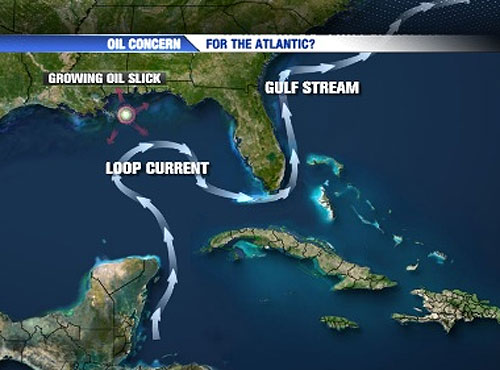
On the island of Key West, south of Florida, coastguard officials said about three tar balls an hour were washing up on the beaches of a state park. They said the globs of concentrated oil suggest leaking crude has now become caught up in the powerful loop current and could move from the gulf up to the Atlantic coast.
Meanwhile, an oceanographic research ship reported sighting a 10km (six-mile) plume lurking at depths below 1,000 metres and invisible from the surface.
The evidence of spreading environmental damage grew even more compelling with the release of fresh video showing thick clouds of oil billowing from the ruptured well.
The Obama administration responded by doubling the no-fishing zone to 19% of the waters in the gulf.
Fighting the spill is risky. Lisa Jackson, head of the Environmental Protection Agency, acknowledged that authorities were relying heavily on Corexit, a chemical banned in the UK because of its effects on limpets and other sea life.
"There has been a real reliance on them, maybe more than anybody thought would ever happen," she told the Senate environment and public works committee.
The mounting evidence forced administration officials to admit for the first time yesterday that they had underestimated the risks of offshore drilling.
In two highly charged hearings in the Senate, Ken Salazar, the interior secretary, conceded there had been failures in oversight by the agency responsible for policing offshore drilling. "We need to clean up that house," he said...
The White House this week intensified its efforts to limit the potential political damage on November's mid-term elections by backing an independent commission to investigate the disaster. In testimony yesterday defensive actions also included dogged resistance by administration officials to senators' demands to provide estimates of the size of the spill.
The stonewalling went beyond the Senate hearings. For the past 48 hours, officials have resisted reports by scientists that the spill could have entered the loop current, or downplayed their significance.
___________
There are quite a few news stories claiming that the tar balls are not from this spill. But they don't say where they are from. If there haven't been tar balls and now there are - that is rather a stretch (wishful thinking?) to say they are not from "Deepwater Horizon".
There was mounting evidence last night that the scale of the oil spill disaster in the Gulf of Mexico has grown beyond all the initial worst-case scenarios, as thousands of gallons of oil continued to gush from the sea floor.
On the island of Key West, south of Florida, coastguard officials said about three tar balls an hour were washing up on the beaches of a state park. They said the globs of concentrated oil suggest leaking crude has now become caught up in the powerful loop current and could move from the gulf up to the Atlantic coast.
Meanwhile, an oceanographic research ship reported sighting a 10km (six-mile) plume lurking at depths below 1,000 metres and invisible from the surface.
The evidence of spreading environmental damage grew even more compelling with the release of fresh video showing thick clouds of oil billowing from the ruptured well.
The Obama administration responded by doubling the no-fishing zone to 19% of the waters in the gulf.
Fighting the spill is risky. Lisa Jackson, head of the Environmental Protection Agency, acknowledged that authorities were relying heavily on Corexit, a chemical banned in the UK because of its effects on limpets and other sea life.
"There has been a real reliance on them, maybe more than anybody thought would ever happen," she told the Senate environment and public works committee.
The mounting evidence forced administration officials to admit for the first time yesterday that they had underestimated the risks of offshore drilling.
In two highly charged hearings in the Senate, Ken Salazar, the interior secretary, conceded there had been failures in oversight by the agency responsible for policing offshore drilling. "We need to clean up that house," he said...
The White House this week intensified its efforts to limit the potential political damage on November's mid-term elections by backing an independent commission to investigate the disaster. In testimony yesterday defensive actions also included dogged resistance by administration officials to senators' demands to provide estimates of the size of the spill.
The stonewalling went beyond the Senate hearings. For the past 48 hours, officials have resisted reports by scientists that the spill could have entered the loop current, or downplayed their significance.
___________
There are quite a few news stories claiming that the tar balls are not from this spill. But they don't say where they are from. If there haven't been tar balls and now there are - that is rather a stretch (wishful thinking?) to say they are not from "Deepwater Horizon".
Monday, May 17, 2010

Whys and Hows RE: the Gulf Oil Disaster
A synopsis of a "60 Minutes" Blowout: The Deepwater Horizon Disaster by Keith Pickering @ Daily Kos:
1 - This was the second attempt to drill a well in about the same spot. The first well had to be abandoned because the well had been drilled too fast (under pressure from BP to bring the well in quickly). Result: the rock fractured, causing loss of control of pressure in the well. Twenty-five million bucks down the drain, said BP to the crew. So they had to try again, in a rock formation known to be problematic.
2 - Early on while drilling the second well (the one that eventually blew up) an accident damaged part of the blowout preventer (BOP). According to Williams, they were conducting a routine test of the annular, a ring of rubber that closes around the well at the top of the BOP stack. While the annular was closed, thus closing off the well, a driller accidentally pushed a joystick, which pulled the pipe casing up through the rubber seal at very high pressure. A short time later, after drilling had resumed, pieces of rubber began coming up from the bottom of the well. A drilling supervisor told Williams that the rubber debris was "no big deal".
3 - The BOP has two redundant electronics boxes, called pods, which communicate with the surface. These are critical devices which trigger the BOP to close the well in emergency. One of the two pods was problematic and occasionally inoperable. The batteries on the BOP were also weak.
4 - The well was in the process of being closed with cement plugs when the blowout occurred. The day of the blowout, there was a disagreement between the Transocean supervisor and the BP supervisor over how that should be accomplished. The Transocean guy wanted to keep mud in the well (i.e., keep pressure in the well) during the cementing. The BP guy wanted the mud pulled from the well for cementing, because it was faster and they were already behind schedule. The BP guy won the argument. If pressure had been maintained in the well during the cementing operation, the blowout would not have occurred.
_______
From another forum posted from another forum:
1 - This was the second attempt to drill a well in about the same spot. The first well had to be abandoned because the well had been drilled too fast (under pressure from BP to bring the well in quickly). Result: the rock fractured, causing loss of control of pressure in the well. Twenty-five million bucks down the drain, said BP to the crew. So they had to try again, in a rock formation known to be problematic.
2 - Early on while drilling the second well (the one that eventually blew up) an accident damaged part of the blowout preventer (BOP). According to Williams, they were conducting a routine test of the annular, a ring of rubber that closes around the well at the top of the BOP stack. While the annular was closed, thus closing off the well, a driller accidentally pushed a joystick, which pulled the pipe casing up through the rubber seal at very high pressure. A short time later, after drilling had resumed, pieces of rubber began coming up from the bottom of the well. A drilling supervisor told Williams that the rubber debris was "no big deal".
3 - The BOP has two redundant electronics boxes, called pods, which communicate with the surface. These are critical devices which trigger the BOP to close the well in emergency. One of the two pods was problematic and occasionally inoperable. The batteries on the BOP were also weak.
4 - The well was in the process of being closed with cement plugs when the blowout occurred. The day of the blowout, there was a disagreement between the Transocean supervisor and the BP supervisor over how that should be accomplished. The Transocean guy wanted to keep mud in the well (i.e., keep pressure in the well) during the cementing. The BP guy wanted the mud pulled from the well for cementing, because it was faster and they were already behind schedule. The BP guy won the argument. If pressure had been maintained in the well during the cementing operation, the blowout would not have occurred.
_______
From another forum posted from another forum:
BP contracted Schlumberger (SLB) to run the Cement Bond Log (CBL) test that was the final test on the plug that was skipped. The people testifying have been very coy about mentioning this, and you'll see why.
SLB is an extremely highly regarded (and incredibly expensive) service company. They place a high standard on safety and train their workers to shut down unsafe operations.
SLB gets out to the Deepwater Horizon to run the CBL, and they find the well still
kicking heavily, which it should not be that late in the operation. SLB orders the"company man" (BP's man on the scene that runs the operation) to dump kill fluid down the well and shut-in the well. The company man refuses. SLB in the very next sentence asks for a helo to take all SLB personel back to shore. The company man says there are no more helo's scheduled for the rest of the week (translation: you're here to do a job, now do it). SLB gets on the horn to shore, calls SLB's corporate HQ, and gets a helo flown out there at SLB's expense and takes all SLB personel to shore.
6 hours later, the platform explodes.
Gulf Oil Disaster Update
There is a tube that was inserted into the gushing well that is allowing recovery of app. one-fifth of the oil. It is being piped a mile up to a tanker at the surface of the water. (Other remedies had been tried and failed to do anything.)
There are also fears that the oil has gotten into the current that could take the oil to and through the Florida Keys and out to the Atlantic. If it isn't already in the current - it is near. It is probably inevitable at this point given the quantity of oil that has gushed out.
Gulf Oil Spreading into Major Current is New Worry
Meanwhile, the head of BP and other conservatives like to think that it's no big deal. (??????!?!?!?!?!??!?!? - arrrrrgghhhhhh):
First off - the Gulf is not an ocean, and second - it is a disaster of the highest magnitude if it ruins even half of the beaches of the Gulf (which it probably will - and possibly the entire Gulf) and ruins the environment and ecosystems for millions of animals. It makes me sick that people with such authority and power are so callous.
From other windbags:
There are also fears that the oil has gotten into the current that could take the oil to and through the Florida Keys and out to the Atlantic. If it isn't already in the current - it is near. It is probably inevitable at this point given the quantity of oil that has gushed out.
Gulf Oil Spreading into Major Current is New Worry
Meanwhile, the head of BP and other conservatives like to think that it's no big deal. (??????!?!?!?!?!??!?!? - arrrrrgghhhhhh):
The boss of BP has claimed its Gulf of Mexico oil spill is "relatively tiny" compared with the "very big ocean".
Chief executive Tony Hayward also admitted his job is on the line because of the disaster, set to be the worst oil spill in history.
He said: "The Gulf of Mexico is a very big ocean.
"The amount of oil and dispersant is tiny in relation to the water volume."
First off - the Gulf is not an ocean, and second - it is a disaster of the highest magnitude if it ruins even half of the beaches of the Gulf (which it probably will - and possibly the entire Gulf) and ruins the environment and ecosystems for millions of animals. It makes me sick that people with such authority and power are so callous.
From other windbags:
Texas Governor Rick Perry (R) speculated that the spill may have just been God's doing: “From time to time there are going to be things that occur that are acts of God that cannot be prevented."(Um - "God" didn't drill a hole in the Gulf)
"The ocean will take care of this on its own if it was left alone and left out there. It's natural. It's as natural as the ocean water is." (Rush Limbaugh - who also suggested it was an environmental conspiracy - to fend off more drilling).(Again, it's not "natural" to have that amount of oil flooded into the environment - and it would take nature decades if not centuries to get back to normal).
Michael Brown, director of FEMA during the Bush years, told FOX News' Neil Cavuto: "This is exactly what they want, because now he can pander to the environmentalists and say, 'I'm gonna shut it down because it's too dangerous. This president has never supported big oil, he's never supported offshore drilling, and now he has an excuse to shut it back down."(that is just stupid and ignorant - as if anyone WANTS a disaster like this. If if wakes people up to the problems - then yes - that is a good result - but only so that more of the same doesn't happen. If the Republicansd have their way - this will be used as an excuse to drill more - because the Gulf will already be ruined.)
House Minority Leader John Boehner (R-Ohio) saw the disaster as an opportunity to call for expanded offshore drilling: “This tragedy should remind us that America needs a real, comprehensive energy plan, like Republicans’ ‘all-of-the-above’ strategy."(the Republican leaders do not have a clue about our need to protect the world in which we live - they are only about protecting their profit and protecting their "life-style".)
Tony Hayward, CEO of BP, the company that owns the oil rig that caused this whole mess, told the BBC that it wasn't their mess, but they'll go ahead and clean it up anyways: “This was not our accident … This was not our drilling rig. This was not our equipment. It was not our people, our systems or our processes. This was Transocean’s rig. Their systems. Their people. Their equipment.”(Besides being overall responsible for what happened out there - it was their manager that made the ultimate disaster-creating decisions).
Friday, May 14, 2010
Jellyfish and Oil Don't Mix
Photos by Carolyn Cole from the LATimes.com

Dead jellyfish float in the waters off the Chandeleur Islands.

Oil surrounds parts of Louisiana's Chandeleur Islands in the Gulf of Mexico.

A boat makes its way along the edge of the oil spill in the Gulf of Mexico near the Chandeleur Islands.
Jellyfish can survive and even thrive with a lot of crap that civilization throws their way. But not oil.

Dead jellyfish float in the waters off the Chandeleur Islands.

Oil surrounds parts of Louisiana's Chandeleur Islands in the Gulf of Mexico.

A boat makes its way along the edge of the oil spill in the Gulf of Mexico near the Chandeleur Islands.
Jellyfish can survive and even thrive with a lot of crap that civilization throws their way. But not oil.
Gulf Oil Disaster 5 times / 10 times larger than 1st Estimate
NPR says the spill is at least 10 times larger that the BP first suggested. Other sources say 5 times.
The amount of oil spilling into the Gulf of Mexico is at least 10 times the size of official estimates, according to an exclusive NPR analysis.
At NPR's request, experts examined video that BP released Wednesday. Their findings suggest the BP spill is already far larger than the 1989 Exxon Valdez accident in Alaska, which spilled at least 250,000 barrels of oil.
NPR's Richard Harris talks to Michele Norris on All Things Considered
[3 min 45 sec]
BP has said repeatedly that there is no reliable way to measure the oil spill in the Gulf of Mexico by looking at the oil gushing out of the pipe. But scientists say there are actually many proven techniques for doing just that.
Steven Wereley, an associate professor of mechanical engineering at Purdue University, analyzed videotape of the seafloor gusher using a technique called particle image velocimetry.
A computer program simply tracks particles and calculates how fast they are moving. Wereley put the BP video of the gusher into his computer. He made a few simple calculations and came up with an astonishing value for the rate of the oil spill: 70,000 barrels a day — much higher than the official estimate of 5,000 barrels a day.
The method is accurate to a degree of plus or minus 20 percent.
Given that uncertainty, the amount of material spewing from the pipe could range from 56,000 barrels to 84,000 barrels a day. It is important to note that it's not all oil. The short video BP released starts out with a shot of methane, but at the end it seems to be mostly oil.
"There's potentially some fluctuation back and forth between methane and oil," Wereley said.
But assuming that the lion's share of the material coming out of the pipe is oil, Wereley's calculations show that the official estimates are too low.
"We're talking more than a factor-of-10 difference between what I calculate and the number that's being thrown around," he said.
At least two other calculations support him.
Timothy Crone, an associate research scientist at the Lamont-Doherty Earth Observatory, used another well-accepted method to calculate fluid flows. Crone arrived at a similar figure, but he said he'd like better video from BP before drawing a firm conclusion.
Eugene Chiang, a professor of astrophysics at the University of California, Berkeley, also got a similar answer, using just pencil and paper.
Without even having a sense of scale from the BP video, he correctly deduced that the diameter of the pipe was about 20 inches. And though his calculation is less precise than Wereley's, it is in the same ballpark.
"I would peg it at around 20,000 to 100,000 barrels per day," he said.
Chiang called the current estimate of 5,000 barrels a day "almost certainly incorrect."
Given this flow rate, it seems this is a spill of unprecedented proportions in U.S. waters.
"It would just take a few days, at most a week, for it to exceed the Exxon Valdez's record," Chiang said...
This new, much larger number suggests that capturing — and cleaning up — this oil may be a much bigger challenge than anyone has let on.
The amount of oil spilling into the Gulf of Mexico is at least 10 times the size of official estimates, according to an exclusive NPR analysis.
At NPR's request, experts examined video that BP released Wednesday. Their findings suggest the BP spill is already far larger than the 1989 Exxon Valdez accident in Alaska, which spilled at least 250,000 barrels of oil.
NPR's Richard Harris talks to Michele Norris on All Things Considered
[3 min 45 sec]
BP has said repeatedly that there is no reliable way to measure the oil spill in the Gulf of Mexico by looking at the oil gushing out of the pipe. But scientists say there are actually many proven techniques for doing just that.
Steven Wereley, an associate professor of mechanical engineering at Purdue University, analyzed videotape of the seafloor gusher using a technique called particle image velocimetry.
A computer program simply tracks particles and calculates how fast they are moving. Wereley put the BP video of the gusher into his computer. He made a few simple calculations and came up with an astonishing value for the rate of the oil spill: 70,000 barrels a day — much higher than the official estimate of 5,000 barrels a day.
The method is accurate to a degree of plus or minus 20 percent.
Given that uncertainty, the amount of material spewing from the pipe could range from 56,000 barrels to 84,000 barrels a day. It is important to note that it's not all oil. The short video BP released starts out with a shot of methane, but at the end it seems to be mostly oil.
"There's potentially some fluctuation back and forth between methane and oil," Wereley said.
But assuming that the lion's share of the material coming out of the pipe is oil, Wereley's calculations show that the official estimates are too low.
"We're talking more than a factor-of-10 difference between what I calculate and the number that's being thrown around," he said.
At least two other calculations support him.
Timothy Crone, an associate research scientist at the Lamont-Doherty Earth Observatory, used another well-accepted method to calculate fluid flows. Crone arrived at a similar figure, but he said he'd like better video from BP before drawing a firm conclusion.
Eugene Chiang, a professor of astrophysics at the University of California, Berkeley, also got a similar answer, using just pencil and paper.
Without even having a sense of scale from the BP video, he correctly deduced that the diameter of the pipe was about 20 inches. And though his calculation is less precise than Wereley's, it is in the same ballpark.
"I would peg it at around 20,000 to 100,000 barrels per day," he said.
Chiang called the current estimate of 5,000 barrels a day "almost certainly incorrect."
Given this flow rate, it seems this is a spill of unprecedented proportions in U.S. waters.
"It would just take a few days, at most a week, for it to exceed the Exxon Valdez's record," Chiang said...
This new, much larger number suggests that capturing — and cleaning up — this oil may be a much bigger challenge than anyone has let on.
Tuesday, May 11, 2010
"Sex & Drugs & the Spill"
By Paul Krugman- New York Times:
...There is a common thread running through Katrina and the gulf spill — namely, the collapse in government competence and effectiveness that took place during the Bush years.
The full story of the Deepwater Horizon blowout is still emerging. But it’s already obvious both that BP failed to take adequate precautions, and that federal regulators made no effort to ensure that such precautions were taken.
For years, the Minerals Management Service, the arm of the Interior Department that oversees drilling in the gulf, minimized the environmental risks of drilling. It failed to require a backup shutdown system that is standard in much of the rest of the world, even though its own staff declared such a system necessary. It exempted many offshore drillers from the requirement that they file plans to deal with major oil spills. And it specifically allowed BP to drill Deepwater Horizon without a detailed environmental analysis.
Surely, however, none of this — except, possibly, that last exemption, granted early in the Obama administration — surprises anyone who followed the history of the Interior Department during the Bush years.
For the Bush administration was, to a large degree, run by and for the extractive industries — and I’m not just talking about Dick Cheney’s energy task force. Crucially, management of Interior was turned over to lobbyists, most notably J. Steven Griles, a coal-industry lobbyist who became deputy secretary and effectively ran the department. (In 2007 Mr. Griles pleaded guilty to lying to Congress about his ties to Jack Abramoff.)
Given this history, it’s not surprising that the Minerals Management Service became subservient to the oil industry — although what actually happened is almost too lurid to believe. According to reports by Interior’s inspector general, abuses at the agency went beyond undue influence: there was “a culture of substance abuse and promiscuity” — cocaine, sexual relationships with industry representatives, and more. Protecting the environment was presumably the last thing on these government employees’ minds.
Now, President Obama isn’t completely innocent of blame in the current spill. As I said, BP received an environmental waiver for Deepwater Horizon after Mr. Obama took office. It’s true that he’d only been in the White House for two and half months, and the Senate wouldn’t confirm the new head of the Minerals Management Service until four months later. But the fact that the administration hadn’t yet had time to put its stamp on the agency should have led to extra caution about giving the go-ahead to projects with possible environmental risks.
And it’s worth noting that environmentalists were bitterly disappointed when Mr. Obama chose Ken Salazar as secretary of the interior. They feared that he would be too friendly to mineral and agricultural interests, that his appointment meant that there wouldn’t be a sharp break with Bush-era policies — and in this one instance at least, they seem to have been right...
What really needs to change is our whole attitude toward government. For the troubles at Interior weren’t unique: they were part of a broader pattern that includes the failure of banking regulation and the transformation of the Federal Emergency Management Agency, a much-admired organization during the Clinton years, into a cruel joke. And the common theme in all these stories is the degradation of effective government by antigovernment ideology.
Mr. Obama understands this: he gave an especially eloquent defense of government at the University of Michigan’s commencement, declaring among other things that “government is what ensures that mines adhere to safety standards and that oil spills are cleaned up by the companies that caused them.”
Yet antigovernment ideology remains all too prevalent, despite the havoc it has wrought. In fact, it has been making a comeback with the rise of the Tea Party movement. If there’s any silver lining to the disaster in the gulf, it is that it may serve as a wake-up call, a reminder that we need politicians who believe in good government, because there are some jobs only the government can do.
...There is a common thread running through Katrina and the gulf spill — namely, the collapse in government competence and effectiveness that took place during the Bush years.
The full story of the Deepwater Horizon blowout is still emerging. But it’s already obvious both that BP failed to take adequate precautions, and that federal regulators made no effort to ensure that such precautions were taken.
For years, the Minerals Management Service, the arm of the Interior Department that oversees drilling in the gulf, minimized the environmental risks of drilling. It failed to require a backup shutdown system that is standard in much of the rest of the world, even though its own staff declared such a system necessary. It exempted many offshore drillers from the requirement that they file plans to deal with major oil spills. And it specifically allowed BP to drill Deepwater Horizon without a detailed environmental analysis.
Surely, however, none of this — except, possibly, that last exemption, granted early in the Obama administration — surprises anyone who followed the history of the Interior Department during the Bush years.
For the Bush administration was, to a large degree, run by and for the extractive industries — and I’m not just talking about Dick Cheney’s energy task force. Crucially, management of Interior was turned over to lobbyists, most notably J. Steven Griles, a coal-industry lobbyist who became deputy secretary and effectively ran the department. (In 2007 Mr. Griles pleaded guilty to lying to Congress about his ties to Jack Abramoff.)
Given this history, it’s not surprising that the Minerals Management Service became subservient to the oil industry — although what actually happened is almost too lurid to believe. According to reports by Interior’s inspector general, abuses at the agency went beyond undue influence: there was “a culture of substance abuse and promiscuity” — cocaine, sexual relationships with industry representatives, and more. Protecting the environment was presumably the last thing on these government employees’ minds.
Now, President Obama isn’t completely innocent of blame in the current spill. As I said, BP received an environmental waiver for Deepwater Horizon after Mr. Obama took office. It’s true that he’d only been in the White House for two and half months, and the Senate wouldn’t confirm the new head of the Minerals Management Service until four months later. But the fact that the administration hadn’t yet had time to put its stamp on the agency should have led to extra caution about giving the go-ahead to projects with possible environmental risks.
And it’s worth noting that environmentalists were bitterly disappointed when Mr. Obama chose Ken Salazar as secretary of the interior. They feared that he would be too friendly to mineral and agricultural interests, that his appointment meant that there wouldn’t be a sharp break with Bush-era policies — and in this one instance at least, they seem to have been right...
What really needs to change is our whole attitude toward government. For the troubles at Interior weren’t unique: they were part of a broader pattern that includes the failure of banking regulation and the transformation of the Federal Emergency Management Agency, a much-admired organization during the Clinton years, into a cruel joke. And the common theme in all these stories is the degradation of effective government by antigovernment ideology.
Mr. Obama understands this: he gave an especially eloquent defense of government at the University of Michigan’s commencement, declaring among other things that “government is what ensures that mines adhere to safety standards and that oil spills are cleaned up by the companies that caused them.”
Yet antigovernment ideology remains all too prevalent, despite the havoc it has wrought. In fact, it has been making a comeback with the rise of the Tea Party movement. If there’s any silver lining to the disaster in the gulf, it is that it may serve as a wake-up call, a reminder that we need politicians who believe in good government, because there are some jobs only the government can do.
Saturday, May 01, 2010
The Gulf Oil Spill Disaster


Gulf Coast oil spill could eclipse Exxon Valdez (AP - April 29, 2010)
VENICE, La. – An oil spill that threatened to eclipse even the Exxon Valdez disaster spread out of control and drifted inexorably toward the Gulf Coast on Thursday as fishermen rushed to scoop up shrimp and crews spread floating barriers around marshes.
The spill was both bigger and closer than imagined — five times larger than first estimated, with the leading edge just three miles from the Louisiana shore. Authorities said it could reach the Mississippi River delta by Thursday night.
"It is of grave concern," David Kennedy of the National Oceanic and Atmospheric Administration, told The Associated Press. "I am frightened. This is a very, very big thing. And the efforts that are going to be required to do anything about it, especially if it continues on, are just mind-boggling."
The oil slick could become the nation's worst environmental disaster in decades, threatening hundreds of species of fish, birds and other wildlife along the Gulf Coast, one of the world's richest seafood grounds, teeming with shrimp, oysters and other marine life.
The leak from the ocean floor proved to be far bigger than initially reported, contributing to a growing sense among many in Louisiana that the government failed them again, just as it did during Hurricane Katrina. President Barack Obama dispatched Cabinet officials to deal with the crisis.
Cade Thomas, a fishing guide in Venice, worried that his livelihood will be destroyed. He said he did not know whether to blame the Coast Guard, the federal government or oil company BP PLC...
The Coast Guard worked with BP, which operated the oil rig that exploded and sank last week, to deploy floating booms, skimmers and chemical dispersants, and set controlled fires to burn the oil off the water's surface.
The Coast Guard urged the company to formally request more resources from the Defense Department. A BP executive said the corporation would "take help from anyone."
Government officials said the blown-out well 40 miles offshore is spewing five times as much oil into the water as originally estimated — about 5,000 barrels, or 200,000 gallons, a day.
At that rate, the spill could easily eclipse the worst oil spill in U.S. history — the 11 million gallons that leaked from the grounded tanker Exxon Valdez in Alaska's Prince William Sound in 1989 — in the three months it could take to drill a relief well and plug the gushing well 5,000 feet underwater on the sea floor.
Ultimately, the spill could grow much larger than the Valdez because Gulf of Mexico wells typically hold many times more oil than a single tanker...
An emergency shrimping season was opened to allow shrimpers to scoop up their catch before it is fouled by oil. Cannons were to be used to scare off birds. And shrimpers were being lined up to use their boats as makeshift skimmers in the shallows.
This murky water and the oysters in it have provided a livelihood for three generations of Frank and Mitch Jurisich's family in Empire, La.
Now, on the open water just beyond the marshes, they can smell the oil that threatens everything they know and love.
"Just smelling it, it puts more of a sense of urgency, a sense of fear," Frank Jurisich said.
The brothers hope to get all the oysters they can sell before the oil washes ashore. They filled more than 100 burlap sacks Thursday and stopped to eat some oysters. "This might be our last day," Mitch Jurisich said.
Without the fishing industry, Frank Jurisich said the family "would be lost. This is who we are and what we do."
Louisiana Gov. Bobby Jindal declared a state of emergency Thursday so officials could begin preparing for the oil's impact. He said at least 10 wildlife management areas and refuges in his state and neighboring Mississippi are in the oil plume's path....
In Buras, La., where Hurricane Katrina made landfall in 2005, the owner of the Black Velvet Oyster Bar & Grill couldn't keep his eyes off the television. News and weather shows were making projections that oil would soon inundate the coastal wetlands where his family has worked since the 1860s.
It was as though a hurricane was approaching, maybe worse.
"A hurricane is like closing your bank account for a few days, but this here has the capacity to destroy our bank accounts," said Byron Marinovitch, 47.
"We're really disgusted," he added. "We don't believe anything coming out of BP's mouth."
Document: BP didn't plan for major oil spill
MOUTH OF THE MISSISSIPPI RIVER – British Petroleum once downplayed the possibility of a catastrophic accident at an offshore rig that exploded, causing the worst U.S. oil spill in decades along the Gulf Coast and endangering shoreline habitat.
In its 2009 exploration plan and environmental impact analysis for the well, BP suggested it was unlikely, or virtually impossible, for an accident to occur that would lead to a giant crude oil spill and serious damage to beaches, fish and mammals.
At least 1.6 million gallons of oil have spilled so far since the April 20 explosion that killed 11 workers, according to Coast Guard estimates. One expert said Friday that the volume of oil leaking from the well nearly 5,000 feet below the surface could actually be much higher, and that even more may escape if the drilling equipment continues to erode.
"The sort of occurrence that we've seen on the Deepwater Horizon is clearly unprecedented," BP spokesman David Nicholas told The Associated Press on Friday. "It's something that we have not experienced before ... a blowout at this depth."
Amid increased fingerpointing Friday, efforts sputtered to hold back the giant oil spill seeping into Louisiana's rich fishing grounds and nesting areas, while the government desperately cast about for new ideas for dealing with the growing environmental crisis. President Barack Obama halted any new offshore drilling projects unless rigs have new safeguards to prevent another disaster.
The seas were too rough and the winds too strong to burn off the oil, suck it up effectively with skimmer vessels, or hold it in check with the miles of orange and yellow inflatable booms strung along the coast.
The floating barriers broke loose in the choppy water, and waves sent oily water lapping over them.
"It just can't take the wave action," said Billy Nungesser, president of Louisiana's Plaquemines Parish.
The spill — a slick more than 130 miles long and 70 miles wide — threatens hundreds of species of wildlife, including birds, dolphins and the fish, shrimp, oysters and crabs that make the Gulf Coast one of the nation's most abundant sources of seafood. Louisiana closed some fishing grounds and oyster beds because of the risk of oil contamination.
Thursday, April 01, 2010
Obama Proposing to Open Offshore Areas to Oil Drilling
From the New York Times:
WASHINGTON — The Obama administration is proposing to open vast expanses of water along the Atlantic coastline, the eastern Gulf of Mexico and the north coast of Alaska to oil and natural gas drilling, much of it for the first time, officials said Tuesday.
The proposal — a compromise that will please oil companies and domestic drilling advocates but anger some residents of affected states and many environmental organizations — would end a longstanding moratorium on oil exploration along the East Coast from the northern tip of Delaware to the central coast of Florida, covering 167 million acres of ocean.
Under the plan, the coastline from New Jersey northward would remain closed to all oil and gas activity. So would the Pacific Coast, from Mexico to the Canadian border.
The environmentally sensitive Bristol Bay in southwestern Alaska would be protected and no drilling would be allowed under the plan, officials said. But large tracts in the Chukchi Sea and Beaufort Sea in the Arctic Ocean north of Alaska — nearly 130 million acres — would be eligible for exploration and drilling after extensive studies....
The proposal is intended to reduce dependence on oil imports, generate revenue from the sale of offshore leases and help win political support for comprehensive energy and climate legislation.
WASHINGTON — The Obama administration is proposing to open vast expanses of water along the Atlantic coastline, the eastern Gulf of Mexico and the north coast of Alaska to oil and natural gas drilling, much of it for the first time, officials said Tuesday.
The proposal — a compromise that will please oil companies and domestic drilling advocates but anger some residents of affected states and many environmental organizations — would end a longstanding moratorium on oil exploration along the East Coast from the northern tip of Delaware to the central coast of Florida, covering 167 million acres of ocean.
Under the plan, the coastline from New Jersey northward would remain closed to all oil and gas activity. So would the Pacific Coast, from Mexico to the Canadian border.
The environmentally sensitive Bristol Bay in southwestern Alaska would be protected and no drilling would be allowed under the plan, officials said. But large tracts in the Chukchi Sea and Beaufort Sea in the Arctic Ocean north of Alaska — nearly 130 million acres — would be eligible for exploration and drilling after extensive studies....
The proposal is intended to reduce dependence on oil imports, generate revenue from the sale of offshore leases and help win political support for comprehensive energy and climate legislation.
Sunday, December 06, 2009
"Will Big Business Save the Earth?"
Large corporations have the capacity to do great harm and the power to help in large ways. One thing about coca-cola is that it is totally useless and the drink is harmful for many people due the quantity they drink. The advertising that encourages consumption is a large part of the problem - healthwise and planetwise.
Walmart - as the purveyor of cheap junk is also a problem - and there are many other problems associated with the company - such as labor practices. But it is interesting to hear Diamond's take on the subject of business and the environment - and see it in the New York Times.
By Jared Diamond / the New York Times:
THERE is a widespread view, particularly among environmentalists and liberals, that big businesses are environmentally destructive, greedy, evil and driven by short-term profits. I know — because I used to share that view.
But today I have more nuanced feelings. Over the years I’ve joined the boards of two environmental groups, the World Wildlife Fund and Conservation International, serving alongside many business executives... I’ve discovered that while some businesses are indeed as destructive as many suspect, others are among the world’s strongest positive forces for environmental sustainability.
The embrace of environmental concerns by chief executives has accelerated recently for several reasons. Lower consumption of environmental resources saves money in the short run. Maintaining sustainable resource levels and not polluting saves money in the long run. And a clean image — one attained by, say, avoiding oil spills and other environmental disasters — reduces criticism from employees, consumers and government.
What’s my evidence for this? Here are a few examples involving three corporations — Wal-Mart, Coca-Cola and Chevron — that many critics of business love to hate, in my opinion, unjustly.
Let’s start with Wal-Mart. Obviously, a business can save money by finding ways to spend less while maintaining sales. This is what Wal-Mart did with fuel costs, which the company reduced by $26 million per year simply by changing the way it managed its enormous truck fleet. Instead of running a truck’s engine all night to heat or cool the cab during mandatory 10-hour rest stops, the company installed small auxiliary power units to do the job. In addition to lowering fuel costs, the move eliminated the carbon dioxide emissions equivalent to taking 18,300 passenger vehicles off the road.
Wal-Mart is also working to double the fuel efficiency of its truck fleet by 2015, thereby saving more than $200 million a year at the pump. Among the efficient prototypes now being tested are trucks that burn biofuels generated from waste grease at Wal-Mart’s delis. Similarly, as the country’s biggest private user of electricity, Wal-Mart is saving money by decreasing store energy use....
Coca-Cola’s problems are different from Wal-Mart’s in that they are largely long-term. The key ingredient in Coke products is water. The company produces its beverages in about 200 countries through local franchises, all of which require a reliable local supply of clean fresh water.
But water supplies are under severe pressure around the world, with most already allocated for human use. The little remaining unallocated fresh water is in remote areas unsuitable for beverage factories, like Arctic Russia and northwestern Australia.
Coca-Cola can’t meet its water needs just by desalinizing seawater, because that requires energy, which is also increasingly expensive. Global climate change is making water scarcer, especially in the densely populated temperate-zone countries, like the United States, that are Coca-Cola’s main customers. Most competing water use around the world is for agriculture, which presents sustainability problems of its own.
Hence Coca-Cola’s survival compels it to be deeply concerned with problems of water scarcity, energy, climate change and agriculture....
The third company is Chevron. Not even in any national park have I seen such rigorous environmental protection as I encountered in five visits to new Chevron-managed oil fields in Papua New Guinea. (Chevron has since sold its stake in these properties to a New Guinea-based oil company.) When I asked how a publicly traded company could justify to its shareholders its expenditures on the environment, Chevron employees and executives gave me at least five reasons.
First, oil spills can be horribly expensive: it is far cheaper to prevent them than to clean them up. Second, clean practices reduce the risk that New Guinean landowners become angry, sue for damages and close the fields. (The company has been sued for problems in Ecuador that Chevron inherited when it merged with Texaco in 2001.) Next, environmental standards are becoming stricter around the world, so building clean facilities now minimizes having to do expensive retrofitting later.
Also, clean operations in one country give a company an advantage in bidding on leases in other countries. Finally, environmental practices of which employees are proud improve morale, help with recruitment and increase the length of time employees are likely to remain at the company.
In view of all those advantages that businesses gain from environmentally sustainable policies, why do such policies face resistance from some businesses and many politicians? The objections often take the form of one-liners.
• We have to balance the environment against the economy. The assumption underlying this statement is that measures promoting environmental sustainability inevitably yield a net economic cost rather than a profit. This line of thinking turns the truth upside down. Economic reasons furnish the strongest motives for sustainability, because in the long run (and often in the short run as well) it is much more expensive and difficult to try to fix problems, environmental or otherwise, than to avoid them at the outset.
• Technology will solve our problems. Yes, technology can contribute to solving problems. But major technological advances require years to develop and put in place, and regularly turn out to have unanticipated side effects — consider the destruction of the atmosphere’s ozone layer by the nontoxic, nonflammable chlorofluorocarbons initially hailed for replacing poisonous refrigerant gases.
• World population growth is leveling off and won’t be the problem that we used to fear. It’s true that the rate of world population growth has been decreasing. However, the real problem isn’t people themselves, but the resources that people consume and the waste that they produce. Per-person average consumption rates and waste production rates, now 32 times higher in rich countries than in poor ones, are rising steeply around the world, as developing countries emulate industrialized nations’ lifestyles.
• It’s futile to preach to us Americans about lowering our standard of living: we will never sacrifice just so other people can raise their standard of living. This conflates consumption rates with standards of living: they are only loosely correlated, because so much of our consumption is wasteful and doesn’t contribute to our quality of life. Once basic needs are met, increasing consumption often doesn’t increase happiness.
Replacing a car that gets 15 miles per gallon with a more efficient model wouldn’t lower one’s standard of living, but would help improve all of our lives by reducing the political and military consequences of our dependence on imported oil. Western Europeans have lower per-capita consumption rates than Americans, but enjoy a higher standard of living as measured by access to medical care, financial security after retirement, infant mortality, life expectancy, literacy and public transport.
NOT surprisingly, the problem of climate change has attracted its own particular crop of objections.
• Even experts disagree about the reality of climate change. That was true 30 years ago, and some experts still disagreed a decade ago. Today, virtually every climatologist agrees that average global temperatures, warming rates and atmospheric carbon dioxide levels are higher than at any time in the earth’s recent past, and that the main cause is greenhouse gas emissions by humans. Instead, the questions still being debated concern whether average global temperatures will increase by 13 degrees or “only” by 4 degrees Fahrenheit by 2050, and whether humans account for 90 percent or “only” 85 percent of the global warming trend.
• The magnitude and cause of global climate change are uncertain. We shouldn’t adopt expensive countermeasures until we have certainty. In other spheres of life — picking a spouse, educating our children, buying life insurance and stocks, avoiding cancer and so on — we admit that certainty is unattainable, and that we must decide as best we can on the basis of available evidence. Why should the impossible quest for certainty paralyze us solely about acting on climate change? As Mr. Holdren, the White House adviser, expressed it, not acting on climate change would be like being “in a car with bad brakes driving toward a cliff in the fog.”
• Global warming will be good for us, by letting us grow crops in places formerly too cold for agriculture. The term “global warming” is a misnomer; we should instead talk about global climate change, which isn’t uniform. The global average temperature is indeed rising, but many areas are becoming drier, and frequencies of droughts, floods and other extreme weather events are increasing. Some areas will be winners, while others will be losers. Most of us will be losers, because the temperate zones where most people live are becoming drier.
•It’s useless for the United States to act on climate change, when we don’t know what China will do. Actually, China will arrive at this week’s Copenhagen climate change negotiations with a whole package of measures to reduce its “carbon intensity.”
...My friends in the business world keep telling me that Washington can help on two fronts: by investing in green research, offering tax incentives and passing cap-and-trade legislation; and by setting and enforcing tough standards to ensure that companies with cheap, dirty standards don’t have a competitive advantage over those businesses protecting the environment. As for the rest of us, we should get over the misimpression that American business cares only about immediate profits, and we should reward companies that work to keep the planet healthy.
Walmart - as the purveyor of cheap junk is also a problem - and there are many other problems associated with the company - such as labor practices. But it is interesting to hear Diamond's take on the subject of business and the environment - and see it in the New York Times.
By Jared Diamond / the New York Times:
THERE is a widespread view, particularly among environmentalists and liberals, that big businesses are environmentally destructive, greedy, evil and driven by short-term profits. I know — because I used to share that view.
But today I have more nuanced feelings. Over the years I’ve joined the boards of two environmental groups, the World Wildlife Fund and Conservation International, serving alongside many business executives... I’ve discovered that while some businesses are indeed as destructive as many suspect, others are among the world’s strongest positive forces for environmental sustainability.
The embrace of environmental concerns by chief executives has accelerated recently for several reasons. Lower consumption of environmental resources saves money in the short run. Maintaining sustainable resource levels and not polluting saves money in the long run. And a clean image — one attained by, say, avoiding oil spills and other environmental disasters — reduces criticism from employees, consumers and government.
What’s my evidence for this? Here are a few examples involving three corporations — Wal-Mart, Coca-Cola and Chevron — that many critics of business love to hate, in my opinion, unjustly.
Let’s start with Wal-Mart. Obviously, a business can save money by finding ways to spend less while maintaining sales. This is what Wal-Mart did with fuel costs, which the company reduced by $26 million per year simply by changing the way it managed its enormous truck fleet. Instead of running a truck’s engine all night to heat or cool the cab during mandatory 10-hour rest stops, the company installed small auxiliary power units to do the job. In addition to lowering fuel costs, the move eliminated the carbon dioxide emissions equivalent to taking 18,300 passenger vehicles off the road.
Wal-Mart is also working to double the fuel efficiency of its truck fleet by 2015, thereby saving more than $200 million a year at the pump. Among the efficient prototypes now being tested are trucks that burn biofuels generated from waste grease at Wal-Mart’s delis. Similarly, as the country’s biggest private user of electricity, Wal-Mart is saving money by decreasing store energy use....
Coca-Cola’s problems are different from Wal-Mart’s in that they are largely long-term. The key ingredient in Coke products is water. The company produces its beverages in about 200 countries through local franchises, all of which require a reliable local supply of clean fresh water.
But water supplies are under severe pressure around the world, with most already allocated for human use. The little remaining unallocated fresh water is in remote areas unsuitable for beverage factories, like Arctic Russia and northwestern Australia.
Coca-Cola can’t meet its water needs just by desalinizing seawater, because that requires energy, which is also increasingly expensive. Global climate change is making water scarcer, especially in the densely populated temperate-zone countries, like the United States, that are Coca-Cola’s main customers. Most competing water use around the world is for agriculture, which presents sustainability problems of its own.
Hence Coca-Cola’s survival compels it to be deeply concerned with problems of water scarcity, energy, climate change and agriculture....
The third company is Chevron. Not even in any national park have I seen such rigorous environmental protection as I encountered in five visits to new Chevron-managed oil fields in Papua New Guinea. (Chevron has since sold its stake in these properties to a New Guinea-based oil company.) When I asked how a publicly traded company could justify to its shareholders its expenditures on the environment, Chevron employees and executives gave me at least five reasons.
First, oil spills can be horribly expensive: it is far cheaper to prevent them than to clean them up. Second, clean practices reduce the risk that New Guinean landowners become angry, sue for damages and close the fields. (The company has been sued for problems in Ecuador that Chevron inherited when it merged with Texaco in 2001.) Next, environmental standards are becoming stricter around the world, so building clean facilities now minimizes having to do expensive retrofitting later.
Also, clean operations in one country give a company an advantage in bidding on leases in other countries. Finally, environmental practices of which employees are proud improve morale, help with recruitment and increase the length of time employees are likely to remain at the company.
In view of all those advantages that businesses gain from environmentally sustainable policies, why do such policies face resistance from some businesses and many politicians? The objections often take the form of one-liners.
• We have to balance the environment against the economy. The assumption underlying this statement is that measures promoting environmental sustainability inevitably yield a net economic cost rather than a profit. This line of thinking turns the truth upside down. Economic reasons furnish the strongest motives for sustainability, because in the long run (and often in the short run as well) it is much more expensive and difficult to try to fix problems, environmental or otherwise, than to avoid them at the outset.
• Technology will solve our problems. Yes, technology can contribute to solving problems. But major technological advances require years to develop and put in place, and regularly turn out to have unanticipated side effects — consider the destruction of the atmosphere’s ozone layer by the nontoxic, nonflammable chlorofluorocarbons initially hailed for replacing poisonous refrigerant gases.
• World population growth is leveling off and won’t be the problem that we used to fear. It’s true that the rate of world population growth has been decreasing. However, the real problem isn’t people themselves, but the resources that people consume and the waste that they produce. Per-person average consumption rates and waste production rates, now 32 times higher in rich countries than in poor ones, are rising steeply around the world, as developing countries emulate industrialized nations’ lifestyles.
• It’s futile to preach to us Americans about lowering our standard of living: we will never sacrifice just so other people can raise their standard of living. This conflates consumption rates with standards of living: they are only loosely correlated, because so much of our consumption is wasteful and doesn’t contribute to our quality of life. Once basic needs are met, increasing consumption often doesn’t increase happiness.
Replacing a car that gets 15 miles per gallon with a more efficient model wouldn’t lower one’s standard of living, but would help improve all of our lives by reducing the political and military consequences of our dependence on imported oil. Western Europeans have lower per-capita consumption rates than Americans, but enjoy a higher standard of living as measured by access to medical care, financial security after retirement, infant mortality, life expectancy, literacy and public transport.
NOT surprisingly, the problem of climate change has attracted its own particular crop of objections.
• Even experts disagree about the reality of climate change. That was true 30 years ago, and some experts still disagreed a decade ago. Today, virtually every climatologist agrees that average global temperatures, warming rates and atmospheric carbon dioxide levels are higher than at any time in the earth’s recent past, and that the main cause is greenhouse gas emissions by humans. Instead, the questions still being debated concern whether average global temperatures will increase by 13 degrees or “only” by 4 degrees Fahrenheit by 2050, and whether humans account for 90 percent or “only” 85 percent of the global warming trend.
• The magnitude and cause of global climate change are uncertain. We shouldn’t adopt expensive countermeasures until we have certainty. In other spheres of life — picking a spouse, educating our children, buying life insurance and stocks, avoiding cancer and so on — we admit that certainty is unattainable, and that we must decide as best we can on the basis of available evidence. Why should the impossible quest for certainty paralyze us solely about acting on climate change? As Mr. Holdren, the White House adviser, expressed it, not acting on climate change would be like being “in a car with bad brakes driving toward a cliff in the fog.”
• Global warming will be good for us, by letting us grow crops in places formerly too cold for agriculture. The term “global warming” is a misnomer; we should instead talk about global climate change, which isn’t uniform. The global average temperature is indeed rising, but many areas are becoming drier, and frequencies of droughts, floods and other extreme weather events are increasing. Some areas will be winners, while others will be losers. Most of us will be losers, because the temperate zones where most people live are becoming drier.
•It’s useless for the United States to act on climate change, when we don’t know what China will do. Actually, China will arrive at this week’s Copenhagen climate change negotiations with a whole package of measures to reduce its “carbon intensity.”
...My friends in the business world keep telling me that Washington can help on two fronts: by investing in green research, offering tax incentives and passing cap-and-trade legislation; and by setting and enforcing tough standards to ensure that companies with cheap, dirty standards don’t have a competitive advantage over those businesses protecting the environment. As for the rest of us, we should get over the misimpression that American business cares only about immediate profits, and we should reward companies that work to keep the planet healthy.
Friday, January 30, 2009
"Exxon Mobil - Record Profits"
(AP) Exxon Mobil Corp. on Friday reported a profit of $45.2 billion for 2008, breaking its own record for a U.S. company, even as its fourth-quarter earnings fell 33 percent from a year ago.
The previous record for annual profit was $40.6 billion, which the world's largest publicly traded oil company set in 2007.
The extraordinary full-year profit wasn't a surprise given crude's triple-digit price for much of 2008, peaking near an unheard of $150 a barrel in July. Since then, however, prices have fallen roughly 70 percent amid a deepening global economic crisis.
In the fourth quarter alone crude tumbled 60 percent, prompting spending and job cuts in an industry that was reporting robust, often record, profits as recently as last summer....
The nation's second largest oil company, Chevron Corp., reported profits of $4.9 billion for the fourth quarter, though revenues slid 26 percent with oil prices in sharp decline.
Thursday, January 01, 2009
"Climate Change Forcing Penguins North?"
Warm ocean currents may have confused some 2,500 penguins from Argentina's Patagonia region that washed up -- dead and alive -- on Brazil's northern coast.
About half the penguins that were found on Brazilian beaches in October were dead, and the others were starving and in very bad shape, said Valeria Ruoppolo, an emergency veterinarian with the International Federation for Animal Welfare (IFAW), in Sao Paulo, who coordinated the rescue of many of the penguins.
"Of the live ones, about 50 percent survived," Ruoppolo told Tierramérica.
Magellan penguins (Spheniscus magellanicus) live in relatively warmer climates than other penguin species, and breed and nest in burrows in the southern hemisphere spring and summer, from October to February, in southern Chile and Argentina, in a temperate and dry climate.
They travel out to sea during the winter, from March to September, to follow anchovies, their favourite food, in order to fatten up.
Juveniles also migrate north. This year, about 2,500 disoriented juvenile penguins traveled more than 2,500 kilometres beyond the normal point, coming ashore in Salvador, in Bahia state, 1,400 kilometres north of Sao Paulo, to the amazement of beachgoers. The penguins were rescued by IFAW and the Centre for Marine Animal Recovery, with help from other organisations and Brazilian environmental authorities.
After months of care and feeding, the 372 surviving penguins were banded and loaded onto a C-130 Hercules military plane and transported to Cassino Beach, in Pelotas, in southern Brazil.
After an overnight rest, they were released into the South Atlantic ocean, along with a few other rescued adult penguins, with the hope that they would guide the younger ones safely home to Patagonia.
About 200 people cheered them on as they waded into the surf. It was the largest penguin rescue on record, a success for animal welfare experts -- but a terrible omen for the penguin population.
"We always have a few strandings here and there. In 1994 and 2000 we had big strandings. But not like this year. More than 2,000 penguins is unheard of," Ruoppolo said.
Magellans are one of 17 species of penguins, which all live in the southern hemisphere, including the Antarctic. Magellans are among the largest, weighing just over four kilograms, with striking colouring: a white chest and a white band around a black back and black head.
The Magellan penguin population is fragile, as their numbers have plummeted by about 20 percent, with about one million breeding pairs today, according to the Wildlife Conservation Society. The penguins are at risk due to the effects of climate change, tourism, oil leaks from tankers and shrimp nets.
About half the penguins that were found on Brazilian beaches in October were dead, and the others were starving and in very bad shape, said Valeria Ruoppolo, an emergency veterinarian with the International Federation for Animal Welfare (IFAW), in Sao Paulo, who coordinated the rescue of many of the penguins.
"Of the live ones, about 50 percent survived," Ruoppolo told Tierramérica.
Magellan penguins (Spheniscus magellanicus) live in relatively warmer climates than other penguin species, and breed and nest in burrows in the southern hemisphere spring and summer, from October to February, in southern Chile and Argentina, in a temperate and dry climate.
They travel out to sea during the winter, from March to September, to follow anchovies, their favourite food, in order to fatten up.
Juveniles also migrate north. This year, about 2,500 disoriented juvenile penguins traveled more than 2,500 kilometres beyond the normal point, coming ashore in Salvador, in Bahia state, 1,400 kilometres north of Sao Paulo, to the amazement of beachgoers. The penguins were rescued by IFAW and the Centre for Marine Animal Recovery, with help from other organisations and Brazilian environmental authorities.
After months of care and feeding, the 372 surviving penguins were banded and loaded onto a C-130 Hercules military plane and transported to Cassino Beach, in Pelotas, in southern Brazil.
After an overnight rest, they were released into the South Atlantic ocean, along with a few other rescued adult penguins, with the hope that they would guide the younger ones safely home to Patagonia.
About 200 people cheered them on as they waded into the surf. It was the largest penguin rescue on record, a success for animal welfare experts -- but a terrible omen for the penguin population.
"We always have a few strandings here and there. In 1994 and 2000 we had big strandings. But not like this year. More than 2,000 penguins is unheard of," Ruoppolo said.
Magellans are one of 17 species of penguins, which all live in the southern hemisphere, including the Antarctic. Magellans are among the largest, weighing just over four kilograms, with striking colouring: a white chest and a white band around a black back and black head.
The Magellan penguin population is fragile, as their numbers have plummeted by about 20 percent, with about one million breeding pairs today, according to the Wildlife Conservation Society. The penguins are at risk due to the effects of climate change, tourism, oil leaks from tankers and shrimp nets.
Saturday, December 27, 2008
The Silk Road Stategy
I saw where someone posted this. As far as I know this has been little talked about in the media.
Congress originally passed legislation on this in 1998/9 and then updated it in 2006.
From the 1998 hearings on it->
STATEMENT OF ROBERT W. GEE, ASSISTANT SECRETARY FOR POLICY AND INTERNATIONAL AFFAIRS, DEPARTMENT OF ENERGY
Mr. GEE:
"I also appreciate the opportunity to appear before you as you begin consideration of H.R. 2867, the House version of the Silk Road Strategy Act. While the Administration does not yet have a formal position on the bill, the underlying theme of the proposed legislation is consistent with our policy objectives and strategic goals in the region.
To begin, you may ask why is the United States active in the region? The United States has energy security, strategic, and commercial interests in promoting Caspian region energy development. We have an interest in strengthening global energy security through diversification, and the development of these new sources of supply. Caspian export routes would diversify rather than concentrate world energy supplies, while avoiding over-reliance on the Persian Gulf.
We have strategic interests in supporting the independence, sovereignty, and prosperity of the Newly Independent States of the Caspian Basin. We want to assist the development of these States into democratic, sovereign members of the world community of nations, enjoying unfettered access to world markets without pressure or undue influence from regional powers.
We also have an interest in maximizing commercial opportunities for U.S. firms and for U.S. and other foreign investment in the region's energy development. In short, our interests are rooted in achieving multiple objectives. Rapid development of the region's energy resources and trade linkages are critical to the independence, prosperity, democracy, and stability of all of the countries of that region.
Four factors frame our policy. First, promoting multiple export routes. The Administration's policy is centered on rapid development of the region's resources and the transportation and sale of those resources to hard-currency markets to secure the independence of these new countries. Accordingly, our government has promoted the development of multiple pipelines and diversified infrastructure networks to open and integrate these countries into the global market and to foster regional cooperation...
Our support of specific pipelines, such as the Baku-Ceyhan oil pipeline and trans-Caspian oil and gas lines, is not driven by any desire to intervene in private commercial decisions. Rather, it derives from our conclusion that it is not in the commercial interest of companies operating in the Caspian States, nor in the strategic interests of those host States, to rely on a major competitor for transit rights...
The United States supports regional approaches to Caspian energy development. The Eurasian corridor will enhance Turkey's energy security through diversification, and will ensure that Kazakhstan, Uzbekistan, Turkmenistan and Azerbaijan have reliable and diversified outlets for their resources...
Our policy on Iran is unchanged. The U.S. Government opposes pipelines through Iran. Development of Iran's oil and gas industry and pipelines from the Caspian Basin south through Iran will seriously undercut the development of east-west infrastructure, and give Iran improper leverage over the economies of the Caucasus and Central Asian States. Moreover, from an energy security standpoint, it makes no sense to move yet more energy resources through the Persian Gulf, a potential major hot spot or chokepoint. From an economic standpoint, Iran competes with Turkmenistan for the lucrative Turkish gas market. Turkmenistan could provide the gas to build the pipeline, only to see itself displaced ultimately by Iran's own gas exports....
The U.S. Government's position is that we support multiple pipelines with the exception of the southern pipeline that would transit Iran. The Unocal pipeline is among those pipelines that would receive our support under that policy.
I would caution that while we do support the project, the U.S. Government has not at this point recognized any governing regime of the transit country, one of the transit countries, Afghanistan, through which that pipeline would be routed. But we do support the project....
Congress originally passed legislation on this in 1998/9 and then updated it in 2006.
From the 1998 hearings on it->
STATEMENT OF ROBERT W. GEE, ASSISTANT SECRETARY FOR POLICY AND INTERNATIONAL AFFAIRS, DEPARTMENT OF ENERGY
Mr. GEE:
"I also appreciate the opportunity to appear before you as you begin consideration of H.R. 2867, the House version of the Silk Road Strategy Act. While the Administration does not yet have a formal position on the bill, the underlying theme of the proposed legislation is consistent with our policy objectives and strategic goals in the region.
To begin, you may ask why is the United States active in the region? The United States has energy security, strategic, and commercial interests in promoting Caspian region energy development. We have an interest in strengthening global energy security through diversification, and the development of these new sources of supply. Caspian export routes would diversify rather than concentrate world energy supplies, while avoiding over-reliance on the Persian Gulf.
We have strategic interests in supporting the independence, sovereignty, and prosperity of the Newly Independent States of the Caspian Basin. We want to assist the development of these States into democratic, sovereign members of the world community of nations, enjoying unfettered access to world markets without pressure or undue influence from regional powers.
We also have an interest in maximizing commercial opportunities for U.S. firms and for U.S. and other foreign investment in the region's energy development. In short, our interests are rooted in achieving multiple objectives. Rapid development of the region's energy resources and trade linkages are critical to the independence, prosperity, democracy, and stability of all of the countries of that region.
Four factors frame our policy. First, promoting multiple export routes. The Administration's policy is centered on rapid development of the region's resources and the transportation and sale of those resources to hard-currency markets to secure the independence of these new countries. Accordingly, our government has promoted the development of multiple pipelines and diversified infrastructure networks to open and integrate these countries into the global market and to foster regional cooperation...
Our support of specific pipelines, such as the Baku-Ceyhan oil pipeline and trans-Caspian oil and gas lines, is not driven by any desire to intervene in private commercial decisions. Rather, it derives from our conclusion that it is not in the commercial interest of companies operating in the Caspian States, nor in the strategic interests of those host States, to rely on a major competitor for transit rights...
The United States supports regional approaches to Caspian energy development. The Eurasian corridor will enhance Turkey's energy security through diversification, and will ensure that Kazakhstan, Uzbekistan, Turkmenistan and Azerbaijan have reliable and diversified outlets for their resources...
Our policy on Iran is unchanged. The U.S. Government opposes pipelines through Iran. Development of Iran's oil and gas industry and pipelines from the Caspian Basin south through Iran will seriously undercut the development of east-west infrastructure, and give Iran improper leverage over the economies of the Caucasus and Central Asian States. Moreover, from an energy security standpoint, it makes no sense to move yet more energy resources through the Persian Gulf, a potential major hot spot or chokepoint. From an economic standpoint, Iran competes with Turkmenistan for the lucrative Turkish gas market. Turkmenistan could provide the gas to build the pipeline, only to see itself displaced ultimately by Iran's own gas exports....
The U.S. Government's position is that we support multiple pipelines with the exception of the southern pipeline that would transit Iran. The Unocal pipeline is among those pipelines that would receive our support under that policy.
I would caution that while we do support the project, the U.S. Government has not at this point recognized any governing regime of the transit country, one of the transit countries, Afghanistan, through which that pipeline would be routed. But we do support the project....
Thursday, December 18, 2008
The Bush Giveaway of America's Redrock Wilderness
By Robert Redford (@ The Huffingtonpost.com)

You can't put a price on silence or solitude. You can't quantify the beauty of wilderness. And yet that's not going to stop the Bush administration from trying to sell off what should be the birthright of future generations.
In three days, this Friday, 110,000 acres of majestic Utah wild lands go on the auction block, to be sold to the highest bidders in the oil and gas industry. It's a last-ditch effort by a corrupt administration to further enrich its friends in the dirty fuels business. If they succeed, they'll leave a wasteland behind them.
Never mind that we the People of the United States just rejected the failed energy policy of "drill, baby, drill!" Never mind that once industrialized, these precious lands will be marred for centuries. Ravaging these places will put cash in the pockets of greedy speculators, even if it won't solve our energy problems.
The miraculous thing about America though, is that we the People have options. And one of those options is to take a corrupt and foolish administration to court.
This morning I stood with my friends at the Natural Resources Defense Council (NRDC) and Rep. Brian Baird (D-WA) to announce an emergency lawsuit aimed at stopping this wanton destruction of Utah wilderness. Sharon Buccino, the head of NRDC's lands program, has been fighting the Bush administration for eight years, holding the line against an industrial juggernaut. She says it's illegal under federal law for the Bureau of Land Management to just snap its fingers and sell off national treasures. In its rush, BLM just ignored the rules.
Sharon's case will be among the last lawsuits NRDC ever files against the Bush administration. Most of those lawsuits have been successful. I don't know the odds on this one, but my fingers are crossed. It could be our last chance to protect these irreplaceable lands.
Bush may be a lame duck president, but he can still quack.

You can't put a price on silence or solitude. You can't quantify the beauty of wilderness. And yet that's not going to stop the Bush administration from trying to sell off what should be the birthright of future generations.
In three days, this Friday, 110,000 acres of majestic Utah wild lands go on the auction block, to be sold to the highest bidders in the oil and gas industry. It's a last-ditch effort by a corrupt administration to further enrich its friends in the dirty fuels business. If they succeed, they'll leave a wasteland behind them.
Never mind that we the People of the United States just rejected the failed energy policy of "drill, baby, drill!" Never mind that once industrialized, these precious lands will be marred for centuries. Ravaging these places will put cash in the pockets of greedy speculators, even if it won't solve our energy problems.
The miraculous thing about America though, is that we the People have options. And one of those options is to take a corrupt and foolish administration to court.
This morning I stood with my friends at the Natural Resources Defense Council (NRDC) and Rep. Brian Baird (D-WA) to announce an emergency lawsuit aimed at stopping this wanton destruction of Utah wilderness. Sharon Buccino, the head of NRDC's lands program, has been fighting the Bush administration for eight years, holding the line against an industrial juggernaut. She says it's illegal under federal law for the Bureau of Land Management to just snap its fingers and sell off national treasures. In its rush, BLM just ignored the rules.
Sharon's case will be among the last lawsuits NRDC ever files against the Bush administration. Most of those lawsuits have been successful. I don't know the odds on this one, but my fingers are crossed. It could be our last chance to protect these irreplaceable lands.
Bush may be a lame duck president, but he can still quack.
Tuesday, October 14, 2008
"Quote of the Week"
From the Energy Bulletin - Peak oil review - Oct 13
“Tightening credit and equity markets will slow the pace of investment [in expanded oil production] with smaller, independent producers and, potentially, several Russian operators seen as particularly at risk.”
Being the skeptic about our government that I am - I was wondering if there was something like this (and more) behind the financial crisis and bailout. If it was a problem with people not having money to pay their mortgages - then job programs and help for the people with the loans (refinance/better interest rates) would seem like the obvious fix. But I never figured that that was what it was about. That it would help the big oil companies is not a surprise.
Oh, and what do you know - many of the Wall Street type people think that all this means that we are supposed to put global warming on the back burner (as if that would cool it down).
“Tightening credit and equity markets will slow the pace of investment [in expanded oil production] with smaller, independent producers and, potentially, several Russian operators seen as particularly at risk.”
Being the skeptic about our government that I am - I was wondering if there was something like this (and more) behind the financial crisis and bailout. If it was a problem with people not having money to pay their mortgages - then job programs and help for the people with the loans (refinance/better interest rates) would seem like the obvious fix. But I never figured that that was what it was about. That it would help the big oil companies is not a surprise.
Oh, and what do you know - many of the Wall Street type people think that all this means that we are supposed to put global warming on the back burner (as if that would cool it down).
Subscribe to:
Posts (Atom)