Video from NOAA Satellite
Showing posts with label space. Show all posts
Showing posts with label space. Show all posts
Thursday, July 19, 2012


Wednesday, June 09, 2010
"Comet in the June Dawn"
 photo by John Chumack
 photo by Michael Jaeger
by Greg Bryant - Skyandtelescope.com:
We rarely see a good comet when it's at its best. Most comets are brightest when nearest the Sun — just when they’re most likely to be hidden in the Sun’s glare or below the sunrise or sunset horizon.
That's the situation this spring with Comet C/2009 R1 (McNaught). Even so, observers in the Northern Hemisphere should be able to pick it up with binoculars just before dawn for at least part of June, during its runup in brightness.
And in fact, the comet is turning out to be 1 or 2 magnitudes brighter that we predicted in the June Sky & Telescope (page 60). Let's hope this behavior keeps up!
...Mid-June is when Comet McNaught should be most interesting, offering the best compromise between its increasing brightness and its decreasing altitude at the start of dawn. Moreover, the sky will be free of moonlight.
 __________________
The helpful conjunctions continue as the comet passes about 1° north of the open cluster M34 in Perseus on the morning of June 10th, and 3° south of 1.8-magnitude Mirfak (Alpha Persei) on the 13th. It’s still about 15° high in the northeast as the sky starts to grow light on June 15th, but it appears roughly 1° lower every day after that. The comet passes zero-magnitude Capella on the 21st, and it’s very low by the 24th, when it passes 2nd-magnitude Beta Aurigae. By now Comet McNaught may be as bright as 4th or 5th magnitude, but moonlight is returning.
The comet will be lost to view by June’s end — just before it reaches perihelion on July 2nd, 0.405 astronomical unit from the Sun. It remains far from Earth throughout this apparition, never venturing closer than 1.135 a.u. (in mid-June). After perihelion it will fade rapidly as it heads to the far-southern sky.
Wednesday, January 06, 2010
New Hubble Photos

This recent photo provided by NASA and the European Space Agency, and captured by the Hubble Space Telescope, shows the deepest image of the universe ever taken in near-infrared light. The faintest and reddest objects in the image are galaxies that formed 600 million years after the Big Bang. No galaxies have been seen before at such early times. The new deep view also provides insights into how galaxies grew in their formative years early in the universe's history.

This image provided by NASA's Hubble Space Telescope Tuesday Dec. 15, 2009 shows hundreds of brilliant blue stars wreathed by warm, glowing clouds. The festive portrait is the most detailed view of the largest stellar nursery in our local galactic neighborhood. The massive, young stellar grouping, called R136, is only a few million years old and resides in the 30 Doradus Nebula, a turbulent star-birth region in the Large Magellanic Cloud (LMC), a satellite galaxy of our Milky Way. There is no known star-forming region in our galaxy as large or as prolific as 30 Doradus.
From Hubble:
NASA's Hubble Space Telescope has broken the distance limit for galaxies and uncovered a primordial population of compact and ultra-blue galaxies that have never been seen before. The deeper Hubble looks into space, the farther back in time it looks, because light takes billions of years to cross the observable universe. This makes Hubble a powerful "time machine" that allows astronomers to see galaxies as they were 13 billion years ago, just 600 million to 800 million years after the Big Bang.
The data from Hubble's new infrared camera, the Wide Field Camera 3 (WFC3), on the Ultra Deep Field (taken in August 2009) have been analyzed by no less than five international teams of astronomers. A total of 15 papers have been submitted to date by astronomers worldwide. Some of these early results are being presented by various team members on Jan. 6, 2010, at the 215th meeting of the American Astronomical Society in Washington, D.C.
Sunday, January 03, 2010
The Known Universe by AMNH (American Museum of Natural History)
Click HERE
The Known Universe takes viewers from the Himalayas through our atmosphere and the inky black of space to the afterglow of the Big Bang. Every star, planet, and quasar seen in the film is possible because of the world's most complete four-dimensional map of the universe, the Digital Universe Atlas that is maintained and updated by astrophysicists at the American Museum of Natural History. The new film, created by the Museum, is part of an exhibition, Visions of the Cosmos: From the Milky Ocean to an Evolving Universe, at the Rubin Museum of Art in Manhattan through May 2010.
For more information visit http://www.amnh.org
The Known Universe takes viewers from the Himalayas through our atmosphere and the inky black of space to the afterglow of the Big Bang. Every star, planet, and quasar seen in the film is possible because of the world's most complete four-dimensional map of the universe, the Digital Universe Atlas that is maintained and updated by astrophysicists at the American Museum of Natural History. The new film, created by the Museum, is part of an exhibition, Visions of the Cosmos: From the Milky Ocean to an Evolving Universe, at the Rubin Museum of Art in Manhattan through May 2010.
For more information visit http://www.amnh.org
Sunday, October 04, 2009
"Illegal toxic waste spotted from space"
From New Scientist:
MOVE over Erin Brockovich. Today's environmental detectives can use radar, helicopters and even satellite images to help them spot illegal toxic waste dumps and help catch those responsible.
Ironically, the tightening of restrictions on waste disposal and the enforcement of new recycling laws have made illegal dumping more likely, turning it into big business for the criminals involved.
The trouble is digging up suspect dumps to investigate their contents can release toxins into local water supplies. But with new remote-sensing techniques, such as ground-penetrating radar (GPR), you can find toxic trash without disturbing the soil. Instead, you bounce microwaves off buried materials and the strength of returning signals provides clues to what they are.
Alastair Ruffell, a forensic geologist at Queen's University, Belfast in the UK, has used GPR in 17 cases for the environment agencies of Scotland, the Republic of Ireland and Northern Ireland. Most are ongoing, however three have resulted in the culprits being jailed and fined.
Ruffell's latest research shows that geophysical techniques can be used to characterise the waste (Environmental Forensics, DOI: 10.1080/15275920903130230). GPR surveys suggested the presence of a highly conductive waste such as farmyard slurry in a peat bog in Northern Ireland, simply because the suspect pocket in the bog reflected no microwaves.
"Soft, diggable, scented peat bogs make an attractive place to bury waste, but geophysical surveys can see right through them," Ruffell says. His method requires investigators to walk over the ground above the suspect site, but landowners can refuse to grant them access.
Sonia Silvestri of the Italian construction firm consortium, Consorzio Venezia Nuova in Venice, has used the transient electromagnetic method to get around such difficulties. TEM is a form of GPR in which electric and magnetic fields are induced in the ground by an electric current pulsing through a coil. It can be carried out from a helicopter hovering 10 metres above the ground. Silvestri recently used the method to identify pollution leaking from a large landfill into groundwater to the north of Padua in north-east Italy. She will present her TEM results at the Twelfth International Waste Management and Landfill Symposium in Sardinia next week.
Her research has also shown that it is possible to detect waste from space using satellite images (International Journal of Geographical Information Science, DOI: 10.1080/13658810802112128).
As illegally buried waste sites tend to be located near industrial sites, landfills and roads, she drew up a map of potential illegal waste sites in a region of north-east Italy. Her team narrowed down the search by scrutinising IKONOS satellite images for patches of disturbed vegetation.
Of 34 sites identified from space as potential illegal dumps, chemical analyses have shown contamination at 17. Police investigations to track down those responsible have begun.
MOVE over Erin Brockovich. Today's environmental detectives can use radar, helicopters and even satellite images to help them spot illegal toxic waste dumps and help catch those responsible.
Ironically, the tightening of restrictions on waste disposal and the enforcement of new recycling laws have made illegal dumping more likely, turning it into big business for the criminals involved.
The trouble is digging up suspect dumps to investigate their contents can release toxins into local water supplies. But with new remote-sensing techniques, such as ground-penetrating radar (GPR), you can find toxic trash without disturbing the soil. Instead, you bounce microwaves off buried materials and the strength of returning signals provides clues to what they are.
Alastair Ruffell, a forensic geologist at Queen's University, Belfast in the UK, has used GPR in 17 cases for the environment agencies of Scotland, the Republic of Ireland and Northern Ireland. Most are ongoing, however three have resulted in the culprits being jailed and fined.
Ruffell's latest research shows that geophysical techniques can be used to characterise the waste (Environmental Forensics, DOI: 10.1080/15275920903130230). GPR surveys suggested the presence of a highly conductive waste such as farmyard slurry in a peat bog in Northern Ireland, simply because the suspect pocket in the bog reflected no microwaves.
"Soft, diggable, scented peat bogs make an attractive place to bury waste, but geophysical surveys can see right through them," Ruffell says. His method requires investigators to walk over the ground above the suspect site, but landowners can refuse to grant them access.
Sonia Silvestri of the Italian construction firm consortium, Consorzio Venezia Nuova in Venice, has used the transient electromagnetic method to get around such difficulties. TEM is a form of GPR in which electric and magnetic fields are induced in the ground by an electric current pulsing through a coil. It can be carried out from a helicopter hovering 10 metres above the ground. Silvestri recently used the method to identify pollution leaking from a large landfill into groundwater to the north of Padua in north-east Italy. She will present her TEM results at the Twelfth International Waste Management and Landfill Symposium in Sardinia next week.
Her research has also shown that it is possible to detect waste from space using satellite images (International Journal of Geographical Information Science, DOI: 10.1080/13658810802112128).
As illegally buried waste sites tend to be located near industrial sites, landfills and roads, she drew up a map of potential illegal waste sites in a region of north-east Italy. Her team narrowed down the search by scrutinising IKONOS satellite images for patches of disturbed vegetation.
Of 34 sites identified from space as potential illegal dumps, chemical analyses have shown contamination at 17. Police investigations to track down those responsible have begun.
Wednesday, April 22, 2009
"Scientists discover a nearly Earth-sized planet"
(AP) HATFIELD, England – In the search for Earth-like planets, astronomers zeroed in Tuesday on two places that look awfully familiar to home. One is close to the right size. The other is in the right place. European researchers said they not only found the smallest exoplanet ever, called Gliese 581 e, but realized that a neighboring planet discovered earlier, Gliese 581 d, was in the prime habitable zone for potential life.
"The Holy Grail of current exoplanet research is the detection of a rocky, Earth-like planet in the 'habitable zone,'" said Michel Mayor, an astrophysicist at Geneva University in Switzerland.
An American expert called the discovery of the tiny planet "extraordinary."
Gliese 581 e is only 1.9 times the size of Earth — while previous planets found outside our solar system are closer to the size of massive Jupiter, which NASA says could swallow more than 1,000 Earths.
Gliese 581 e sits close to the nearest star, making it too hot to support life. Still, Mayor said its discovery in a solar system 20 1/2 light years away from Earth is a "good example that we are progressing in the detection of Earth-like planets."
Scientists also discovered that the orbit of planet Gliese 581 d, which was found in 2007, was located within the "habitable zone" — a region around a sun-like star that would allow water to be liquid on the planet's surface, Mayor said...
Gliese 581 d is probably too large to be made only of rocky material, fellow astronomer and team member Stephane Udry said, adding it was possible the planet had a "large and deep" ocean.
"It is the first serious 'water-world' candidate," Udry said...
Nearly 350 planets have been found outside our solar system, but so far nearly every one of them was found to be extremely unlikely to harbor life.
Most were too close or too far from their sun, making them too hot or too cold for life. Others were too big and likely to be uninhabitable gas giants like Jupiter. Those that are too small are highly difficult to detect in the first place.
Both Gliese 581 d and Gliese 581 e are located in constellation Libra and orbit around Gliese 581...
"The Holy Grail of current exoplanet research is the detection of a rocky, Earth-like planet in the 'habitable zone,'" said Michel Mayor, an astrophysicist at Geneva University in Switzerland.
An American expert called the discovery of the tiny planet "extraordinary."
Gliese 581 e is only 1.9 times the size of Earth — while previous planets found outside our solar system are closer to the size of massive Jupiter, which NASA says could swallow more than 1,000 Earths.
Gliese 581 e sits close to the nearest star, making it too hot to support life. Still, Mayor said its discovery in a solar system 20 1/2 light years away from Earth is a "good example that we are progressing in the detection of Earth-like planets."
Scientists also discovered that the orbit of planet Gliese 581 d, which was found in 2007, was located within the "habitable zone" — a region around a sun-like star that would allow water to be liquid on the planet's surface, Mayor said...
Gliese 581 d is probably too large to be made only of rocky material, fellow astronomer and team member Stephane Udry said, adding it was possible the planet had a "large and deep" ocean.
"It is the first serious 'water-world' candidate," Udry said...
Nearly 350 planets have been found outside our solar system, but so far nearly every one of them was found to be extremely unlikely to harbor life.
Most were too close or too far from their sun, making them too hot or too cold for life. Others were too big and likely to be uninhabitable gas giants like Jupiter. Those that are too small are highly difficult to detect in the first place.
Both Gliese 581 d and Gliese 581 e are located in constellation Libra and orbit around Gliese 581...
Tuesday, March 11, 2008
Precision Cosmology
From Sky and Telescope


Everything in the universe, now and long ago. The top chart shows the constituents today. The bottom one shows the composition just 380,000 years after the Big Bang, when the microwave background radiation broke free.
The relative composition changed greatly as the universe expanded. Dark matter and baryonic matter ("atoms") just thinned out as the universe expanded, like ordinary gases. But photons and neutrinos also lose energy in expanding space, so their energy density decreased faster than the matter. They're an insignificant portion now. Meanwhile, the proportion of dark energy increased with the increasing volume of space.
NASA / WMAP Science Team
______________________
From www.princeton.edu:

...In just the last decade or so, astronomers working in a remarkable specialty have determined — with high accuracy — such things as the date of the Big Bang, the amount and makeup of all the matter and energy in the universe, the large-scale shape of space, and how cosmic structure (galaxy clusters, galaxies, stars) grew and evolved from the very beginning to now, and why.
Along the way, researchers have confirmed some key predictions of the "inflationary universe" theory of how the Big Bang itself erupted from a much larger, underlying pre-existence, which could be producing inconceivable numbers of other, separate big-bang universes all the time.
This has become possible not by conventional astronomy, but by analyzing the cosmic microwave background radiation that covers the entire sky. This weak radio glow is literally the white light emitted by the still-white-hot universe as it stood just 380,000 years after the Big Bang. The light has been redshifted down into the microwave part of the spectrum (by a factor of 1,091) by the expansion of space since that time.
Dozens of experiments have mapped tiny, telltale irregularities in the microwave background, working at various scales and pointing at various parts of the sky. But the most important instrument now doing this work is the orbiting Wilkinson Microwave Anisotropy Probe (WMAP). It is mapping the background radiation's temperature and polarization across the entire celestial sphere, and at a wide variety of angular scales: from large (many degrees wide, constellation-size) to nearly as small as the resolution of the human eye.
As time goes on, WMAP has continued to sharpen its picture...
• The universe is 13.73 ± 0.12 billion years old. That's an uncertainty of only 0.9% now (at the 68-percent confidence level). Astronomy books in your public library probably say the universe is "between 10 and 20" billion years old.
• The Hubble constant, the rate of the universe's expansion today, is 70.1 ± 1.3 kilometers per second per megaparsec. Books in your library probably say it's "between 50 and 100." These refinements affect everything else. For instance:
• The sum total of everything in the universe consists of the following: matter made of atoms ("baryonic matter") 4.6% ± 0.15%, nonbaryonic dark matter 23% ± 1%, dark energy 72% ± 1.5%. We know almost nothing about what the dark matter and dark energy are, but we do know quite well now how much of each is out there.
• All this matter and energy adds up, within just 1% uncertainty, to exactly enough to make space "flat," as inflationary-universe theories predict. That is, empty space on the largest cosmic scales is just like the ordinary space right around you: having no overall curvature or weird geometry. This also implies that space extends infinitely far beyond our visible horizon, equally in all directions, as best we can tell...
• The behavior of the mysterious dark energy is becoming clearer. Its "equation of state," a parameter known as w, equals –1 to a precision of 6%. That's the best determination of it yet. This implies that dark energy is not something that spreads out as space expands, the way particles in space would, but is something inherent to spacetime itself — so that one cubic centimeter of space always contains the same amount of it no matter how greatly space has expanded. This matches Albert Einstein's idea of a "cosmological constant" from the 1920s (referred to by the Greek letter Λ) and argues against the dark energy being a sort of physical substance that has been proposed, dubbed "quintessence." ...
• WMAP also finds concrete evidence for a "cosmic neutrino background" filling space. The neutrinos (weak, extremely low-mass particles) came from nuclear reactions in the dense matter that filled the universe in the Big Bang's first few minutes. By the time of the visible microwave background, 380,000 years later, neutrinos still amounted to 10% of all matter and energy in the universe, compared to their vanishingly small proportion today.
In addition, the three types of neutrinos that exist have masses that can add up to no more that 0.61 electron volt, agreeing with laboratory experiments.
• The cosmic "dark ages" — the era between when the Big Bang cooled and the first stars formed (an era when the universe became so cold that molecular-hydrogen snowflakes may have formed) — began ending around cosmic age 400 million years (redshift 11). This change is known as the "reionization era." The date fits in with evidence that's been coming from more normal astronomical methods. (Reionization apparently was, however, a drawn-out affair, happening by fits and starts in different places.)

Everything in the universe, now and long ago. The top chart shows the constituents today. The bottom one shows the composition just 380,000 years after the Big Bang, when the microwave background radiation broke free.
The relative composition changed greatly as the universe expanded. Dark matter and baryonic matter ("atoms") just thinned out as the universe expanded, like ordinary gases. But photons and neutrinos also lose energy in expanding space, so their energy density decreased faster than the matter. They're an insignificant portion now. Meanwhile, the proportion of dark energy increased with the increasing volume of space.
NASA / WMAP Science Team
______________________
From www.princeton.edu:
The results also are providing the best data yet for examining the astonishing burst of growth in the first trillionth of a second of the universe, when ripples in space itself may have been created.
“Doomsday ark” on the moon?
This may be a good thing to do - but it would seem like it would also be good to bury several on the earth - they would be easier to get to.
From the Timesonline (UK)
From the Timesonline (UK)
IF civilisation is wiped out on Earth, salvation may come from space. Plans are being drawn up for a “Doomsday ark” on the moon containing the essentials of life and civilisation, to be activated in the event of earth being devastated by a giant asteroid or nuclear war.
Construction of a lunar information bank, discussed at a conference in Strasbourg last month, would provide survivors on Earth with a remote-access toolkit to rebuild the human race.
A basic version of the ark would contain hard discs holding information such as DNA sequences and instructions for metal smelting or planting crops. It would be buried in a vault just under the lunar surface and transmitters would send the data to heavily protected receivers on earth. If no receivers survived, the ark would continue transmitting the information until new ones could be built.
The vault could later be extended to include natural material including microbes, animal embryos and plant seeds and even cultural relics such as surplus items from museum stores.
As a first step to discovering whether living organisms could survive, European Space Agency scientists are hoping to experiment with growing tulips on the moon within the next decade.
According to Bernard Foing, chief scientist at the agency’s research department, the first flowers - tulips or arabidopsis, a plant widely used in research - could be grown in 2012 or 2015.
“Eventually, it will be necessary to have a kind of Noah’s ark there, a diversity of species from the biosphere,” said Foing.
Tulips are ideal because they can be frozen, transported long distances and grown with little nourishment. Combined with algae, an enclosed artificial atmosphere and chemically enhanced lunar soil, they could form the basis of an ecosystem.
The first experiments would be carried out in transparent biospheres containing a mix of gases to mimic the earth’s atmosphere. Carbon dioxide given off by the decomposing plants would be mopped up by the algae, which would generate oxygen through photosynthesis.
The databank would initially be run by robots and linked to earth by radio transmissions. Scientists hope to put a manned station on the moon before the end of the century.
The databank would need to be buried under rock to protect it from the extreme temperatures, radiation and vacuum on the moon. It would be run partly on solar power. The scientists envisage placing the first experimental databank on the moon no later than 2020 and it could have a lifespan of 30 years. The full archive would be launched by 2035.
The information would be held in Arabic, Chinese, English, French, Russian and Spanish and would be linked by transmitter to 4,000 “Earth repositories” that would provide shelter, food, a water supply for survivors.
Friday, November 16, 2007
Comet Holmes Bigger Than The Sun

_________________________________________________________

This composite image prepared by Jewitt shows a Nov. 9th photo of the comet beside the sun and Saturn for scale. To photograph the comet, Stevenson et al used the 3.6 meter Canada-France-Hawaii Telescope atop Mauna Kea, "one of the few professional instruments still capable of capturing the whole comet in one image," notes Jewett.
------
The sun remains by far the most massive object in the solar system, with an extended influence of particles that reaches all the planets. But the comparatively tiny Comet Holmes has released so much gas and dust that its extended atmosphere, or coma, is larger than the diameter of the sun. The comparison is clear in a new image.
"It continues to expand and is now the largest single object in the solar system," according to astronomers at the University of Hawaii.
The coma's diameter on Nov. 9 was 869,900 miles (1.4 million kilometers), based on measurements by Rachel Stevenson, Jan Kleyna and Pedro Lacerda of the University of Hawaii Institute for Astronomy. They used observations from the Canada-France-Hawaii Telescope. The sun's diameter, stated differently by various sources and usually rounded to the nearest 100, is about 864,900 miles (1.392 million kilometers).
Separately, a new Hubble Space Telescope photo of the comet reveals an intriguing bow-tie structure around its nucleus.
The comet's coma—mostly microscopic particles—shines by reflecting sunlight.
Holmes is still visible to the naked eye as a fuzzy star anytime after dark, high in the northeast sky. You can find it by using this sky map. It is faintly visible from cities, and from dark country locations is truly remarkable.
"Right now, in a dark sky it appears as a very noticeable circular cloud," said Joe Rao, SPACE.com's Skywatching Columnist. Rao advises looking for the comet this weekend, before the moon becomes more of a factor. The comet will likely diminish in brightness yet remain visible for the next two to three weeks, he said.
"Over the next few weeks and months, the coma and tail are expected to expand even more while the comet will fade as the dust disperses," Stevenson and her colleagues write.
On Monday, Nov. 19, the comet will create a unique skywatching event with its see-through coma, according to the Web site Spaceweather.com: "The comet will glide by the star Mirfak [also called Alpha Persei] and appear to swallow it—a sight not to be missed."
...Nobody knows why Holmes erupted, but it underwent a similar explosive brightening in 1892. The recent display, which began Oct. 24, brought the comet from visual obscurity to being one of the brighter objects in the night sky. It has since dimmed somewhat as the material races outward from the nucleus at roughly 1,100 mph (0.5 km/sec).
The Hawaiian astronomy team writes in a press statement: "This amazing eruption of the comet is produced by dust ejected from a tiny solid nucleus made of ice and rock, only 3.6 kilometers (roughly 2.2 miles) in diameter."
The new image from the Hawaiian observatory also shows a modest tail forming to one side, now just a fuzzy region to the lower-right. That's caused by the pressure of sunlight pushing on the gas and dust of the coma.
But the comet is so far away—149 million miles (240 million kilometers), or about 1.6 times the distance from Earth to the sun—that even Hubble can't resolve its nucleus.
The offset nature of the coma, seen in ground-based images, suggests "a large fragment broke off and subsequently disintegrated into tiny dust particles after moving away from the main nucleus," Hubble astronomers said in a statement today. The comet's distance, plus all the dust, prevent Hubble from seeing any fragments, however.
Tuesday, October 09, 2007
"Astronomers Find Dust in the Wind of Black Holes"
The hit song that proclaimed, "All we are is dust in the wind," may have some cosmic truth to it. New findings from NASA's Spitzer Space Telescope suggest that space dust – the same stuff that makes up living creatures and planets – was manufactured in large quantities in the winds of black holes that populated our early universe.
The findings are a significant new clue in an unsolved mystery: where did all the dust in the young universe originate?
"We were surprised to find what appears to be freshly made dust entrained in the winds that blow away from supermassive black holes," said Ciska Markwick-Kemper of the University of Manchester, U.K. Markwick-Kemper is lead author of a new paper appearing in an upcoming issue of the Astrophysical Journal Letters. "This could explain where the dust came from that was needed to make the first generations of stars in the early universe."
Space dust is essential to the formation of planets, stars, galaxies and even life as we know it. The dust in our corner of the universe was piped out by dying stars that were once a lot like our sun. But, when the universe was less than a tenth of its present age of 13.7 billion years, sun-like stars hadn't been around long enough to die and make dust. So, what produced the precious substance back when the universe was just a toddler?
Theorists have long-postulated that short-lived, massive exploding stars, or supernovae, might be the source of this mysterious dust, while others have proposed that a type of energetic, growing supermassive black hole, called a quasar, could be a contributing factor. A quasar consists of a supermassive black hole surrounded by a dusty doughnut-shaped cloud that feeds it. Theoretically, dust could form in the outer portion of the winds that slowly blow away from this doughnut cloud.
"Quasars are like the Cookie Monster," said co-author Sarah Gallagher of the University of California at Los Angeles, who is currently a visiting astronomer at the University of Western Ontario, Canada. "They are messy eaters, and they can consume less matter than they spit out in the form of winds."
The findings are a significant new clue in an unsolved mystery: where did all the dust in the young universe originate?
"We were surprised to find what appears to be freshly made dust entrained in the winds that blow away from supermassive black holes," said Ciska Markwick-Kemper of the University of Manchester, U.K. Markwick-Kemper is lead author of a new paper appearing in an upcoming issue of the Astrophysical Journal Letters. "This could explain where the dust came from that was needed to make the first generations of stars in the early universe."
Space dust is essential to the formation of planets, stars, galaxies and even life as we know it. The dust in our corner of the universe was piped out by dying stars that were once a lot like our sun. But, when the universe was less than a tenth of its present age of 13.7 billion years, sun-like stars hadn't been around long enough to die and make dust. So, what produced the precious substance back when the universe was just a toddler?
Theorists have long-postulated that short-lived, massive exploding stars, or supernovae, might be the source of this mysterious dust, while others have proposed that a type of energetic, growing supermassive black hole, called a quasar, could be a contributing factor. A quasar consists of a supermassive black hole surrounded by a dusty doughnut-shaped cloud that feeds it. Theoretically, dust could form in the outer portion of the winds that slowly blow away from this doughnut cloud.
"Quasars are like the Cookie Monster," said co-author Sarah Gallagher of the University of California at Los Angeles, who is currently a visiting astronomer at the University of Western Ontario, Canada. "They are messy eaters, and they can consume less matter than they spit out in the form of winds."
Friday, September 07, 2007
"Turbulence Key to Planet Formation..."

Swirling eddies and chaotic vortices are crucial to the formation of new planets, suggests a counterintuitive new study.
Such turbulence is vital to helping planets go from "toddler" to "teenage" size by helping rocks and boulders stick together, the computer simulation hints.
A few scientists recently suspected that turbulence might help in planet formation, but no one had showed in detail how that might work until now.
"We were the first to model how interacting boulders move around in this turbulence," said Anders Johansen of the Max Planck Institute for Astronomy in Germany, who led the research team that made the new findings. The study appeared last week in the journal Nature.
The research showed that turbulence could create "planetesimals," or planetary precursors, very quickly—in only seven orbits around a star, or around just a hundred years.
New solar systems form from a swirling disk of dust and gas surrounding a central star. (Related: "Planet-Forming Disk Spotted Around Dead Star" [April 5, 2006].)
As the matter swirls around, microscopic bits of dust hit each other and stick together. Gradually they can gather into rocks and boulders, around a yard (a meter) across.
"We have a pretty good grasp of this [process]," Johansen said.
But explaining how matter forms bigger clumps—up to planetesimals about a kilometer across—has eluded scientists.
"That has been known to be a big problem for the last 30 years," Johansen said.
Part of the issue is that when larger boulders collide with each other, "they don't stick to each other very well, but are likely to destroy each other when they collide," Johansen said.
And around this size, the rocks would begin to experience drag from the gas around them.
In the new computer model, scientists studied what would happen if this disk of orbiting matter does not spin calmly around but instead has turbulence stirring things up.
Although researchers haven't figured out for sure what might cause such turbulence, they're confident that there would be a fair amount of it in the disks surrounding young stars.
The turbulence has high-pressure areas where boulders tend to accumulate, the simulation revealed.
Once a few boulders get stuck together in such locations, the formation can help other boulders stick too, since they shield each other from the gas.
The areas also help the boulders resist the headwind from the gas around them, like "drafting" racers...
Gravity would then pull the boulders closer together, until they gradually collapsed into planetesimals a couple of hundred miles (a few hundred kilometers) across.
Planetesimals that large would attract even more rocks with their gravity, allowing them to grow into full-fledged planets...
"It's kind of ironic," Throop said. "We're used to explaining things on the size of galaxies, and on really small scales the size of light waves.
"In planetesimal formation, however, the tricky part is these medium-sized grains," around a yard (a meter) across, he added.
This new study is "a big step," Throop said, toward figuring out how budding planetesimals pass through their "toddler" stage and grow to full-size planets.
"Asteroid Smashup May Have Wiped Out the Dinosaurs"

The rock that blasted a 110-mile-wide crater in Mexico's Yucatán Peninsula and probably killed off the dinosaurs 65 million years ago may owe its origin to the breakup of an asteroid nearly as big as the crater itself.
Using computer simulations, researchers reconstructed the trajectories of several thousand asteroids between Mars and Jupiter that are clustered near a 25-mile-wide rock called 298 Baptistina.
They report that this so-called Baptistina family must have come from the collision of a roughly 40-mile-wide asteroid with one measuring about 110 miles wide—the parent of 298 Baptistina—some 160 million years ago.
The explosion would have showered the space around Earth and the moon with asteroids, doubling the overall rate of Earth and lunar impacts for the next 100 million years or so. Among the shower would hurtle dozens of "dinosaur killer" asteroids six miles wider or larger, approximately one of which should have struck Earth, according to results published in Nature.
"The one crater that sticks out is the Chicxulub Crater," says William Bottke, assistant director of space studies at the Southwest Research Institutein Boulder, Colo., and lead author of the Nature report describing the findings.
Many researchers believe that whatever meteorite or comet punched out the crater in the southern tip of Mexico probably flung up a cloud of dust that killed 75 percent or more of plant and animal species, including the dinosaurs, by choking off the sunlight that supports the food chain. The die-off, known as the K-T extinction, was the biggest mass extinction of the last 250 million years.
Bolstering their statistical argument, Bottke and his colleagues cite ground-based chemical scans of 298 Baptistina that indicate it consists of a substance similar to carbonaceous chondrite, a rare material found in some asteroids...
The chondrite, which is rich in water and carbon compounds, cropped up in samples dug from beneath Chicxulub. However, Bottke and colleagues note that it turns up in fewer than 30 percent of the usual assortment of near-Earth asteroids and comets—the other possible source of a dinosaur killer.
Based on the estimated frequency of Earth impacts from such objects, his group concluded there is more than a 90 percent likelihood that the Chicxulub Crater resulted instead from the Baptistina hail.
The researchers say the same bombardment may also have blasted the 53-mile-wide lunar crater Tycho, formed about 109 million years ago during the shower's calculated peak.
Wednesday, August 15, 2007
"A Star with a Comet's Tail"

From NASA
Astronomers using a NASA space telescope, the Galaxy Evolution Explorer, have spotted an amazingly long comet-like tail behind a star streaking through space. The star, named Mira after the Latin word for "wonderful," has been a favorite of astronomers for about 400 years, yet this is the first time the tail has been seen.
Galaxy Evolution Explorer--"GALEX" for short--scanned the popular star during its ongoing survey of the entire sky in ultraviolet light. Astronomers then noticed what looked like a comet with a gargantuan tail. In fact, material blowing off Mira is forming a wake 13 light-years long, or about 20,000 times the average distance of Pluto from the sun. Nothing like this has ever been seen before around a star...
Astronomers say Mira's tail offers a unique opportunity to study how stars like our sun die and ultimately seed new solar systems. Mira is an older star called a red giant that is losing massive amounts of surface material. As Mira hurtles along, its tail sheds carbon, oxygen and other important elements needed for new stars, planets and possibly even life to form. This tail material, visible now for the first time, has been released over the past 30,000 years.
"This is an utterly new phenomenon to us, and we are still in the process of understanding the physics involved," says co-author Mark Seibert of the Observatories of the Carnegie Institution of Washington in Pasadena. "We hope to be able to read Mira's tail like a ticker tape to learn about the star's life."...
Thursday, July 12, 2007
"Telescope gives deepest view of space"

HILO, Hawaii - Astronomers believe they've glimpsed light from some of the universe's first stars through the world's largest telescope on the Big Island. The astronomy team from the California Institute of Technology, which was to present its findings in London on Wednesday, said they used the Keck II telescope atop Mauna Kea volcano to see farther into space than ever before.
By magnifying the telescope's range, the scientists said they were able to see light generated by galaxies 13 billion years ago, when the universe was only 500 million years old. At that time, the universe was still in its "Dark Ages" because hydrogen atoms hadn't broken apart and stars hadn't yet formed.
"We have detected six faint star-forming galaxies," said graduate student Dan Stark. "We estimate the combined radiation output of this population could be sufficient to break apart the hydrogen atoms in space at that time, thereby ending the Dark Ages."
The astronomers said they were able to push the telescope to its limits by using a gravitational lens.
Team leader Richard Ellis said the group's technique was to increase the telescope's magnifying capability by focusing on a large object in the foreground and then looking around its edges into the space beyond. The bending of light around the object creates the universe's own magnification.
In this case, the scientists used a massive cluster of galaxies to do the light bending for them.
These faraway galaxies appeared to be very faint because their light has been traveling through space over these billions of years, Ellis said.
"There's not a chance we could have done it with a smaller scope," he said.
The researchers made their discoveries months ago after they spent 14 nights observing the sky.
They waited until completing tests to support their findings before revealing what they saw.
Friday, May 11, 2007
"Sowing the Substance of Life"
An editorial from New York Times:
Living where we do, it can be hard to tell how ordinary our Sun is, shining dimly in our ordinary galaxy. Then comes something to remind us. This time it is a colossal supernova, called SN 2006gy, the brightest ever recorded. A supernova is an exploding star. This one, first observed last September, lies about 240 million light-years from us in the constellation Perseus. The explosion was perhaps 100 times more powerful than an ordinary supernova, and the star that exploded may have been 150 times the Sun’s mass, “freakishly massive,” as one astronomer put it. A photograph of SN 2006gy shows that it vastly outshines the entire galaxy in which it is located. This takes some imagining.
But so does the nature of the explosion itself, which puzzled observers at first. The usual explanations could not account for a supernova on this scale, nor was this the predictable demise of such a massive star. Instead, this anomalous explosion seems to offer a glimpse into one of the essential conditions for the universe we observe — the dispersal of heavy elements like carbon and iron. What we are witnessing in SN 2006gy may be the making of the very atomic stuff out of which we ourselves are made. We are used to the notion that looking at the stars means looking back in time. Looking at SN 2006gy may mean looking at one of the fundamental processes in a much earlier universe.
Astronomers point to an analogous star in our own galaxy, Eta Carinae, about 7,500 light-years away. It is similar in size, and similar in instability, to the star that turned, dying, into SN 2006gy. There is a possibility that Eta Carinae may itself die a similar, extraordinary death. It is perhaps unwise to hope for grand celestial events in one’s lifetime. Stunning discoveries from the past should be enough. But it is tempting to wonder what such a nearby supernova, on such a scale, would be like, how it would be to live under such an altered sky.
Living where we do, it can be hard to tell how ordinary our Sun is, shining dimly in our ordinary galaxy. Then comes something to remind us. This time it is a colossal supernova, called SN 2006gy, the brightest ever recorded. A supernova is an exploding star. This one, first observed last September, lies about 240 million light-years from us in the constellation Perseus. The explosion was perhaps 100 times more powerful than an ordinary supernova, and the star that exploded may have been 150 times the Sun’s mass, “freakishly massive,” as one astronomer put it. A photograph of SN 2006gy shows that it vastly outshines the entire galaxy in which it is located. This takes some imagining.
But so does the nature of the explosion itself, which puzzled observers at first. The usual explanations could not account for a supernova on this scale, nor was this the predictable demise of such a massive star. Instead, this anomalous explosion seems to offer a glimpse into one of the essential conditions for the universe we observe — the dispersal of heavy elements like carbon and iron. What we are witnessing in SN 2006gy may be the making of the very atomic stuff out of which we ourselves are made. We are used to the notion that looking at the stars means looking back in time. Looking at SN 2006gy may mean looking at one of the fundamental processes in a much earlier universe.
Astronomers point to an analogous star in our own galaxy, Eta Carinae, about 7,500 light-years away. It is similar in size, and similar in instability, to the star that turned, dying, into SN 2006gy. There is a possibility that Eta Carinae may itself die a similar, extraordinary death. It is perhaps unwise to hope for grand celestial events in one’s lifetime. Stunning discoveries from the past should be enough. But it is tempting to wonder what such a nearby supernova, on such a scale, would be like, how it would be to live under such an altered sky.
Saturday, April 07, 2007
Mystery of Red Space Glow Solved
Scientists have solved a decades-long mystery of a red glow that permeates our Milky Way Galaxy and other galaxies.
The red glow is most prominent in a strange, dying star called the Red Rectangle, named for the bizarre structure that surrounds it.
The red light, astronomers now say, radiates from invisibly small clusters of dust that are now believed to glow because of newly described molecular forces that oppose each other on very small scales.
The glow, called the Extended Red Emission (conveniently ERE for short) has been known but inexplicable for more than 30 years. Researchers suspected carbon-rich molecules called polycyclic aromatic hydrocarbons (PAHs) were the culprit. These clusters of molecules form a structure that looks like chicken wire; they are measured on a scale of billionths of a meter, far too small to see.
Thing is, for PAHs to create the red glow, they would have to be bombarded by ultraviolet radiation so harsh that it would destroy all known forms of these structures.
"Although I had results that strongly supported the idea that PAHs had something to do with the ERE, the experimental results made it clear that if PAHs were involved, they were present in some as-yet unknown exotic form," said Murthy Gudipati, a NASA researcher also at the University of Maryland. So exotic, indeed, that they can't be recreated in a lab. In fact, the red glow seen in space doesn't occur on Earth because the nano-sized PAH clusters are very reactive and don't last long.
So Gudipati and colleagues, led by Louis Allamandola at NASA's Ames Research Center, employed some fancy theoretical chemistry calculations to the problem. The glow comes from unusual clusters of PAHs that are charged and highly reactive but, at the same time, "have a stable, closed-shell electron configuration as does any stable molecule on Earth," the researchers said in a statement.
"Our simulation shows that this type of charged PAH cluster can account for the ERE while satisfying the physical requirements necessary to survive the harsh interstellar conditions," said team member Young Min Rhee, postdoctoral fellow at the University of California, Berkeley.
The red glow is most prominent in a strange, dying star called the Red Rectangle, named for the bizarre structure that surrounds it.
The red light, astronomers now say, radiates from invisibly small clusters of dust that are now believed to glow because of newly described molecular forces that oppose each other on very small scales.
The glow, called the Extended Red Emission (conveniently ERE for short) has been known but inexplicable for more than 30 years. Researchers suspected carbon-rich molecules called polycyclic aromatic hydrocarbons (PAHs) were the culprit. These clusters of molecules form a structure that looks like chicken wire; they are measured on a scale of billionths of a meter, far too small to see.
Thing is, for PAHs to create the red glow, they would have to be bombarded by ultraviolet radiation so harsh that it would destroy all known forms of these structures.
"Although I had results that strongly supported the idea that PAHs had something to do with the ERE, the experimental results made it clear that if PAHs were involved, they were present in some as-yet unknown exotic form," said Murthy Gudipati, a NASA researcher also at the University of Maryland. So exotic, indeed, that they can't be recreated in a lab. In fact, the red glow seen in space doesn't occur on Earth because the nano-sized PAH clusters are very reactive and don't last long.
So Gudipati and colleagues, led by Louis Allamandola at NASA's Ames Research Center, employed some fancy theoretical chemistry calculations to the problem. The glow comes from unusual clusters of PAHs that are charged and highly reactive but, at the same time, "have a stable, closed-shell electron configuration as does any stable molecule on Earth," the researchers said in a statement.
"Our simulation shows that this type of charged PAH cluster can account for the ERE while satisfying the physical requirements necessary to survive the harsh interstellar conditions," said team member Young Min Rhee, postdoctoral fellow at the University of California, Berkeley.
Saturday, January 20, 2007
Comet McNaught
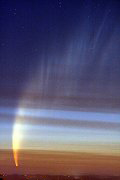 At spaceweather.com there are a lot of cool photos of Comet McNaught from the Southern Hemisphere.
 We may still be able to see part of the tail in the Northern Hemisphere. The brightest comet in 40+ years. "The comet has been dubbed the Great Comet of 2007."
More at space.com and SOHO.
Subscribe to:
Posts (Atom)