Tuesday, August 28, 2012

Unprecedented snow melt and heat in the European Alps


The recent heat wave in Europe has especially been anomalous at higher altitudes resulting in some of the highest Alpine peaks in Europe being snow-free for the first time on record including the iconic peak Matterhorn.

Early snow melt and record temps at mountain-top stations in the Alps

On August 19th the temperature at Jungfraujoch, Switzerland (the highest railway station in Europe) reached 12.8°C (55.0°F) the warmest temperature ever measured at this site where records began in 1937. This observatory is located at an elevation of 3580m (11,745’) just above the famous railway station. 

The significance of this is that this site has been studied by European climatologists for 75 years and is considered a 'bell-weather' location because of its long POR and isolation from surrounding possible human-induced influence. 


The Jungfraujoch Observatory of Switzerland  (not a recent photo)

The Jungfraujoch Observatory has the longest (since  1937) temperature time series of any high-altitude (3000m+) weather station in Europe. Graphic and caption from Meteo Swiss.


Another site on the border of Switzerland and Italy near the summit of Mt. Rosa (2nd highest mountain in the Alps after Mt. Blanc) named Capanna Regina Margherita (also known as Mt. Signalkuppe) and located at an elevation of 4554m (14,940’) registered a record temperature of 8.3°C (47.0°F) on August 20th. This surpassed its previous record high of 7.2°C (45.0°F) although records have only been kept here for about 15 years. The minimum temperature at the site that day was -0.1°C (31.8°F), also a record. This is the highest weather station in Europe. The Plateau Rosa near here is snow-free for the first time on record.

Aguille du Midi, a mountain in the Mt. Blanc massif in the French Alps, with an elevation of 3842m (12,605’) registered a high of 13.4°C (56.1°F) and low of 4.7°C (40.5°F) on August 19th, both records for the site since it was built in 1955. The peak is accessible by a cable car from the ski resort of Chamonix, France. Chamonix (elevation 1035m/3,396’) also recorded its all-time record warmest temperature on August 20th with a 34.4°C (93.9°F) reading. For the first time on record the peak of Aguille du Midi is now snow-free.

(not a recent photo)

For the first time in memory many of the highest Alpine peaks, including the iconic Matterhorn, have lost their entire snow cover (aside from glaciers). Sonnblick Observatory in Austria (located at 3030 m/9,940’) had its earliest snow melt on record this summer when the last of the winter snow disappeared by July 31st. The previous earliest snow melt (since records began here in 1886) was August 12th, 2003, the year of the famous European heat wave.


Alpine Glacier Melt


The Pasterze Glacier in Austria as photographed in 1875 (top) and then again in 2004 (bottom). Bottom photo by Gary Braasch.

It has been widely recognized (and researched) that most of Europe’s Alpine glaciers have been in retreat for the past 60 years or so. How much of this is due to solar radiation and how much to Global Climate Change remains a center of debate although it would seem that the two are related. An article in Geophysical Research Letters (Vol. 36, 2009) by M. Huss et al studied a 94-year time series of annual glacier melt at four high elevation sites in the Alps and found that the first massive melt off occurred in the late 1940s when “global shortwave radiation over the summer months was 8% above the long-term average and significantly higher than today”. Dimming of solar radiation from the 1950s until the 1980s reduced glacial melt rates. In the 1990s to the current time solar radiation has increased again but this time (since 2000) has also been accompanied by warmer summertime surface temperatures. Thus the glacial melt rates have exponentially increased in the past decade.

NASA released this statement at the annual AGU (American Geophysical Union) meeting in San Francisco last December (2011):

“Dec. 12, 2011: A new glacier inventory of the French Alps produced by Marie Gardent and colleagues at the University of Savoie has found that 100 square kilometers of glacier area has been lost between the early 1970s and today—a 26 percent loss. Using Landsat data together with historical aerial photography and maps, Gardent was able to evaluate and compare historic and contemporary glacier surface area.”

Tuesday, August 21, 2012

Mississippi River suffering from drought - and Fracking?


- Common Dreams

Climate change induced drought wreaks havoc on water highway

Continued drought conditions have brought the Mississippi River to its lowest level since 1988 and have lead the U.S. Coast Guard to close an 11-mile stretch of the river, backing up traffic on the heavily used waterway. In New Orleans, the levels mean salt water is creeping into the drinking supply.
Members of the Mississippi River Commission, which advises the U.S. Army Corps of Engineers on managing the river, met one of it stops in Caruthersville, Mo. on Monday during its annual low water inspection tour.  "The unofficial 28 day forecast is for no rain and if that happens, we will be approaching the water levels, the historic water levels of 1988 which means problems up and down the river system," said R.D. James with the Mississippi River Commission. "If we go below the water stages of 1988, I don't think there'll be enough dredges available even if we had the money to maintain the harbors and the channel from Cairo to the Gulf. It'd be tragic."
To keep the water at levels usable for cargo, the Army Corps of Engineers has set out a dozen dredging vessels to suck up sediment from the bottom of the river and spit it out to banks.
In The Lede blog in the New York Times discusssing the Mississippi River Commission's tour, John Schwartz subtley points out how factors beyond drought may be affecting river levels:  "Brig. Gen. Margaret W. Burcham, a member of the commission, said that on this year’s trip, gas drillers in North Dakota have expressed their need to use enormous quantities of water from the upper Mississippi for fracking [emphasis ours], but farmers farther downstream want that water for irrigation; while others want the water in the river so they can get their good to market on barges."
The low water levels in the river are bringing a drinking water crisis to the New Orleans area.  The low level coupled with the higher density of salt water is allowing water from the Gulf to travel upward affecting water supplies. To stop this, a $5.8 million underwater sill is being created by making a dam from sediment from further up the river.

Saturday, August 18, 2012

"Rare wildfires threaten Canadian polar bear habitat"

Chicago Tribune/Reuters

Wildfires sparked by lightning near Canada's Hudson Bay are threatening the habitat of polar bears, encroaching on the old tree roots and frozen soil where females make their dens, a conservation expert on the big, white bears said on Thursday.
Polar bears are more typically threatened by the melting of sea ice, which they use as platforms for hunting seals, their main prey. But those who live near Hudson Bay spend their summers resting up on shore when the bay thaws, living in dens dug in the frozen soil among the roots of stunted spruce trees.
Fires in this area are rare, said Steven Amstrup, a former polar bear specialist with the U.S. Geological Survey and now chief scientist at the nonprofit conservation organization, Polar Bears International.
"It's a cool, wet environment that doesn't burn very often," Amstrup said by telephone from Washington state. "It's not an environment where the forest is adapted to fires very much."
Unusually hot, dry weather in Manitoba, Canada, and lightning strikes caused several fires through Wapusk National Park across known polar bear dens in July, said Manitoba Conservation Officer Daryll Hedman.
Female polar bears in the western Hudson Bay population use dens under the root crowns of small, slow-growing spruce trees that grow in permafrost soils along the banks of rivers and lakes. Some dens have been used for over 100 years.
"Not only is the permafrost no longer permanent, tree roots needed to stabilize the den structure are disappearing," Amstrup said. "The kinds of habitats where mother polar bears in this area give birth to their cubs are simply disappearing as the world warms."
Historically, the soil in most areas around Hudson Bay is frozen solid below a surface layer about one foot thick that thaws and re-freezes seasonally, Amstrup said.
In recent years, that top layer of soil has gotten increasingly thicker, so the thawing goes deep enough to defrost the soil around the tree roots, making the openings that the bears dig collapse, Amstrup said.
When the trees burn, as some may this summer, their roots die out and further damage the polar bear dens, he said.
Unlike other polar bear populations, where pregnant females use dens dug in snow, Hudson Bay females come ashore to these tree-root dens to rest and give birth, remaining in the dens until the following spring.
"They're essentially food-deprived in the summertime. They come ashore and basically just rest and try to save energy. They crawl into these dens, it's cool in there, they're not harassed by insects and they basically just rest until the snow comes and until they give birth," Amstrup said.
Without these earthen dens, he said, females would not be able to conserve their energy as well. And if snow does not come early enough, cubs could be born out in the open, where they would be exceedingly vulnerable.
"Cubs are born at about a pound and a half (680 grams), blind, nearly hairless, essentially immobile and totally helpless," he said in a follow-up email. "Their survival depends upon the shelter of the den to protect them from the elements."
Polar bears have government protection in Canada and the United States. The U.S. polar bear population in Alaska is listed as threatened under the Endangered Species Act because of increasing damage to their icy habitat by climate change.

Monday, August 13, 2012

Fukushima Nuclear Disaster Caused Mutant Butterflies

From Common Dreams

Radioactive fallout from the Fukushima nuclear disaster caused mutations to butterflies, researchers show in a new study.
The study, published Thursday in the journal Scientific Reports, documented physiological and genetic damage to the pale grass blue Zizeeria maha, which was overwintering as larvae when the nuclear disaster began.
The researchers write that "the Zizeeria maha population in the Fukushima area is deteriorating physiologically and genetically. Most likely, this deterioration is due to artificial radionuclides from the Fukushima Dai-ichi NPP, as suggested by our field work and laboratory experiments."
"It has been believed that insects are very resistant to radiation," lead researcher Joji Otaki from the University of the Ryukyus, Okinawa, told BBC news.
"In that sense, our results were unexpected," said Otaki.
As ABC News explains the experiment,
Scientists first began tracking common butterflies around the nuclear plant two months after the disaster. They collected 121 insects, and found 12 percent of them had unusually small wings. That number jumped more than 5 percent when butterflies collected from the plant site had offspring of their own.
In another group of butterflies collected six months after the disaster, scientists found 28 percent had “abnormal” traits. That number nearly doubled among the second generation born.
Researchers noted other abnormalities including malformed antennae and appendages.

Thursday, August 09, 2012

"July Sizzles, Records Fall: Warmest Month on Record"

From ClimateCentral.org

July 2012 was officially not only the warmest July on record, but also the warmest month ever recorded for the lower 48 states, according to a report released Wednesday by the National Oceanic and Atmospheric Administration'sNational Climatic Data Center. The average temperature for the month came in at 77.6°F overall, which is 3.3°F higher than the 20th-century average, and 0.2°F warmer than the previous hottest month on record, set in July 1936 back in the Dust Bowl era.


It wasn’t just that July was a single-record month: the 12 months ending with July was the warmest such period since modern recordkeeping began in 1895, and the January-July 2012 period was also the warmest on record. The top 13 warmest 12-month periods since 1895 have all occurred since 1999.
The National Climatic Data Center also looked at precipitation: the average for July was 2.57 inches, which was 0.19 inches below average. That may not sound like much of a shortfall, but the nation’s midsection experienced near-record dryness.
The warmest 12-month periods for the lower 48 states. Click on the image for a larger version. Credit: NOAA/NCDC.

Overall, the so-called drought footprint for the states, excluding Alaska and Hawaii, covered nearly 63 percent of the total land area, according to the U.S. Drought Monitor. The drought is the most widespread and intense drought since at least 1956, and is expected to cost billions in damage to agricultural interests, as what was expected to be a bumper corn crop withered under unrelenting heat and dry conditions.
Extreme weather continued to plague the nation as well. The U.S. Climate Extremes Index, which keeps track of the highest and lowest extremes in temperatures, precipitation, and other events, stood at a record 46 percent for the period January-July, 2012, which is twice the average. That means that nearly half the country was affected by extreme weather conditions during the period. The record (42 percent) was last set in 1934 — again, during the Dust Bowl.
Much of the explanation for the currently high index is due to very warm daytime temperatures and warm overnight temperatures across a record-large area of the nation. The overnight warmth is what distinguishes July, 2012 from July, 1936. "In 1936," said NOAA scientist Jake Crouch in an interview, "the record was driven primarily by high daytime temperatures." In both cases, the daytime highs were driven in part by drought. When the soil is wet, Crouch said, "solar energy goes into evaporating moisture." When it's dry, the same energy goes into raising the thermometer.
Warm nights, however, don't have much to do with soil moisture, so they're a more robust signal that the planet is warming overall in response to increasing concentrations of greenhouse gases. They're also more dangerous than daytime heat. "Cooler temperatures at night let our bodies recover," Crouch said. 
As Climate Central reported yesterday, record daily high temperatures through August 5 of this year have already eclipsed the number of record daily highs set during all of 2011, a remarkable feat. For the year so far, record daily highs have been outpacing record daily lows by a ratio of nearly 10-to-1, which reflects the trend identified in a 2009 study on how temperature records are changing as the climate warms.


Monday, August 06, 2012

"Thousands of fish die as Midwest streams heat up"

From Yahoo:

LINCOLN, Neb. (AP) — Thousands of fish are dying in the Midwest as the hot, dry summer dries up rivers and causes water temperatures to climb in some spots to nearly 100 degrees.
About 40,000 shovelnose sturgeon were killed in Iowa last week as water temperatures reached 97 degrees. Nebraska fishery officials said they've seen thousands of dead sturgeon, catfish, carp, and other species in the Lower Platte River, including the endangered pallid sturgeon. And biologists in Illinois said the hot weather has killed tens of thousands of large- and smallmouth bass and channel catfish and is threatening the population of the greater redhorse fish, a state-endangered species.
So many fish died in one Illinois lake that the carcasses clogged an intake screen near a power plant, lowering water levels to the point that the station had to shut down one of its generators.
"It's something I've never seen in my career, and I've been here for more than 17 years," said Mark Flammang, a fisheries biologist with the Iowa Department of Natural Resources. "I think what we're mainly dealing with here are the extremely low flows and this unparalleled heat."
The fish are victims of one of the driest and warmest summers in history. The federal U.S. Drought Monitor shows nearly two-thirds of the lower 48 states are experiencing some form of drought, and the Department of Agriculture has declared more than half of the nation's counties — nearly 1,600 in 32 states — as natural disaster areas. More than 3,000 heat records were broken over the last month....
____
Anther article:

This summer’s unusually high temperatures and continuing drought are killing fish across the Great Lakes region.
“There’s nothing wrong water quality-wise,” said Randy Schumacher, fisheries supervisor for the Wisconsin Department of Natural Resources. “The species simply can’t tolerate that hot of water for this extended period of time.”
There were multiple reports of fish kills in early July across Michigan, Minnesota, Wisconsin, Indiana and Illinois, according to state fisheries supervisors. There have been at least 60 separate incidents in Illinois. About a dozen have been reported in Indiana....

Saturday, August 04, 2012

"Historic heat wave in Oklahoma"

From Jeff Master's Wunderground Blog:
A historic heat wave and drought fueled raging fires on Friday in Oklahoma. The fires destroyed at least 65 homes, forced multiple evacuations, and closed major roads. Oklahoma City had its hottest day in history, hitting 113°, tying the city's all-time heat record set on August 11, 1936. The low bottomed out at 84°, the warmest low temperature ever recorded in the city (previous record: a low of 83° on August 13, 1936.) Oklahoma City has now had three consecutive days with a high of 112° or higher, which has never occurred since record keeping began in 1891. With today's high expected to reach 113° again, the streak may extend to four straight days. Yesterday was the third consecutive day with more than a third of Oklahoma experiencing temperatures of 110° or higher, according to readings from the Oklahoma Mesonet. NOAA's Storm Prediction Center (SPC) declared a "Critical" fire weather day over most of Oklahoma yesterday, due to extreme heat and drought, low humidities, and strong winds. Between 4 - 5 pm CDT Friday, Oklahoma City had a temperature of 113°, a humidity of 12%, and winds of 14 mph gusting to 25 mph. Another "Critical" fire weather day has been declared for Saturday. A cold front approaching from the northwest will bring winds even stronger than Friday's winds, and Oklahoma will likely endure another hellish day of extreme heat, dryness, and fires.


The Geary, Oklahoma fire, looking north, on August, 3, 2012. Image credit: Oklahoma City Fire Department. The Geary fire spawned a gustnado

Only comparable heat wave: August 1936
The only heat wave in Oklahoma history that compares to this week's occurred in the great Dust Bowl summer of 1936, the hottest summer in U.S. history. Oklahoma City experienced three days at 110° that summer, and a record streak of 22 straight days with a temperature of 100° or hotter. Those numbers are comparable to 2012's: three days at 110° or hotter, and a string of 17 consecutive days with temperatures of 100° or hotter. It's worth noting that Oklahoma City has experienced only 11 days since 1890 with a high of 110° or greater. Three of those days were in 2011, three were in 2012, and three were in the great Dust Bowl summer of 1936. Clouds moved in over Tulsa, Oklahoma yesterday, holding down the high temperature to just 107°, ending that city's 3-day streak of 110°+ days. The only longer streak was 5 consecutive days on August 9 - 13, 1936. 

Tuesday, July 31, 2012

"Rare jellyfish appears in San Diego Bay"

Black jellyfish
From LA Times Blogs:
A rare species of jellyfish, distinguishable by its black color and long tentacles, is being spotted along a stretch of San Diego Bay popular with boaters.
With the formal name of Chrysaora achlyos, the so-called "black jellyfish" range from Monterey Bay to the tip of Baja California and seem to be making increasing appearances in San Diego-area waters, perhaps because the water is getting warmer.
This summer, they have been spotted near Shelter Island.
Stepping on the jellyfish, or otherwise coming into contact with one, can be a painful experience. The creatures have nettles that sting and immobilize their prey. Even a dead jellyfish carries a sting -- not enough to kill a human, but enough to be unpleasant.

The jellyfish's body can measure 3 feet in diameter, and the tentacles can be 25 feet or more in length.
-------
The black jellyfish (which can weigh 50 pounds) seem to like the Coronado beaches:

"Lobster shortage in Conn. is a warning"

From the Bangor Daily News.com:


By Hugh Bailey, Connecticut Post

Posted July 28, 2012, at 6:16 a.m.
If lobster is your thing, there’s never been a better time to splurge. Prices are at 30-year lows — below what lobstermen need to charge just to break even.
But they’re not coming from Connecticut. Aside from that 17-pounder liberated from a Niantic restaurant last week, the lobster situation in Long Island Sound is dire. After a spate of die-offs, the haul is about 1 percent of what it was just over a decade ago.
Lobstering is, or was, big business around here. And there have been all sorts of studies and efforts aimed at figuring out what happened, most focused on pesticides that find their way into the Sound. But there’s been nothing conclusive, so more studies are in order.
But there is a more plausible explanation that is for some reason considered controversial: Long Island Sound, like oceans and seas around the world, is heating up because of global climate change. What was once a hospitable habitat for lobsters is now, for the most part, too warm to support them in large numbers.
They’re doing fine just up the coast. It is true that Sound waters don’t circulate as well as the open ocean, but there’s no reason to think pesticides in Maine are any different than the ones we have here. The glut up there is sending prices so low this summer that some lobstermen say it doesn’t pay to catch them.
Experts here have noted that the die-offs have come in years when water temperatures increased. The pesticides don’t help, but it’s hard to see what another round of studies would tell us.
The global-warming-denial industry has gone through a few iterations. For a while it meant acknowledging the rising trend in temperatures but questioning humans’ role in making it happen. Lately, though, the data itself is questioned, which leads to supposed experts trying to deny that it’s hot outside, with every run of cool weather held up as proof that all the science is wrong.
It would be one thing if these were fringe attitudes, but there are U.S. senators pushing this line.
It’s never been clear just what the conspiracy theorists think is in it for the global-warming pushers. What are we supposed to get by believing this? On the other hand, anyone willing to claim it’s all a big hoax is welcomed with open arms by people who stand to profit by that sort of thing.
They don’t need to convince the public. They just need to sow some doubt. Make climate change seem controversial, as if it’s all still up in the air, and no one really knows for sure what’s going on out there. But we do know. And we know making necessary changes could cost certain people some big money.
So we do nothing. And eventually we’ll all pay.
And, sure, the fact that Greenland is melting into the ocean could be happenstance. The drought hitting most of the U.S. could be a coincidence. And maybe there’s something else to blame for all those lobsters dying.
But what we shouldn’t pretend is that this is some long-term hypothesis. This is happening now. It’s affecting the economy, right here in Connecticut. That’s a hundred-million-dollar lobstering industry in shambles, and it won’t be the last one to go.
In a saner world, this would be the talk of the presidential campaign. But since neither side is interested in tackling the issue, we’ll just keep ignoring it.
Officials and homeowners met in Fairfield last week to brainstorm ways to slow beach erosion caused by rising water levels. Expect a lot more of these kind of meetings in coming years.


"India blackouts leave 700 million without power"

From the Guardian:


More than 700 million people in India have been left without power in the world's worst modern blackout, prompting fears that protests and even riots could follow if the country's electricity supply continues to fail to meet growing demand.
Twenty of India's 28 states were hit by power cuts, along with the capital, New Delhi, when three of the five electricity grids failed at lunchtime.
As engineers struggled for hours to fix the problem, hundreds of trains stalled, leaving passengers stranded along thousands of miles of track from Kashmir in the north to Nagaland on the eastern border with Burma.
Traffic lights went out, causing widespread jams in New Delhi, Kolkata and other major cities. Operations were cancelled across the country, with nurses at one hospital just outside Delhi having to manually operate life-saving equipment when back-up generators failed.
Elsewhere, electric crematoriums stopped operating, some with bodies left half burnt before wood was brought in to stoke the furnaces.
As Delhiites sweated in 89% humidity and drivers honked their horns even more impatiently than usual, in West Bengal the power cut left hundreds of miners trapped underground for hours when their lifts broke down. All teh state's government workers were sent homeafter the chief minister announced it would take 10 to 12 hours for the power to return.
First to fail was the northern grid, which had also collapsed the previous day, leaving an estimated 350 million people in the dark for up to 14 hours. This was quickly followed by the eastern grid, which includes Kolkata, then the north-eastern grid.
An estimated 710 million people live in the affected area, ever more of whom require electricity as they snap up the air-conditioning units, flat-screen TVs and other gadgets that have become status symbols among India's burgeoning middle classes.
The two consecutive blackouts raised serious concerns about India's creaky infrastructure and the government's inability to meet its increasing appetite for energy as the country aspires to become a regional superpower....
At the beginning of July, repeated power cuts during a spell of 40C-plus heat prompted hundreds of residents to vandalise electricity substations in the new city of Gurgaon just outside Delhi. Rioters even beat up energy company officials, holding some of them hostage and blocking roads in several parts of the city.
But despite howls of protest from those whose TVs and computers were not working this week, one-third of India's households do not even have electricity to power a light bulb, according to the 2011 census.
A large minority of those in the blackout zone have never been connected to any grid – just 16.4% of the 100 million people who live in the central-eastern state of Bihar have access to electricity, compared with 96.6% in Punjab in the west.

Thursday, July 26, 2012

"Greenland ice sheet melted at unprecedented rate during July"

From the Guardian.UK:
"Scientists at Nasa admitted they thought satellite readings were a mistake after images showed 97% surface melt over four days"
Greenland ice sheet composite.View larger picture
The Greenland ice sheet on July 8, left, and four days later on the right. In the image, the areas classified as 'probable melt' (light pink) correspond to those sites where at least one satellite detected surface melting. The areas classified as 'melt' (dark pink) correspond to sites where two or three satellites detected surface melting. Photograph: Nasa

The Greenland ice sheet melted at a faster rate this month than at any other time in recorded history, with virtually the entire ice sheet showing signs of thaw.
The rapid melting over just four days was captured by three satellites. It has stunned and alarmed scientists, and deepened fears about the pace and future consequences of climate change....
The set of images released by Nasa on Tuesday show a rapid thaw between 8 July and 12 July. Within that four-day period, measurements from three satellites showed a swift expansion of the area of melting ice, from about 40% of the ice sheet surface to 97%.
Scientists attributed the sudden melt to a heat dome, or a burst of unusually warm air, which hovered over Greenland from 8 July until 16 July.
Greenland had returned to more typical summer conditions by 21 or 22 July, Mote told the Guardian.
But he said the event, while exceptional, should be viewed alongside other compelling evidence of climate change, including on the ground in Greenland.
"What we are seeing at the highest elevations may be a sort of sign of what is going on across the ice sheet," he said. "At lower elevations on the ice sheet, we are seeing earlier melting, melting later in the
season, and more frequent melting over the last 30 years and that is consistent of what you would expect with a warming climate."
Zwally, who has made almost yearly trips to the Greenland ice sheet for more than three decades, said he had never seen such a rapid melt.
About half of Greenland's surface ice sheet melts during a typical summer, but Zwally said he and other scientists had been recording an acceleration of that melting process over the last few decades. This year his team had to rebuild their camp, at Swiss Station, when the snow and ice supports melted.
_____

Meltwater from Greenland glacier wipes out key crossing

Scientists in Kangerlussuaq on western edge of ice sheet film runoff from glacier washing out roads and taking out a tractor

US Drought Monitor 7-24-2012

droughtmonitor.unl.edu/

I live in one of the "exceptional" areas - so this is hitting home. 
___
From weather.com:
The 2012 drought disaster is rapidly worsening in severity, especially over the nation's agricultural heartland, according to the latest weekly U.S. Drought Monitor report, released Thursday.While the area covered by the overall drought grew only slightly, the intensity increased alarmingly. 
Nationally, the percentage of the country in "extreme" to "exceptional" drought – the two worst categories on the scale – jumped from 13.53% to 20.57%. In other words, another 219,000 square miles was added to the area in extreme drought – an area slightly larger than the states of California and New York combined. 
All percentage figures refer to the contiguous 48 states: 
- The percentage of the country in "severe" drought (level 2) or worse set a new 21st-century high for the second straight week, rising from 42.23% last week to 45.57% this week. 
- The percentage of country in "exceptional" drought climbed from 0.99% last week to 2.38% this week – a considerable jump, but still well below the levels in the 2011 Southern Plains drought.

"Weather Extremes Leave Parts of U.S. Grid Buckling"


WASHINGTON — From highways in Texas to nuclear power plants in Illinois, the concrete, steel and sophisticated engineering that undergird the nation’s infrastructure are being taxed to worrisome degrees by heat, drought and vicious storms.
On a single day this month here, a US Airways regional jet became stuck in asphalt that had softened in 100-degree temperatures, and a subway train derailed after the heat stretched the track so far that it kinked — inserting a sharp angle into a stretch that was supposed to be straight. In East Texas, heat and drought have had a startling effect on the clay-rich soils under highways, which “just shrink like crazy,” leading to “horrendous cracking,” said Tom Scullion, senior research engineer with the Texas Transportation Institute at Texas A&M University. In Northeastern and Midwestern states, he said, unusually high heat is causing highway sections to expand beyond their design limits, press against each other and “pop up,” creating jarring and even hazardous speed bumps.
Excessive warmth and dryness are threatening other parts of the grid as well. In the Chicago area, a twin-unit nuclear plant had to get special permission to keep operating this month because the pond it uses for cooling water rose to 102 degrees; its license to operate allows it to go only to 100. According to the Midwest Independent System Operator, the grid operator for the region, a different power plant had had to shut because the body of water from which it draws its cooling water had dropped so low that the intake pipe became high and dry; another had to cut back generation because cooling water was too warm.
The frequency of extreme weather is up over the past few years, and people who deal with infrastructure expect that to continue. Leading climate models suggest that weather-sensitive parts of the infrastructure will be seeing many more extreme episodes, along with shifts in weather patterns and rising maximum (and minimum) temperatures.
“We’ve got the ‘storm of the century’ every year now,” said Bill Gausman, a senior vice president and a 38-year veteran at the Potomac Electric Power Company, which took eight days to recover from the June 29 “derecho” storm that raced from the Midwest to the Eastern Seaboard and knocked out power for 4.3 million people in 10 states and the District of Columbia.
In general, nobody in charge of anything made of steel and concrete can plan based on past trends, said Vicki Arroyo, who heads the Georgetown Climate Center at Georgetown University Law Center in Washington, a clearinghouse on climate-change adaptation strategies.
Highways, Mr. Scullion noted, are designed for the local climate, taking into account things like temperature and rainfall. “When you get outside of those things, man, all bets are off.” As weather patterns shift, he said, “we could have some very dramatic failures of highway systems.”
Adaptation efforts are taking place nationwide. Some are as huge as the multibillion-dollar effort to increase the height of levees and flood walls in New Orleans because of projections of rising sea levels and stronger storms to come; others as mundane as resizing drainage culverts in Vermont, where Hurricane Irene damaged about 2,000 culverts. “They just got blown out,” said Sue Minter, the Irene recovery officer for the state.
In Washington, the subway system, which opened in 1976, has revised its operating procedures. Authorities will now watch the rail temperature and order trains to slow down if it gets too hot. When railroads install tracks in cold weather, they heat the metal to a “neutral” temperature so it reaches a moderate length, and will withstand the shrinkage and growth typical for that climate. But if the heat historically seen in the South becomes normal farther north, the rails will be too long for that weather, and will have an increased tendency to kink. So railroad officials say they will begin to undertake much more frequent inspection.
Some utilities are re-examining long-held views on the economics of protecting against the weather. Pepco, the utility serving the area around Washington, has repeatedly studied the idea of burying more power lines, and the company and its regulators have always decided that the cost outweighed the benefit. But the company has had five storms in the last two and a half years for which recovery took at least five days, and after the derecho last month, the consensus has changed. Both the District of Columbia and Montgomery County, Md., have held hearings to discuss the option — though in the District alone, the cost would be $1.1 billion to $5.8 billion, depending on how many of the power lines were put underground.
Even without storms, heat waves are changing the pattern of electricity use, raising peak demand higher than ever. That implies the need for new investment in generating stations, transmission lines and local distribution lines that will be used at full capacity for only a few hundred hours a year. “We build the system for the 10 percent of the time we need it,” said Mark Gabriel, a senior vice president of Black & Veatch, an engineering firm. And that 10 percent is “getting more extreme.”...
Ms. Arroyo of Georgetown said the federal government must do more. “They are not acknowledging that the future will look different from the past,” she said, “and so we keep putting people and infrastructure in harm’s way.”

Wednesday, July 25, 2012

"Beijing's worst storms for 60 years kill at least 37"

From the Guardian.UKFlooded streets in Beijing after China's heaviest rain in six decades, with up to 460mm (18in) falling in some places since Saturday Link to this video
The heaviest rainstorm in Beijing in six decades has killed at least 37 people, flooded streets and stranded 80,000 people at the main airport, state media and the government said on Sunday.
The storm, which started on Saturday afternoon and continued late into the night, flooded major roads and sent torrents of water tumbling down steps into underpasses.
The Beijing city government said on its official microblog that at least 37 people had died, including 25 drowned, six crushed in collapsing homes, five electrocuted and one struck by lightning.
More than 500 flights were cancelled at Beijing's Capital International Airport, the Beijing News added.
The subway system was largely unaffected by the floods but was swamped with people desperate to get home and unable to use cars, buses or taxis.
The city received about 170mm (6.7 inches) of rain on average, but one township in Fangshan District to Beijing's west was hit by 460mm, Xinhua news agency said.
The Beijing city government said on its website it was working to get the metropolis back on its feet, and warned people to prepare for further bad weather.
"The weather forecasters say that from late July to early September this city is prone to flooding, and there could be further large-scale storms or extreme weather," it said.

Thursday, July 19, 2012


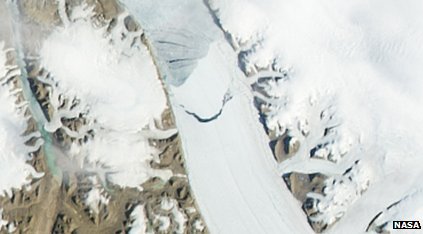
Iceberg twice the size of Manhattan breaking off the Peterman Glacier in Greenland. AP/NASA image.