Showing posts with label drought. Show all posts

Wednesday, April 30, 2014

California's Drought

Climatologist Who Predicted California Drought 10 Years Ago Says It May Soon Be ‘Even More Dire’

U.S. Drought Monitor forWest

BY JOE ROMM 

First, though, as I’ve reported, scientists a decade ago not only predicted the loss of Arctic ice would dry out California, they also precisely predicted the specific, unprecedented change in the jet stream that has in fact caused the unprecedented nature of the California drought. Study co-author, Prof. Lisa Sloan, told me last week that, “I think the actual situation in the next few decades could be even more dire that our study suggested.”
“Where the sea ice is reduced, heat transfer from the ocean warms the atmosphere, resulting in a rising column of relatively warm air,” Sewall said. “The shift in storm tracks over North America was linked to the formation of these columns of warmer air over areas of reduced sea ice.” In January, Sewall wrote me that “both the pattern and even the magnitude of the anomaly looks very similar to what the models predicted in the 2005 study (see Fig. 3a [below]).”
Here is what Sewall’s model predicted in his 2005 paper:
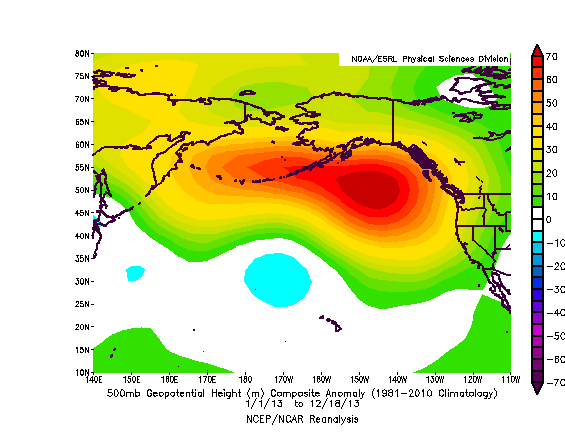
Figure 3a: Differences in DJF [winter] averaged atmospheric quantities due to an imposed reduction in Arctic sea ice cover. The 500-millibar geopotential height (meters) increases by up to 70 m off the west coast of North America. Increased geopotential height deflects storms away from the dry locus and north into the wet locus
“Geopotential height” is the height above mean sea level for a given pressure level. The “500 mb level is often referred to as the steering level as most weather systems and precipitation follow the winds at this level,” which is around 18,000 feet.
Now here is what the 500 mb geopotential height anomaly looked like over the last year, viaNOAA:

2013 anomaly
That is either a highly accurate prediction or one heck of a coincidence.
The San Jose Mercury News explained that “meteorologists have fixed their attention on the scientific phenomenon they say is to blame for the emerging drought: a vast zone of high pressure in the atmosphere off the West Coast, nearly four miles high and 2,000 miles long, so stubborn that one researcher has dubbed it the Ridiculously Resilient Ridge.” This high pressure ridge has been acting “like a brick wall” and forcing the jet stream along a much more northerly track, “blocking Pacific winter storms from coming ashore in California, deflecting them up into Alaska and British Columbia, even delivering rain and cold weather to the East Coast.
Last year, I contacted Sloan to ask her if she thought there was a connection between the staggering loss of Arctic sea ice in recent years and the brutal drought gripping the West, as her research predicted. She wrote, “Yes, sadly, I think we were correct in our findings, and it will only be worse with Arctic sea ice diminishing quickly.” Last week, Sloan wrote me:
Yes, in this case I hate that we (Sewall & Sloan) might be correct. And in fact, I think the actual situation in the next few decades could be even more dire that our study suggested. Why do I say that? (1) we did not include changes in greenhouse gases other than CO2; (2) maybe we should have melted more sea ice and see what happens; (3) these atmospheric and precipitation estimates do not include changes in land use, in the US and elsewhere. Changing crops, or urban sprawl increases, or melting Greenland and Northern Hemisphere glaciers will surely have an impact on precipitation patterns.
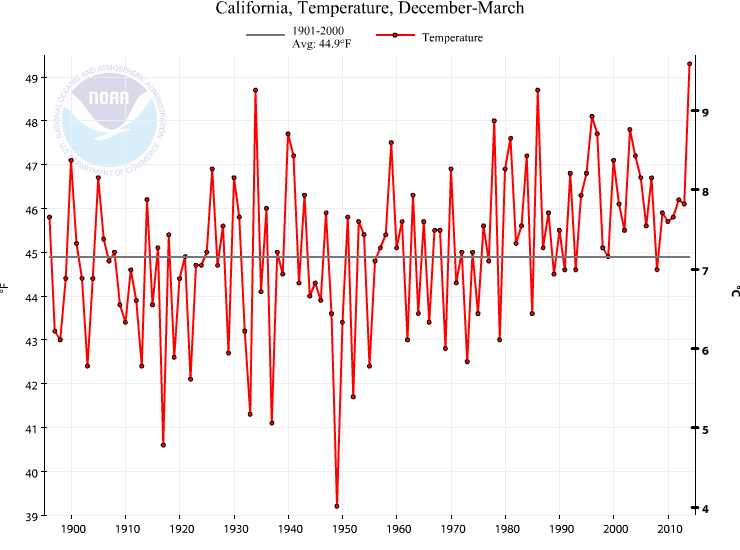
2013-2014 was California’s warmest winter on record. (NOAA/NCDC)
 The increasing trend in annual temperature in California over the past 118 years. (Source: NOAA). This trend mirrors the global increase.
_____________________________________________
_____________________________________________
From UJ:
This same phenomena that is causing the California drought is causing Alaska to get more warm air, which would warm the arctic more (presumably). It also is what pushed cold air down to the Midwest / Great Lakes region this past winter - referred to as the Polar Vortex. We had near record snowfalls, and were colder than usual. It also took longer than normal (by 3-4 weeks) for Spring to get here this year.
It is interesting to see the world as whole - departures from normal - below:


March 2014 land and sea surface temperature anomalies in degrees Celsius. NOAA

Tuesday, August 21, 2012

Mississippi River suffering from drought - and Fracking?


- Common Dreams

Climate change induced drought wreaks havoc on water highway

Continued drought conditions have brought the Mississippi River to its lowest level since 1988 and have lead the U.S. Coast Guard to close an 11-mile stretch of the river, backing up traffic on the heavily used waterway. In New Orleans, the levels mean salt water is creeping into the drinking supply.
Members of the Mississippi River Commission, which advises the U.S. Army Corps of Engineers on managing the river, met one of it stops in Caruthersville, Mo. on Monday during its annual low water inspection tour.  "The unofficial 28 day forecast is for no rain and if that happens, we will be approaching the water levels, the historic water levels of 1988 which means problems up and down the river system," said R.D. James with the Mississippi River Commission. "If we go below the water stages of 1988, I don't think there'll be enough dredges available even if we had the money to maintain the harbors and the channel from Cairo to the Gulf. It'd be tragic."
To keep the water at levels usable for cargo, the Army Corps of Engineers has set out a dozen dredging vessels to suck up sediment from the bottom of the river and spit it out to banks.
In The Lede blog in the New York Times discusssing the Mississippi River Commission's tour, John Schwartz subtley points out how factors beyond drought may be affecting river levels:  "Brig. Gen. Margaret W. Burcham, a member of the commission, said that on this year’s trip, gas drillers in North Dakota have expressed their need to use enormous quantities of water from the upper Mississippi for fracking [emphasis ours], but farmers farther downstream want that water for irrigation; while others want the water in the river so they can get their good to market on barges."
The low water levels in the river are bringing a drinking water crisis to the New Orleans area.  The low level coupled with the higher density of salt water is allowing water from the Gulf to travel upward affecting water supplies. To stop this, a $5.8 million underwater sill is being created by making a dam from sediment from further up the river.

Saturday, August 04, 2012

"Historic heat wave in Oklahoma"

From Jeff Master's Wunderground Blog:
A historic heat wave and drought fueled raging fires on Friday in Oklahoma. The fires destroyed at least 65 homes, forced multiple evacuations, and closed major roads. Oklahoma City had its hottest day in history, hitting 113°, tying the city's all-time heat record set on August 11, 1936. The low bottomed out at 84°, the warmest low temperature ever recorded in the city (previous record: a low of 83° on August 13, 1936.) Oklahoma City has now had three consecutive days with a high of 112° or higher, which has never occurred since record keeping began in 1891. With today's high expected to reach 113° again, the streak may extend to four straight days. Yesterday was the third consecutive day with more than a third of Oklahoma experiencing temperatures of 110° or higher, according to readings from the Oklahoma Mesonet. NOAA's Storm Prediction Center (SPC) declared a "Critical" fire weather day over most of Oklahoma yesterday, due to extreme heat and drought, low humidities, and strong winds. Between 4 - 5 pm CDT Friday, Oklahoma City had a temperature of 113°, a humidity of 12%, and winds of 14 mph gusting to 25 mph. Another "Critical" fire weather day has been declared for Saturday. A cold front approaching from the northwest will bring winds even stronger than Friday's winds, and Oklahoma will likely endure another hellish day of extreme heat, dryness, and fires.


The Geary, Oklahoma fire, looking north, on August, 3, 2012. Image credit: Oklahoma City Fire Department. The Geary fire spawned a gustnado

Only comparable heat wave: August 1936
The only heat wave in Oklahoma history that compares to this week's occurred in the great Dust Bowl summer of 1936, the hottest summer in U.S. history. Oklahoma City experienced three days at 110° that summer, and a record streak of 22 straight days with a temperature of 100° or hotter. Those numbers are comparable to 2012's: three days at 110° or hotter, and a string of 17 consecutive days with temperatures of 100° or hotter. It's worth noting that Oklahoma City has experienced only 11 days since 1890 with a high of 110° or greater. Three of those days were in 2011, three were in 2012, and three were in the great Dust Bowl summer of 1936. Clouds moved in over Tulsa, Oklahoma yesterday, holding down the high temperature to just 107°, ending that city's 3-day streak of 110°+ days. The only longer streak was 5 consecutive days on August 9 - 13, 1936. 

Thursday, July 26, 2012

US Drought Monitor 7-24-2012

droughtmonitor.unl.edu/

I live in one of the "exceptional" areas - so this is hitting home. 
___
From weather.com:
The 2012 drought disaster is rapidly worsening in severity, especially over the nation's agricultural heartland, according to the latest weekly U.S. Drought Monitor report, released Thursday.While the area covered by the overall drought grew only slightly, the intensity increased alarmingly. 
Nationally, the percentage of the country in "extreme" to "exceptional" drought – the two worst categories on the scale – jumped from 13.53% to 20.57%. In other words, another 219,000 square miles was added to the area in extreme drought – an area slightly larger than the states of California and New York combined. 
All percentage figures refer to the contiguous 48 states: 
- The percentage of the country in "severe" drought (level 2) or worse set a new 21st-century high for the second straight week, rising from 42.23% last week to 45.57% this week. 
- The percentage of country in "exceptional" drought climbed from 0.99% last week to 2.38% this week – a considerable jump, but still well below the levels in the 2011 Southern Plains drought.

Thursday, July 19, 2012

The Heat Goes On


 The US drought with record high temperatures continues. Other places like the UK are having record rainfall. Japan also had severe flooding from the rain.

Record High Temps in Red (lows in blue) 7-17--7-19

101 degrees on one side of the rain, 74 degrees on the other


This is corn in Brownsburg, IN.
The rain events have been spottier than usual. A small storm popping up, dropping a little rain, dissipating.

We hear thunder and get a few drops.

The map with the weather stations is from a couple of days ago - a storm got some areas and temporarily a relief from the 100 degree heat.

Owen County, Indiana, where I live, is in the official disaster area.

Fortunately we continue to have water in our well. We aren't wasting any (much). I water a few pots and recently planted blueberries a little. We hope we can make it until the drought is over (I hope it will be over).

Much is dry. The grass doesn't grow - we don't worry about it. Most of the established trees seem fine. Some have dried and dropped some leaves already.

Farmers are having a tough time.

The dried up lake with boats is Morse Reservoir - just north of Indianapolis. It's not completely dried up - just the shallower parts. Morse, Geist and Eagle Creek are where Indy gets their water.


Morse Reservoir showing drought effects


Saturday, June 30, 2012

It's hot.... and dry

We could use some rain.


Thursday's significant temperature records:

• 109° in Chesterfiled, Missouri (well short of state monthly record of 112°)• 108° in Lawrenceville, Illinois (ties all-time state June monthly record of 108° at Palestine in June 1954)• 108° in Huntingsburg, Indiana (well short of state monthly record of 111°)• 107° in Defiance, Ohio (1° short of all-time state June record-108° in Germantown in 1934)• 111° in Evening Shade, Arkansas (short of state June record of 113° in 1936)• 108° in Smyrna, Tennessee (short of 110° state record in 1936)• 107° in Little Rock, Arkansas (all-time June monthly record)
From the Weather Underground - Jeff Masters
The Amazing June Heat Wave of 2012

One of the most intense heat waves in U.S. history has enveloped portions of the western plains and Midwest and has now spread eastward. All-time heat records have fallen at a number of significant weather stations. And it is still just June. Is this a prelude for the coming summer or just a flash in the pan? 

June had been a warm but not excessively so month until around June 20-23rd when an upper level high pressure dome that had been centered over the Baja of Mexico began to move/expand northeastward and strengthen dramatically. Between June 23 and June 27 this dome remained nearly stationary over the southern plains and maintained its strength.


The water vapor image for 3Z on June 23 shows a deep trough over the Pacific Ocean west of California amplifying the high pressure ridge over the southwest and southern plains. Image from UNYSYS GOES West satellite.


he air aloft became so abnormally warm that the NWS office in Dodge City focused on how intense the air aloft was in their daily discussions. At the 850 millibar level (about 5000’) the temperature was averaging an amazing 30°C (86°F) at the 5 a.m. (12Z) observation times on June 23-27!

The heat at surface level reached its greatest extent on June 26th, although the period of all-time records broken ranged from June 23 to June 27.

Here is a surface temperature map for 5p.m CST time on June 26:


Could this be the Beginning of Another ‘Summer of 1936'?

The only previous June heat waves in U.S. history that compare to the current one were those of 1934, 1936, and 1954. The summer of 1934 went on to be the warmest on record for the U.S. (74.6° June-August average) and July 1936 the single hottest month on record (77.4° average).

Ominously, some of the June records that have so far been set this month have eclipsed those of June 1934 and 1936 (1954 turned out be a summer of only slightly above long-term average normal temperature).


From the Weather Underground blog - by  Christopher C. Burt

Wednesday, October 19, 2011

"Mexico's newest export to US: Water"

From msnbc.com:

SAN DIEGO — Mexico ships televisions, cars, sugar and medical equipment to the United States. Soon, it may be sending water north.

Western states are looking south of the border for water to fill drinking glasses, flush toilets and sprinkle lawns, as four major U.S. water districts help plan one of two huge desalination plant proposals in Playas de Rosarito, about 15 miles south of San Diego. Combined, they would produce 150 million gallons a day, enough to supply more than 300,000 homes on both sides of the border.

The plants are one strategy by both countries to wean themselves from the drought-prone Colorado River, which flows 1,450 miles from the Rocky Mountains to the Sea of Cortez. Decades of friction over the Colorado, in fact, are said to be a hurdle to current desalination negotiations.

The proposed plants have also sparked concerns that American water interests looking to Mexico are simply trying to dodge U.S. environmental reviews and legal challenges.

Desalination plants can blight coastal landscapes, sucking in and killing fish eggs and larvae. They require massive amounts of electricity and dump millions of gallons of brine back into the ocean that can, if not properly disposed, also be harmful to fish.

But desalination has helped quench demand in Australia, Saudi Arabia and other countries lacking fresh water....

Water agencies that supply much of Southern California, Phoenix, Las Vegas and Tijuana, Mexico, are pursuing the plant that would produce 50 million gallons a day in Rosarito near an existing electricity plant. They commissioned a study last year that found no fatal flaws and ordered another one that will include a cost estimate, with an eye toward starting operations in three to five years.

Potential disagreements between the two countries include how the new water stores will be used.

The U.S. agencies want to consider helping pay for the plant and letting Mexico keep the water for booming areas of Tijuana and Rosarito. In exchange, Mexico would surrender some of its allotment from the Colorado River, sparing the cost of laying pipes from the plant to California.

Mexico would never give up water from the Colorado, which feeds seven western U.S. states and northwest Mexico, said Jose Gutierrez, assistant director for binational affairs at Mexico's National Water Commission. Mexico's rights are enshrined in a 1944 treaty.

"The treaty carries great significance in our country. We have to protect it fiercely," Gutierrez said.

The San Diego County Water Authority is also considering a plant at Southern California's Camp Pendleton that would produce up to 150 million gallons a day. Poseidon wants to build one in Huntington Beach, near Los Angeles, that would churn out 50 million gallons a day. Those ideas face significant challenges....

The San Diego agency wants to get 10 percent of the region's water from desalination by 2020 as a way to lessen its dependence on the Colorado River, which is connected by aqueduct about 200 miles away. Tijuana also wants to rely less on the river, a priority that gained urgency after a 2010 earthquake knocked out its aqueduct for about three weeks.

Thursday, July 14, 2011

US Drought Map as of July 12, 2011


D0 ... Abnormally Dry ... used for areas showing dryness but not yet in drought, or for areas recovering from drought.

Drought Intensity Categories
D1 ... Moderate Drought
D2 ... Severe Drought
D3 ... Extreme Drought
D4 ... Exceptional Drought

Drought or Dryness Types
A ... Agricultural
H ... Hydrological

For more maps - see: http://drought.unl.edu/dm/monitor.html

Sunday, July 03, 2011

During Texas drought - lots of water going to Fracking

From Grist.org:

Texas is experiencing the driest eight-month period in its recorded history. But in 2010, natural gas companies used 13.5 billion gallons of fresh water for hydraulic fracturing, and that could more than double by 2020. Where's all this water coming from? Oh, it was just lying around, in these aquifers! You guys weren't using it to drink or irrigate or anything, right? Guys?

Crockett County, Tx., near San Angelo (which you probably also haven't heard of, but it's not near much else), has gotten less than two inches of rain since October. But water for fracking could soon make up 25 percent of the county's water usage, according to its groundwater conservation manager. Fracking takes between 50,000 and 4 million gallons for a single well, on average, and could take as many as 13 million gallons. And most of that water is gone for good -- 75 percent of it can't be recovered.

Fracking works with brackish water, the stuff that's not really useful for drinking or irrigation. The equipment is just so precious and delicate, though -- we wouldn't want it getting gummed up! "[G]iven the specific sort of engineering and pressure they're using, it's better to have fewer impurities in the water, so fresh water works better," says the president of the pro-oil Permian Basin Petroleum Association. Thank goodness the same can't be said of people and animals and crops!

Wednesday, June 29, 2011

"Horn of Africa sees 'worst drought in 60 years'"

From the BBC:

More than 10 million people are thought to be affected across the region.

The UN now classifies large areas of Somalia, Ethiopia, Djibouti and Kenya as a crisis or an emergency.

Charity Save the Children says drought and war in Somalia has led to unprecedented numbers fleeing across the border into Kenya, with about 1,300 people arriving every day.

Three camps at Dadaab, just inside Kenya, are home to well over 350,000 people, but they were built to hold just 90,000 and are severely overcrowded.

A prolonged failure of rains, which began in late 2010, is now taking its toll.

The UN's Office for the Co-Ordination of Humanitarian Affairs (Ocha) warns that the situation is continuing to deteriorate, and the number of people in need will continue to increase.

The numbers now affected are huge, Ohca says: 3.2m in Ethiopia, 3.2m in Kenya, 2.6m in Somalia and more than 100,000 in Djibouti.

Every month during 2011, about 15,000 Somalis have fled their country, arriving in Kenya and Ethiopia, according to Ocha.

While conflict has been a fact of life for them for years, it is the drought that has brought them to breaking point. Many have walked for days, are exhausted, in poor health, desperate for food and water.

Nearly one third of all children in the Juba region of Somalia are acutely malnourished, while in parts of Ethiopia the figure is even higher, the UN research says. Parts of Uganda are also suffering from the drought.

Sunday, June 19, 2011

"China evacuates 500,000 as flooding breaks worst drought in 50 years"

From the Guardian.UK:


China has evacuated more than 500,000 people from deadly floods that are devastating areas in the south of the country following the worst drought in 50 years.

At least 105 people have been swept to their deaths or killed in landslides and another 65 are missing after rivers burst their banks. The authorities have issued the highest level of alarm about dykes and dams under dangerous pressure.

Television channels that were only recently broadcasting images of dried-up lake beds are now carrying footage of flooded homes and boats plying their way through inundated streets. China Daily said 550,000 people have been forced to leave their homes.

The dramatic shift is in line with weather trends identified by the Beijing Climate Centre, which says rain is coming in shorter, fiercer bursts, interspersed by protracted periods of drought.

The worst affected province is Zhejiang, where some stretches of the Qiantang river have risen to their highest level since 1955, according to the Flood Control and Drought Relief Office.

In the Zhuji district, which has had 40.5cm of rain since the start of the month, the Puyang river inundated 88 villages and 13,000 hectares of crops.

In neighbouring Jiangxi province, troops have helped 122,400 residents evacuate from vulnerable lowlands, according to the China News Service. Roads have been closed and bridges have collapsed in the floods, which have also affected Hubei, Hunan, Sichuan and Guizhou provinces.

Monitoring stations on 40 rivers have recorded water levels above the safety limit, including Asia's biggest waterway – the Yangtze – which is simultaneously suffering a flood downstream and a drought closer to its source.

Monday, October 25, 2010

"Severe drought afflicts Brazilian Amazon"

From the BBC:

The money will fund water pumping and purification, as well as food deliveries to towns cut off by the drop in river levels.

The Brazilian air force has already flown 500 tonnes of supplies to areas that usually depend on water transport.

The River Amazon at Manaus has fallen to its lowest level since 1963.

Scientists say the region is facing its worst drought since that year.

In Amazonas state 27 municipalities have declared a state of emergency because of the dry spell.

Several tributaries of the Amazon have almost completely dried up, paralysing river transport and the fishing industry.

The rainy season in the region usually begins in November.

The Peruvian Amazon, 2,000km (1,240 miles) upstream has also been affected.

Environmental groups say severe droughts are likely to become more frequent in the Amazon as a result of global warming, putting further strain on the rainforest.

The Amazon is the world's second-longest river, after the Nile, but discharges far more water from its mouth and drains more territory.

Tuesday, October 12, 2010

"Huge Parts of World Are Drying Up..."

From Science Daily:

The soils in large areas of the Southern Hemisphere, including major portions of Australia, Africa and South America, have been drying up in the past decade, a group of researchers conclude in the first major study to ever examine "evapotranspiration" on a global basis.

Most climate models have suggested that evapotranspiration, which is the movement of water from the land to the atmosphere, would increase with global warming. The new research, published online this week in the journal Nature, found that's exactly what was happening from 1982 to the late 1990s.

But in 1998, this significant increase in evapotranspiration -- which had been seven millimeters per year -- slowed dramatically or stopped. In large portions of the world, soils are now becoming drier than they used to be, releasing less water and offsetting some moisture increases elsewhere.

Due to the limited number of decades for which data are available, scientists say they can't be sure whether this is a natural variability or part of a longer-lasting global change. But one possibility is that on a global level, a limit to the acceleration of the hydrological cycle on land has already been reached.

If that's the case, the consequences could be serious.

They could include reduced terrestrial vegetation growth, less carbon absorption, a loss of the natural cooling mechanism provided by evapotranspiration, more heating of the land surface, more intense heat waves and a "feedback loop" that could intensify global warming.

"This is the first time we've ever been able to compile observations such as this for a global analysis," said Beverly Law, a professor of global change forest science at Oregon State University. Law is co-author of the study and science director of the AmeriFlux network of 100 research sites, which is one major part of the FLUXNET synthesis that incorporates data from around the world.

"We didn't expect to see this shift in evapotranspiration over such a large area of the Southern Hemisphere," Law said. "It is critical to continue such long-term observations, because until we monitor this for a longer period of time, we can't be sure why this is occurring."

Some of the areas with the most severe drying include southeast Africa, much of Australia, central India, large parts of South America, and some of Indonesia. Most of these regions are historically dry, but some are actually tropical rain forests.

Greater evapotranspiration was expected with global warming, because of increased evaporation of water from the ocean and more precipitation overall. And data indeed show that some areas are wetter than they used to be.

However, other huge areas are now drying out, the study showed. This could lead to increased drought stress on vegetation and less overall productivity, Law said, and as a result less carbon absorbed, less cooling through evapotranspiration, and more frequent or extreme heat waves.

Tuesday, August 10, 2010

Pakistan Floods, African Drought, and more

From the Guardian.co.uk:
Villagers surrounded by floodwater rush to pick up relief supplies dropped from an army helicopter in the Mithan Kot area of central Pakistan. Photograph: Khalid Tanveer/AP


Regions across the world have been buffeted by extremes of weather, drought and floods. Sometimes an area is hit by one extreme, followed soon after by another, Niger being a case in point. In the case of floods in Pakistan, the Met Office says high pressure over Russia has forced the jet stream much further south than usual this year and this pattern has remained almost stationary over recent weeks. Therefore low pressure has been sitting over Pakistan longer than normal, intensifying the monsoon rains. "The extremes of rainfall are getting heavier and are entirely consistent with climate change predictions," said Helen Chivers, a spokeswoman with the Met Office.

Asia

In China rescuers used shovels and bare hands as they struggled today to save survivors of a major mudslide in the north-west, where blocked roads hindered vehicles trying to reach the disaster scene. At least 337 people were killed and 90 injured when landslides and flood waters engulfed Zhouqu county in Gansu province late on Saturday night. But with more than 1,100 people still missing, the death toll is likely to grow. Flooding across many provinces has killed more than 1,450 people this year and forced 12 million to flee their homes, but the Zhouqu landslide is the worst single incident. Experts had warned of the dangers of soil erosion in the area, known to be prone to mudslides. In spring south-western China was hit by drought, described as the worst in a century. In June south-east China, which had also endured drought, was hit by devastating floods. Southern China experiences flooding almost every summer, but the Beijing climate centre says extreme weather events have increased in recent years, with longer droughts and rain falling in more intense and damaging bursts. Pakistan's floods were caused by monsoon rains, described as the worst since 1929. The Pakistan meteorological department said that at one point 12 inches (300mm) of rain fell over a 36-hour period. Water levels in the river Indus, which cuts down the middle of Pakistan and has most of the population huddled around it, are said to be the highest in 110 years. The torrents, having ravaged the north-west, are now gushing deeper into Pakistan. The authorities have evacuated people living alongside expanding rivers as forecasts predicted further heavy rain that could worsen the country's flood crisis. The UN has raised its forecast of the number of people affected to six million and said the scale of the crisis was similar to the 2005 earthquake that hit northern Pakistan. About 1,600 people have died in the floods.

Africa

A severe drought is causing increasing hunger across the Eastern Sahel in west Africa, affecting 10 million people in four countries. In Niger, the worst-affected country, 7.1 million are hungry, with nearly half considered highly food insecure because of the loss of livestock and crops coupled with a surge in prices. Last year exceptionally heavy rainfall destroyed crops and devastated this year's harvest in the region. The resulting fall in production in staples like maize, millet and sorghum has affected much of West Africa's Sahel – fragile in the best of times – including neighbouring Chad and northern Nigeria.

Latin America

In April floods and mudslides struck the state of Rio de Janeiro, Brazil, after the heaviest downpours in four decades, leaving at least 212 people dead. The favelas, the shanty towns built on the hillsides of the city of Rio de Janeiro, were badly hit. Floods struck again in June, this time in the states of Alagoas and Pernambuco, over 1,200 miles north-east of Rio de Janeiro. At least 1,000 people were unaccounted for.

Europe

Southern Poland suffered its worst flooding in decades in May after heavy rains engorged rivers sending torrents of water through Bogatynia in south-west Poland and Görlitz in eastern Germany. The UK experienced the driest first six months of the year since 1929, which led to the imposition of a hosepipe ban covering 6.5 million people in north-west England. Russia experienced generally dry and hot weather starting around late May. Temperatures of 35C (95F) first occurred after 12 June, which alone was abnormal for the country, as average mid-June temperatures seldom rise above 30C ). Moscow and St Petersburg both recorded temperatures as high as 42C on 3, 4 and 5 July. Average temperatures in the region increased to over 35C. In early August, President Dmitry Medvedev declared a state of emergency in seven regions as firefighters struggled to contain about 600 blazes covering an estimated 309,000 acres (125,000 hectares).

Friday, July 23, 2010

"...U.S. Counties Face Water Shortages Due to Climate Change"


From NRDC:

Greatest Risks Seen in 14 States: AZ, AR, CA, CO, FL, ID, KS, MS, MT, NE, NV, NM, OK and TX;

WASHINGTON (July 20, 2010) -- More than 1,100 U.S. counties -- a full one-third of all counties in the lower 48 states -- now face higher risks of water shortages by mid-century as the result of global warming, and more than 400 of these counties will be at extremely high risk for water shortages, based on estimates from a new report by Tetra Tech for the Natural Resources Defense Council (NRDC).

The report uses publicly available water use data across the United States and climate projections from a set of models used in recent Intergovernmental Panel on Climate Change (IPCC) work to evaluate withdrawals related to renewable water supply. The report finds that 14 states face an extreme or high risk to water sustainability, or are likely to see limitations on water availability as demand exceeds supply by 2050. These areas include parts of Arizona, Arkansas, California, Colorado, Florida, Idaho, Kansas, Mississippi, Montana, Nebraska, Nevada, New Mexico, Oklahoma, and Texas. In particular, in the Great Plains and Southwest United States, water sustainability is at extreme risk.

The more than 400 counties identified as being at greatest risk in the report reflects a 14-times increase from previous estimates. For a look at county- and state-specific maps detailing the report findings (including a Google Earth map), go to http://www.nrdc.org/globalWarming/watersustainability/ and http://rd.tetratech.com/climatechange/projects/nrdc_climate.asp.

While detailed modeling of climate change impacts on crop production was beyond the scope of the Tetra Tech analysis, the potential scale of disruption is reflected based on the value of the crops produced in the 1,100 at-risk counties. In 2007, the value of the crops produced in the at-risk counties identified in the report exceeded $105 billion. A separate study compared the Tetra Tech data with county-level crop production data from the U.S. Department of Agriculture; state-specific fact sheets outlining the potential agricultural impacts may be found at http://agcarbonmarkets.com/Science.htm....

Saturday, July 17, 2010

In Russia, Worst Drought In 130 Years

(Reuters) - Soaring temperatures across large swathes of Russia have destroyed nearly 10 million hectares of crops and prompted a state of emergency to be declared in 17 regions.

On Friday the state-run Moscow region weather bureau said it expected the heatwave, which has gripped the country since late June and is estimated to have already cost the agricultural sector about $1 billion, to continue into next week.

Saturday could see temperatures in Moscow hit 37 Celsius (98.6 Fahrenheit), which would break the previous record of 36.6C. set in 1936.

"It looks like tomorrow could just break the record," the weather bureau's Moscow head Yelena Timakina said.

The high temperatures and tinder dry land have exacerbated the problem of forest fires. Billowing smoke and orange flames encircle Moscow as peat and forest fires resist attempts to extinguish them.

A state of emergency due to what the grain lobby says is the country's worst drought in 130 years, has now been imposed in 17 Russian regions, up from 16 earlier this week.

The area affected sprawls from the southern Urals and central European Russia to the Volga, the Agriculture Ministry said in a statement on Friday. A state of emergency might be declared in a further two regions.

As of Thursday crops on a combined area of 9.6 million hectares have been destroyed. This comprises some 12 percent of all lands sown to crops in Russia, or a territory roughly the size of Hungary.

Thursday, January 28, 2010

"Eastern Syria grapples with drought, poverty"

From Reuters:

DAMASCUS - Syrian officials addressing a rare public forum have revealed the full impact of a drought that ravaged the 2008 wheat crop and displaced hundreds of thousands of people in the east of the country.

The officials recommended diversifying the eastern Syrian economy and finding alternatives to subsidized cash crops, whose cultivation has severely depleted water resources, mainly in the eastern region along the River Euphrates.

The officials, speaking at a forum that is a rare reminder of the "Damascus Spring" democracy movement snuffed out in 2001, recognized they faced a huge challenge, tackling high levels of poverty, unemployment and illiteracy, and low investment.

Rainfall in eastern Syria fell to 30 percent of the annual average in 2008 -- the worst drought for 40 years -- and al-Khabour, a main tributary of the River Euphrates, dried up, they told the meeting on Tuesday.

The region's wheat crop fell by about half to 1.3 million tonnes that year, and the number of people displaced is estimated at between 300,000 and one million, though there are no official figures.

"We must plan an overhaul that includes an integrated economy, health and education, not just agricultural production," said Hassan Katana, head of statistics and planning at the agriculture ministry.

Poverty levels stand at 80 percent and the region's investment budget is only $17.4 million, according to Khader al-Muhaisen of the government-backed Peasants Union.

Infrastructure in the east, which accounts for the bulk of Syria's grain and cotton output, has fallen into disrepair.

Illiteracy is rising because the education system has been neglected, and many of those displaced by the drought have moved to Damascus, Aleppo and Hamah where they live as squatters.

Syria was an important Middle East wheat exporter before the drought began in 2007, while the water table had already been depleted by the thousands of illegal wells sunk to irrigate subsidized wheat.

Official figures put national wheat output at 2.1 million tonnes in 2008 against 4.1 million in 2007, rising to 3.8 million last year.

The state controls the production and marketing of wheat and cotton, part of the command economy imposed by the Baath Party when it took power in 1963, banned all opposition and imposed emergency laws that are still in force.

Katana said the government had already reduced the area allocated for cotton production because of the lack of water, but he did not expect cash-strapped farmers to obey the order.

"All our agricultural resources have been used up. The real challenge is to develop strategies and know-how to provide for new economic activity in this region," Katana said.

Poverty is widespread in the east, although it produces all of Syria's 375,000 barrels per day of oil and contains some of the world's most important sites of antiquity, such as the Greco -Roman city of Dura Europos, called the "Pompeii of the desert."

The region is also home to a substantial Kurdish minority, tens of thousands of whom have been effectively shut out of mainstream society since the 1960s when they were excluded from a national census.

Atieh al-Hindi, head of the National Agriculture Policy Center, said the government subsidies policy had helped to improve living standards in the east but had contributed to its water shortage...

Sunday, January 17, 2010

"Drought drives Middle Eastern pepper farmers out of business..."

From Grist:

Most Turks live on the water’s edge in the far western reaches of their vast country. But many of the spices that perfume the air in Turkey’s famous urban bazaars come from the nation’s southeastern farming areas of Sanliurfa and Kahramanmaras. In fact, spices from this region rank among the most highly prized condiments and herbs you can find in any spice emporium anywhere.

As I wandered through the Misir Carsisi Spice Bazaar in Istanbul, and the Kemeralti Bazaar at the western terminus of the Silk Road in Izmir, I could see the chile powders, pastes and dried fruits from Sanliurfa and Kahramanmaras proudly and prominently displayed.

Urfa and Maras peppers from Turkey have the same international fame that Aleppo (Halaby) peppers do from Syria, Tabascos do from Louisiana, or Habaneros do from the Yucatan. But their prices are soaring and supplies are becoming scarce—not merely because of international demand, but because of drought and agricultural water scarcity triggered by global climate change.

The same climate-driven pressures are affecting the survival of the Halaby pepper and its traditional farmers near Aleppo, Syria. In the past three years, 160 Syrian farming villages have been abandoned near Aleppo as crop failures have forced over 200,000 rural Syrians to leave for the cities. This news is distressing enough, but when put into a long-term perspective, its implications are staggering: many of these villages have been continuously farmed for 8000 years. As one expert puts it, this may be the worst long-term drought and most severe set of crop failures since agricultural civilizations began in the Fertile Crescent many millennia ago.

The thousands of tourists and residents who purchase Urfa and Maras chiles in Istanbul’s Spice Bazaar may not yet realize it, but their access to these world class spices is being disrupted by climate change. Since 2007, rains in some forty Turkish provinces, northern Syria and eastern Iraq have been 30 percent to 40 percent of their normal levels. The drought in southeastern Anatolia has reduced harvests by 80 percent. In Syria, 60 percent of the agricultural lands have been affected by these droughts.

In Iraq, 2 million rural residents have been left without water. Many irrigation canals remain dry, as the only water reaching rivers like the Euphrates is being usurped by cities upstream. Downstream on the Tigris-Euphrates delta, saltwater intrusion is making domestic water unpotable. Between the three countries, perhaps five million people have been directly affected...

Tuesday, October 06, 2009

"UN warns of 70 percent desertification by 2025"

BUENOS AIRES (AFP) — Drought could parch close to 70 percent of the planet's soil by 2025 unless countries implement policies to slow desertification, a senior United Nations official has warned.

"If we cannot find a solution to this problem... in 2025, close to 70 percent could be affected," Luc Gnacadja, executive secretary of the United Nations Convention to Combat Desertification, said Friday.

Drought currently affects at least 41 percent of the planet and environmental degradation has caused it to spike by 15 to 25 percent since 1990, according to a global climate report.

"There will not be global security without food security" in dry regions, Gnacadja said at the start of the ninth UN conference on the convention in the Argentine capital.

"A green deal is necessary" for developing countries working to combat drought, he stressed.

The next meeting on the convention is scheduled to take place in South Korea in 2010.

Thursday, September 24, 2009

Sydney dust storm 'like Mars'


From the BBC:

A storm which blew in from the Australian outback blanketed Sydney in a layer of orange dust. Here, residents describe the bizarre and frightening scene.

Tanya Ferguson said the dust was the weirdest thing she had seen in her life, turning the city into a scene from another planet.
"It was like being on Mars," she told the BBC News website.

"I haven't been there, obviously, but I imagine that's what the sky would look like."

She said she woke to a massive gust of wind blowing through her windows early in the morning.

"The whole room was completely orange. I couldn't believe my eyes," she said.

Ms Ferguson said she initially thought there was a bush fire. When she finally decided to venture outside, she said the entire city was covered in a film of orange dust.

"All the cars are just orange - and the orange was so intense," she said by phone from Sydney, where she has lived for the past six years.

Sydney dust storm worst in 70 years, says weather bureau

The dust cloud covers almost the whole of NSW, after an extreme low pressure system moved across the state from central Australia and western NSW.

The dust caused commuter chaos, the cancellation of flights from Sydney Airport, the closure of the M5 tunnel and the suspension of Sydney ferries.

People with respiratory illnesses were told to stay indoors and health authorities advised people to avoid exercise until the dust cleared.

The Bureau of Meteorology's Regional Director for New South Wales Barry Hanstrum said visibility at Sydney Airport had dropped as low as 400m.

“An event like this is extremely rare,” Mr Hanstrum said. “It's one of the worst, if not the worst.”

The Bureau of Meteorology issued a severe weather warning for damaging winds in Sydney with a gale warning issued for Sydney closed waters.

Wild winds are lashing the Hunter region and gale force winds of up to 100km/h are expected to hit Sydney.

Global warning: Sydney dust storm just the beginning

It is the natural consequence of a very long drought, and the probable onset of another El Nino effect. The storm today is unusual in that particles were carried as far as the coast.

What seems certain is that future dust storms will get more frequent and probably bigger, as the climate warms. Along with other firmly grounded projections such as an increase in bushfires and a drop in rainfall, we can expect more dust storms in the coming decades as a consequence of climate change.

Reports from farmers in outback NSW suggest a surge in the number of storms in the past few years, as topsoil is dried and exposed to winds.

It may look like Doomsday, but the causes of today's storm are relatively prosaic.

Tiny particles lifted from the desert in South Australia are wafted high into the air and carried east. The ruddy haze is caused by sunlight refracting through iron-rich dust.

If it were possible to scrape the film of dust coating outdoor surfaces across Sydney together into a heap, it would probably weigh something like 1000 tonnes - equal to the huge storm that blanketed Melbourne in 1983.