Friday, November 30, 2012

"Study Gives New Benchmark for How Much Ice is Melting"


From Climate Central by Michael Lemonick


The vast ice sheets that cover Greenland and Antarctica have begun melting and sliding into the ocean as heat-trapping greenhouse gases continue to build in the atmosphere. How much and how fast the ice is disappearing, however, has been poorly understood, because the satellites that measure it haven’t always agreed. But a report published Thursday in Science has cleared up much of the uncertainty.
A team of no fewer than 47 scientists from 36 laboratories, looking at data from 10 different satellites, has come up with numbers everyone is on board with: between 1992 and 2011, Greenland has lost 152 billion metric tons of ice, while Antarctica has shed 71 billion, contributing 11 millimeters to the rise in sea level over that period — about a fifth of the total (the rest has come from seawater expanding as it warms).

“The new estimates,” lead author Andrew Shepherd, of the University of Leeds, said in a press conference, “are the most reliable to date. They end 20 years of uncertainty.”

The estimates don't change projections about what’s likely to happen for the rest of this century. Scientists’ best estimate is that that the ocean, which has risen an average of 8 inches since 1900, should rise another 3 feet or so by 2100. But without a truly accurate record of how much melting has already occurred, it’s hard to know how good that projection is. It will also be hard to be certain if the melting starts to speed, or slow.
“This [study] provides a nice baseline. It’s really the start of the reliable record,” said co-author Ben Smith, of the University of Washington, at the press conference...
Scientists working on data from all 10 came together, and compared results from exactly the same time periods for exactly the same regions within Antarctica and Greenland. It was somewhat analogous to photographing a scene not with a single camera, but with 10 different cameras looking from 10 different perspectives: you get a much richer picture of what’s going on. 
In particular, Shepherd said, scientists can now start to pinpoint changes in ice region by region, and figure out what’s happening in each place.
For example, the ice sheet in East Antarctica, which holds by far the most ice, is actually growing slightly, because of an increase in snowfall. “That’s consistent with climate warming because you expect more evaporation and therefore more rain and snow,” Shepherd said.
By contrast, the smaller ice sheets in West Antarctic and the Antarctic Peninsula are losing ice more quickly. “In general,” said co-author Ian Joughin of the University of Washington in an interview, “this is due to heat from the ocean. We’re doing lots of work trying to understand the melting going on beneath ice shelves.”

Friday, November 02, 2012

Robert Redford's message


American Determination and Climate Change


I'm so struck with America's human spirit as Hurricane Sandy has left a trail of destruction in its wake, destroying homes and businesses and turning the lives of so many upside down. And yet people remain unbowed -- New Yorkers and New Jerseyans, first responders, hospital workers, National Guard and countless others -- are pulling together, as they always do, in the face of tragedy. And this would be the case whether or not a Presidential election were running in the background.
But elections are, indeed, running in the background of this human consequence and the inspiration we are seeing from countless citizens is exactly the kind of determination and collective responsibility we're going to need to fight climate change -- the force that super-charged this "superstorm." It will take resourcefulness and grit to reduce the carbon pollution that's fueling these storms, but Hurricane Sandy proves once again we have it.
The question is: Will we use it?
Many lawmakers and fossil fuel companies don't want us to unleash America's ingenuity on the problem of climate change. Oil, gas, and coal companies have spent more than $150 million on campaign ads in this election, and their talking points are echoed on the campaign trail.
Nearly every contender for the GOP's presidential nomination denied climate change and called for more dirty fuels. Mitt Romney -- who supported climate action when he was governor of Massachusetts -- has joined the crowd. At the Republican National Convention, he mocked President Obama's promise to slow the rise of the oceans and heal the planet.
Romney's comment drew laughs in the conventional hall. But there was nothing funny about being in New York or New Jersey when Hurricane Sandy's storm surge breeched seawalls and swamped entire neighborhoods. This is what I find so troubling about climate deniers. By ignoring the scientific facts, they dishonor the human suffering brought on by climate change....
 We know how to power our economy with clean, renewable energy that doesn't run out and doesn't pollute. President Obama has presided over the largest increase in renewable energy in our nation's history. He has also issued new fuel economy standards that will cut carbon emissions from new cars in half and save drivers $1.7 trillion at the pump.

On Thursday, New York Mayor Bloomberg endorsed Obama, citing Hurricane Sandy, climate change, and the need for presidential leadership. Governor Romney, meanwhile, opposes those standards and wants to end wind incentives. If he becomes president, no doubt we can expect a surge in fossil fuels pollution and more climate paralysis....
I put my faith in young people to be a driving force in answering this challenge and maybe demanding that the childishness around climate change in Washington stop, immediately. They know their generation will pay the price if America doesn't start confronting climate change now.

Superstorm Sandy Crashes Ashore

The disaster was also made worse because of the full moon high tide.

Essentially the NYC area got to see what rising sea levels will look like for the area. It is likely Sandy will be what it takes to get people moving on at least protecting the city. Perhaps we will see more movement on reducing emissions & alternative energy. Let's hope so. We are long past due.


ABC Synopsis :
Ferocious superstorm Sandy barrelled into the East Coast this evening, driving a record storm surge that flooded coastal areas from Delaware to Connecticut, and knocking out power to millions of people from New York City to Ohio. 
The center of the storm made landfall just south of Atlantic City, N.J., around 8 p.m., shortly after it had been downgraded from a hurricane to a post-tropical storm. But the lowering in status was no reflection of the power the storm still packed. 
It brought with it a record 13.88-foot storm surge at the southern tip of Manhattan, breaking the mark of 10.02 feet set in 1960's Hurricane Donna. 
Shortly after the storm surge began flooding into lower Manhattan, the lights started going off throughout that part of the city. By 11 p.m., some 250,000 customers were without power, as nearly a quarter of the borough was in the dark. 
With the high winds and pounding rains that lashed much of the eastern United States, there were blackouts from downed trees and flooding throughout the region.
There were an estimated 2.5 million customers without power in the New York metropolitan area alone. 
Hours before Sandy's arrival on land, power was being cut to New York City's financial district amd most of Atlantic City was already under several feet of water as waves crashed over the sea wall, spitting up chunks of the famed boardwalk. 
Power went out in much of lower Manhattan as water poured over the seawalls. Storm surge combined with the high tide, caused a breach the led to flooding on both the east and west sides of the island. 
High winds crippled a crane atop a skyscraper, leaving it dangling ominously above the city, tore branches from trees and ripped fixtures from skyscrapers, making walking the city's darkened streets like a scene from a video game... 
Sandy was packing top winds of 80 mph and waves are approaching 20 feet off the coast of Long Island and have exceeded 30 feet off the coast of the Carolinas, according to the National Hurricane Center. 
The turbulent weather has brought much of the region's transportation to a halt. Paralyzed airports have stranded people all over the country. Over 10,000 flights have been cancelled so far, according to Flight Aware. It is grounding planes throughout Europe since they can't land at their U.S. destinations.

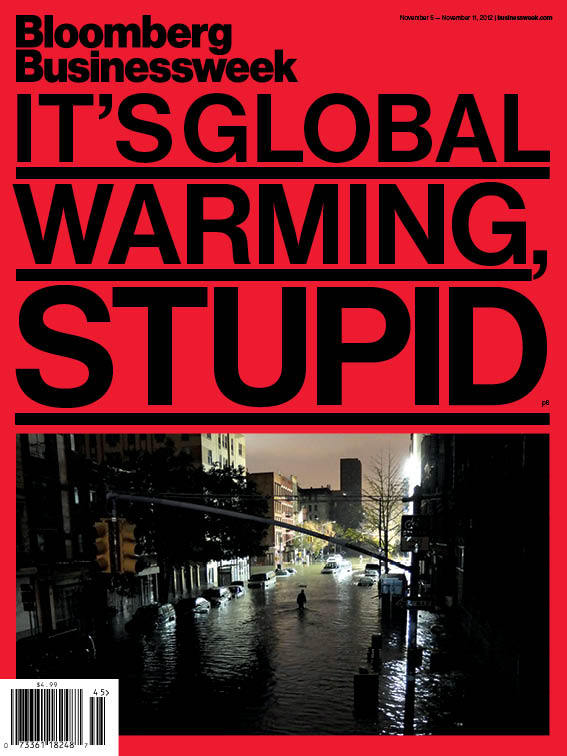
Hurricane Sandy and Global Warming

bloomberg businessweek sandy

It's nice that there are some business people who can acknowledge the truth.

From the Bloomberg article: 
The broadening consensus: “Climate change amps up other basic factors that contribute to big storms. For example, the oceans have warmed, providing more energy for storms. And the Earth’s atmosphere has warmed, so it retains more moisture, which is drawn into storms and is then dumped on us.” Even those of us who are science-phobic can get the gist of that.
Sandy featured a scary extra twist implicating climate change. An Atlantic hurricane moving up the East Coast crashed into cold air dipping south from Canada. The collision supercharged the storm’s energy level and extended its geographical reach. Pushing that cold air south was an atmospheric pattern, known as a blocking high, above the Arctic Ocean. Climate scientists Charles Greene and Bruce Monger of Cornell University, writing earlier this year in Oceanography, provided evidence that Arctic icemelts linked to global warming contribute to the very atmospheric pattern that sent the frigid burst down across Canada and the eastern U.S.


New York Mayor Michael Bloomberg (founder of the Bloomberg Businessweek) endorsed Obama, following the Hurricane, because (among other things) Obama at least does not go around denying and mocking Global Warming. Some of us have been disappointed that he has not made it more of an issue. I assume he must be under threat of retaliation from Big OIl or something. Why else not speak out? It's the major issue of our time.

The Economist also endorses Obama - at least partly because Romney flip-flops too much.


(Steve) Forbes magazine and the Wall Street Journal continue to deny, deny, deny global warming. Forbes article following Sandy was, 

"Leave It To The Global Warming Alarmists To "Make Fake Lemonade" Out Of Hurricane Sandy"
AT SEA - OCTOBER 28: In this handout satellite...
(NOAA), Hurricane Sandy, October 28, 2012 

The Denialists say, 

"Sorry Global Warming Alarmists, The Earth Is Cooling"
"That is one of the most interesting conclusions to come out of the seventh International Climate Change Conference sponsored by the Heartland Institute..."  Conference held in May 2012 - Chicago
Not that they have any evidence - they just say that - to confuse people, to create the appearance of a debate. The Heartland Institute promotes something it calls, "Free Market Environmentalism."

"The Heartland Institute and its ilk are not trying to build a theory of anything. They have set the bar much lower, and are happy muddying the waters." Nature 7/2011

Hurricane Sandy hit home for a lot of people - what with putting lower Manhattan out of commission. Flooding, subways shut down, power out - on Wall Street, no less.


PHOTO: Lower Manhattan dark

(Bebeto Matthews/AP Photo)

Wednesday, October 03, 2012

Bhutan Pledges to be First 100% Organic Nation

Good for them! :)

From CommonDreams:

The small nation of Bhutan, nestled in the Himalayas between China and India, is committed to becoming the first "hundred percent organic" nation.

Farmers in Bhutan hope to be 100 percent organic in ten years. Photo by *christopher* via flickrAt the Rio+20 Conference on Sustainable Development in June, Prime Minister Jigmi Thinley announced that his government is developing a National Organic Policy and a plan to convert 100% of his nation's agricultural land to organic farms. The policy's goal is to phase out artificial chemicals in farming over the next 10 years.
"Bhutan has decided to go for a green economy in light of the tremendous pressure we are exerting on the planet," Agriculture Minister Pema Gyamtsho toldthe Agence France-Presse. "If you go for very intensive agriculture it would imply the use of so many chemicals, which is not in keeping with our belief in Buddhism, which calls for us to live in harmony with nature."
The Himilayan kingdom of 700,000 became a pioneer in 1972 when Bhutan's fourth Dragon King, Jigme Singye Wangchuck coined the term "Gross National Happiness" and announced that the nation would measure their success based on well-being and other Buddhist spiritual values rather than economic measures. This value rating has been publicly embraced by the United Nations and other countries worldwide. Other measures Bhutan has taken to ensure their quality of life include banning television until 1999 and deterring mass tourism to protect its culture from foreign influence.
According to Gyamtsho, Bhutan's chemical use is already "very low" by international standards. He explained, "only farmers in areas that are accessible by roads or have easy transport have access to chemicals." The majority of farmers are already organic and rely on rotting leaves or compost as a natural fertilizer. Two-thirds of the country depend on farming the nation's 7.8 percent arable which is peppered among the plains in the south and the Himalayan peaks to the north.
The Prime Minister is employing a step-by-step strategy to going organic: "We have identified crops for which we can go organic immediately and certain crops for which we will have to phase out the use of chemicals, for rice in certain valleys for example." Staple food exports include of wheat, exotic mushrooms, red rice, potatoes and fruits.


Gyamtsho released a report (pdf) explaining that the organic program is not just about protecting the environment. It will also train farmers in new methods that will help them grow more food and, consequently, move the country closer to self-sufficiency. Bhutan has sent a number of farmers to India to study at Vanadana Shiva's organic training farm and has invited consultants from the farm to help educate locals so they can help other Bhutanese farmers transition to organic.
The Prime Minister had said in his speech that his goal is for the 'Raised in Bhutan' label to be "synonymous with 'organically grown.'" In addition to the obvious ecological benefits, the Bhutan Observer notes that the hope is for the program is to "pursue organic farming as the finest recourse to alleviate rural poverty in the country."
There is a growing market for organic goods in neighboring countries, like India, with a growing middle class. Nadia Scialabba, global specialist on organic farming at the UN's Food and Agriculture Organization, told the AFP that this trend is "happening in very small countries who are not competitive on quantity, but they would like to be competitive in quality."

Thursday, September 13, 2012

"‘Astonishing’ Ice Melt May Lead to More Extreme Winters"

From Climate Central:

The record loss of Arctic sea ice this summer will echo throughout the weather patterns affecting the U.S. and Europe this winter, climate scientists said on Wednesday, since added heat in the Arctic influences the jet stream and may make extreme weather and climate events more likely.

The “astounding” loss of sea ice this year is adding a huge amount of heat to the Arctic Ocean and the atmosphere, said Jennifer Francis, an atmospheric scientist at Rutgers University in New Jersey. “It’s like having a new energy source for the atmosphere.” Francis was one of three scientists on a conference call Wednesday to discuss the ramifications of sea ice loss for areas outside the Arctic. The call was hosted by Climate Nexus.


The extent of Arctic sea ice on Aug. 26, 2012, the day the sea ice dipped to its smallest extent ever recorded in more than three decades of satellite measurements. The line on the image shows the average minimum extent from the period covering 1979-2010. Click on the image for a larger version. Credit: NASA/JPL.On August 26, Arctic sea ice extent broke the record low set in 2007, and it has continued to decline since, dropping below 1.5 million square miles. That represents a 45 percent reduction in the area covered by sea ice compared to the 1980s and 1990s, according to the National Snow and Ice Data Center (NSIDC), and may be unprecedented in human history. The extent of sea ice that melted so far this year is equivalent to the size of Canada and Alaska combined.
The loss of sea ice initiates a feedback loop known as Arctic amplification. As sea ice melts, it exposes darker ocean waters to incoming solar radiation. The ocean then absorbs far more energy than had been the case when the brightly colored sea ice was present, and this increases water and air temperatures, thereby melting even more sea ice.
Peter Wadhams, the head of the polar ocean physics group at the University of Cambridge in the U.K., told BBC News on September 6 that the added heat from sea ice loss is equivalent to the warming from 20 years of carbon dioxide emissions. Carbon dioxide is the main greenhouse gas that is causing manmade global warming.
During the fall, when the sun sets once again and the Arctic Ocean begins to refreeze, the heat in the ocean gets released back into the atmosphere. Since the jet stream, which is a corridor of strong winds at upper levels of the atmosphere that generally blows from west to east across the northern mid-latitudes, is powered by the temperature difference between the Arctic and areas farther south, any alteration of that temperature difference is bound to alter the jet stream — with potentially profound implications. It just so happens that the jet stream steers day-to-day weather systems.
Francis published a study last year in which she showed that Arctic warming might already be causing the jet stream to become more amplified in a north-south direction. In other words, the fall and winter jet stream may be getting wavier. A more topsy-turvy jet stream can yield more extreme weather events, Francis said, because weather and climate extremes are often associated with large undulations in the jet stream that can take a long time to dissipate.
While there are indications that the jet stream is slowing and may be more prone to making huge dips, or “troughs,” scientists have a limited ability to pinpoint how this will play out in the coming winter season.
“The locations of those waves really depends on other factors,” Francis said, such as El Niño and a natural climate pattern known as the Arctic Oscillation. “I can only say that it’s probably going to be a very interesting winter,” she said.
Francis’ work has linked Arctic warming to the unusually cold and snowy winters of 2009-10 and 2010-11, during which the U.S. East Coast and parts of Europe were pummeled by fierce winter storms and experienced cooler-than-average conditions. The winter of 2011-12 was much milder, by comparison, but Francis said it, too, was consistent with her research. Not all meteorologists agree on the Arctic connection theory, but that may change with time.
Jim Overland, an oceanographer at NOAA's Pacific Marine Environmental Laboratory, said the inconsistency of the past three winters doesn’t mean the Arctic connection hypothesis is invalid.
“People like direct causality, [the notion that] if you lose the ice every year it will cause the same effect,” Overland said. But the chaotic nature of the atmosphere means that all that scientists can say with a high degree of confidence is that “the number of [extreme] events somewhere are destined to increase” as a result of rapid Arctic climate change, Overland said.

"Scotts Miracle-Gro to Pay Record Fines for Poisoning Birds and Selling Illegal Pesticides"

By Mike Ludwig, Truthout | Report


Tainted, mislabeled pesticides added to the company's wild bird seed resulted in countless wildlife deaths, massive product recalls and unprecedented civil and criminal penalties.  

America's leading lawn care company is in big trouble for potentially poisoning wild birds across the country, and lying to the government and consumers about pesticide products.

Before a voluntary recall in 2008, The Scotts Miracle-Gro Company sold 70 million units of wild bird feed that was illegally treated with an insecticide that is dangerously toxic to wild birds, fish and other wildlife. The Marysville, Ohio-based company must now pay $12.5 million in criminal and civil penalties that regulators say are the heftiest ever issued under federal pesticide law.

It's practically impossible to quantify how many wild birds and other wildlife were impacted by Scotts' crimes against nature, but a federal court in Ohio fined the company $4 million, plus $500,000 worth of environmental community service, after Scotts pleaded guilty to distributing the poisonous bird feed and other crimes involving mislabeled and unregistered pesticides.

In a separate civil agreement with the EPA, which launched a civil investigation after the criminal violations were discovered, Scotts agreed to pay $6 million in fines and donate $2 million to environmental projects. Regulators also are touting this settlement as the largest in the history of the Federal Insecticide, Fungicide and Rodenticide Act (FIFRA), which has regulated pesticides since 1947.

Scotts plead guilty to selling consumers wild bird feed that was poisonous to birds, along with deceiving regulators by falsifying pesticide registration documents, distributing pesticides with misleading and unapproved labels, and distributing unregistered pesticides. Misuse and mislabeling of pesticides can cause illness in humans and kill wildlife, and as a result of the settlement, a "significant number" of potentially harmful pesticides will be removed from the market, according to the EPA...

Scotts added the pesticides Storcide II and Actellic 5E to the wild bird feed to prevent insect infestations while the product was in storage, but the company apparently ignored the warning label on Storcide II that specifically states the pesticide is toxic to birds, fish and other wildlife. Scotts sold the tainted bird feed for two years after it began marketing the product, and for six months after company employees alerted management to the danger posed by the pesticides, according to the EPA.
Scotts also pleaded guilty to submitting falsified documents to the EPA and state regulatory agencies in an effort to deceive regulators into believing that the chemical formulas were registered with the EPA, when they were not...

As the criminal violations came to light, the EPA launched a review of Scotts' pesticide registrations that uncovered a list of civil violations. For at least five years, Scotts had made nationwide sales of canceled, unregistered and misbranded pesticide products, including products with inadequate warnings or cautions on their labels...

EPA regional spokesperson Josh Singer told Truthout that, during the civil investigation, Scotts complied with 40 orders to stop the sale of more than 100 Scotts products that were in violation of federal law. Scotts also paid a third-party reviewer to check the compliance status of the company's products, and shared that information with the government.

Here's a list of Scotts products involved in the EPA settlement:
• Banrot Broad Spectrum Fungicide 40 percent Wettable Powder),
• Basics Solutions Weed & Grass Killer Concentrate
• Brush-B-Gon Poison Ivy & Poison Oak Killer
• Contrast 70 WSP
• Duosan WSB Wettable Powder Turf and Ornamental Fungicide
• ORTHO Bug-B-Gon MAX Lawn & Garden Insect Killer Ready-To-Spray ORTHO Bug B Gon MAX Lawn & Garden Insect Killer Concentrate ORTHO Bug-B-Gon Multi-Purpose Insect Killer Ready-To-Use Granules (aka Ortho Bug B Gon Lawn & Soil Insect Killer with Grub Control
• ORTHO Home Defense Max (aka Ortho Home Defense Indoor and Outdoor Insect Killer)
• ORTHO Malathion 50 Insect Spray
• ORTHO Orthonex Insect & Disease Control Formula III Concentrate
• ORTHO ProSelect Roach, Ant & Spider Killer
• ORTHO Weed B Gon Weed Killer for Lawns Concentrate Total Kill Lawn Weed Killer (aka Weed-Be-Gon Spot Weed Killer and Basic Solutions Lawn Weed Killer)


Tuesday, August 28, 2012

"Whatever You Call it, Water is Rising in Norfolk"


By Jennifer Weeks, The Daily Climate
NORFOLK, Va. — Water is inescapable in Virginia's second-largest city, home to the world's biggest naval base, three major port facilities and public and private shipyards. Norfolk is nearly surrounded by water: it sits at the mouth of the mouth of the Chesapeake Bay and the junction of the Elizabeth and James Rivers. Canals and creeks penetrate into many neighborhoods, and home sale listings highlight water access — "Within 50 feet of H2O — You can canoe and kayak!"
Yet as much as water is a resource in Norfolk and the surrounding area, known as Hampton Roads, it also represents a threat.
City and county leaders, already burdened with typical tasks of local governance — zoning, construction permits, liquor licenses, school board appointments — are also weighing multi-million-dollar flood control projects to keep the ocean at a livable distance. 
While they struggle to pull together know-how and funding, those with the broader view and resources — state agencies — are absent from the discussions: In a study released earlier this year, the Natural Resources Defense Council ranked Virginia as one of 29 states that were "largely unprepared and lagging behind" on planning for climate change at the state level.
In many ways the problem is already upon Norfolk. The Atlantic Ocean off Virginia's coast is rising a quarter of an inch annually, equivalent to two feet in 100 years — faster than anywhere else in the United States except for coastal Louisiana. The ocean at Sewells Point, site of the Norfolk Naval Station, rose 14.5 inches between 1930 and 2010. And that's likely to accelerate. Last month the U.S. Geological Survey reported that sea levels are rising more quickly along the Atlantic coast from North Carolina to Massachusetts than globally, possibly as a result of slowing Atlantic Ocean circulation patterns.
Planning for climate change is not a winning political platform in Virginia. Republican Governor Bob McDonnell said in 2010 that "to what degree [climate change] is attributable to manmade causes is a matter I will leave up to the experts," and shelved a climate change action plan proposed by a commission under his Democratic predecessor. Attorney General Ken Cuccinelli made headlines in 2010 for investigating University of Virginia climate scientist Michael Mann, and again this year for trying unsuccessfully to block the Environmental Protection Agency from regulating greenhouse gases. 
But whatever state leaders think of climate change, local officials find they can't ignore increasingly apparent street-level impacts. 
Rain and a storm surge associated with Hurricane Isabel floods a parking lot at the Norfolk Naval Station parking lot.

Most of Norfolk is less than 15 feet above sea level, and low-lying neighborhoods already flood regularly when heavy rains combine with high tides, swamping storm-water systems. The worst flooding in memory happened in 1933, when a hurricane and five-foot storm surge left residents wading thigh-deep on downtown streets. If sea levels rise between two and five feet in the area by 2100, as recent studies predict, that could become routine. Even now, city maps show that the surge from a Category Three hurricane would inundate nearly the entire city. 
In the wettest zones, streets are studded with "for sale" signs. "I know people who can't find buyers for their houses," said Skip Stiles, executive director of Wetlands Watch, a statewide advocacy group, on a drive through a historic neighborhood called The Hague. The area fronts on a canal and floods regularly. Telltale signs are easy to spot. Evaporating salt water leaves rusty stains on street curbs. Repeated overflows have killed grass in waterfront parks, leaving stretches of bare ground. Spartina, a salt-tolerant marsh grass, is sprouting on slopes above canals and marinas.
At the entrance to the Chrysler Museum of Art, which faces the estuary, Stiles paused. "There are usually ducks swimming around the front steps here after storms." 

'Recurrent Flooding'

Last spring delegates from the Hampton Roads area sought money from the General Assembly to study how sea-level rise could affect coastal Virginia. After Tea Party activists objected to spending money on climate science, the topic was changed to "recurrent flooding" and passed. Local officials hope the report will convince lawmakers to help communities pay for flood control projects. That won't happen until next year at the earliest, after state legislators review scientists' projections.
The long-term average rate of sea-level rise in Hampton Roads is about one foot per century, but that pace has accelerated sharply recently, which makes it challenging to gauge future rates of change. 
This question has become a political issue in other coastal states — notably North Carolina, where the state's Coastal Resources Commission issued a report, based on the latest computer models, advising coastal communities to plan for up to 39 inches of sea-level rise by 2100, well beyond historic norms. North Carolina's Republican-majority legislature, backed by developers, initially barred the commission from planning on anything beyond historic rates of change, then compromised by telling commissioners to study the issue for four more years before developing a new model for sea-level rise.


"Tens of thousands join Japan protests"


Broad dissatisfaction with govt's handling of Fukushima and restart of nuclear reactors
TOKYO - This is Japan's summer of discontent. Tens of thousands of protesters descend on Tokyo every Friday evening to shout anti-nuclear slogans at the Prime Minister's office.

"I used to complain about this to my family but I realised that doesn't do any good," said a protester. "So I came here to say this to his office. I don't know if we can make a difference but I had to do something, and at least it's a start."

The government's much-criticised handling of the Fukushima nuclear crisis has spawned a new breed of protesters in Japan, especially after the government decided to restart two nuclear reactors in June.

Drawn from the ranks of ordinary citizens rather than activists, they are a manifestation of a broader dissatisfaction with government and could create pressure for change in a political system that has long resisted it.

"All these years, lawmakers have only cared about vested interests, and that was good enough to run this country," said Mr Kiyomi Tsujimoto, an activist-turned-lawmaker.

"The government is still seen doing the same politics, and that's what people are angry about," he added.

Distrust of politics runs deep in Japan. Many think politicians are corrupt and only care about big business.

Some were angered about the recent sales tax hike and many are unhappy that the government has done little to reduce the American military presence on the southern island of Okinawa.

Still, there are signs of change. Many lawmakers have converted to supporting a nuclear-free future amid speculation that an election may be called soon and that nuclear policy will be a key campaign issue.

The government was also forced to step up transparency during town meetings to better reflect public views on energy policy in deciding to phase out nuclear power by 2030. AP

Unprecedented snow melt and heat in the European Alps


The recent heat wave in Europe has especially been anomalous at higher altitudes resulting in some of the highest Alpine peaks in Europe being snow-free for the first time on record including the iconic peak Matterhorn.

Early snow melt and record temps at mountain-top stations in the Alps

On August 19th the temperature at Jungfraujoch, Switzerland (the highest railway station in Europe) reached 12.8°C (55.0°F) the warmest temperature ever measured at this site where records began in 1937. This observatory is located at an elevation of 3580m (11,745’) just above the famous railway station. 

The significance of this is that this site has been studied by European climatologists for 75 years and is considered a 'bell-weather' location because of its long POR and isolation from surrounding possible human-induced influence. 


The Jungfraujoch Observatory of Switzerland  (not a recent photo)

The Jungfraujoch Observatory has the longest (since  1937) temperature time series of any high-altitude (3000m+) weather station in Europe. Graphic and caption from Meteo Swiss.


Another site on the border of Switzerland and Italy near the summit of Mt. Rosa (2nd highest mountain in the Alps after Mt. Blanc) named Capanna Regina Margherita (also known as Mt. Signalkuppe) and located at an elevation of 4554m (14,940’) registered a record temperature of 8.3°C (47.0°F) on August 20th. This surpassed its previous record high of 7.2°C (45.0°F) although records have only been kept here for about 15 years. The minimum temperature at the site that day was -0.1°C (31.8°F), also a record. This is the highest weather station in Europe. The Plateau Rosa near here is snow-free for the first time on record.

Aguille du Midi, a mountain in the Mt. Blanc massif in the French Alps, with an elevation of 3842m (12,605’) registered a high of 13.4°C (56.1°F) and low of 4.7°C (40.5°F) on August 19th, both records for the site since it was built in 1955. The peak is accessible by a cable car from the ski resort of Chamonix, France. Chamonix (elevation 1035m/3,396’) also recorded its all-time record warmest temperature on August 20th with a 34.4°C (93.9°F) reading. For the first time on record the peak of Aguille du Midi is now snow-free.

(not a recent photo)

For the first time in memory many of the highest Alpine peaks, including the iconic Matterhorn, have lost their entire snow cover (aside from glaciers). Sonnblick Observatory in Austria (located at 3030 m/9,940’) had its earliest snow melt on record this summer when the last of the winter snow disappeared by July 31st. The previous earliest snow melt (since records began here in 1886) was August 12th, 2003, the year of the famous European heat wave.


Alpine Glacier Melt


The Pasterze Glacier in Austria as photographed in 1875 (top) and then again in 2004 (bottom). Bottom photo by Gary Braasch.

It has been widely recognized (and researched) that most of Europe’s Alpine glaciers have been in retreat for the past 60 years or so. How much of this is due to solar radiation and how much to Global Climate Change remains a center of debate although it would seem that the two are related. An article in Geophysical Research Letters (Vol. 36, 2009) by M. Huss et al studied a 94-year time series of annual glacier melt at four high elevation sites in the Alps and found that the first massive melt off occurred in the late 1940s when “global shortwave radiation over the summer months was 8% above the long-term average and significantly higher than today”. Dimming of solar radiation from the 1950s until the 1980s reduced glacial melt rates. In the 1990s to the current time solar radiation has increased again but this time (since 2000) has also been accompanied by warmer summertime surface temperatures. Thus the glacial melt rates have exponentially increased in the past decade.

NASA released this statement at the annual AGU (American Geophysical Union) meeting in San Francisco last December (2011):

“Dec. 12, 2011: A new glacier inventory of the French Alps produced by Marie Gardent and colleagues at the University of Savoie has found that 100 square kilometers of glacier area has been lost between the early 1970s and today—a 26 percent loss. Using Landsat data together with historical aerial photography and maps, Gardent was able to evaluate and compare historic and contemporary glacier surface area.”

Tuesday, August 21, 2012

Mississippi River suffering from drought - and Fracking?


- Common Dreams

Climate change induced drought wreaks havoc on water highway

Continued drought conditions have brought the Mississippi River to its lowest level since 1988 and have lead the U.S. Coast Guard to close an 11-mile stretch of the river, backing up traffic on the heavily used waterway. In New Orleans, the levels mean salt water is creeping into the drinking supply.
Members of the Mississippi River Commission, which advises the U.S. Army Corps of Engineers on managing the river, met one of it stops in Caruthersville, Mo. on Monday during its annual low water inspection tour.  "The unofficial 28 day forecast is for no rain and if that happens, we will be approaching the water levels, the historic water levels of 1988 which means problems up and down the river system," said R.D. James with the Mississippi River Commission. "If we go below the water stages of 1988, I don't think there'll be enough dredges available even if we had the money to maintain the harbors and the channel from Cairo to the Gulf. It'd be tragic."
To keep the water at levels usable for cargo, the Army Corps of Engineers has set out a dozen dredging vessels to suck up sediment from the bottom of the river and spit it out to banks.
In The Lede blog in the New York Times discusssing the Mississippi River Commission's tour, John Schwartz subtley points out how factors beyond drought may be affecting river levels:  "Brig. Gen. Margaret W. Burcham, a member of the commission, said that on this year’s trip, gas drillers in North Dakota have expressed their need to use enormous quantities of water from the upper Mississippi for fracking [emphasis ours], but farmers farther downstream want that water for irrigation; while others want the water in the river so they can get their good to market on barges."
The low water levels in the river are bringing a drinking water crisis to the New Orleans area.  The low level coupled with the higher density of salt water is allowing water from the Gulf to travel upward affecting water supplies. To stop this, a $5.8 million underwater sill is being created by making a dam from sediment from further up the river.