Showing posts with label Alaska. Show all posts

Wednesday, April 30, 2014

California's Drought

Climatologist Who Predicted California Drought 10 Years Ago Says It May Soon Be ‘Even More Dire’

U.S. Drought Monitor forWest

BY JOE ROMM 

First, though, as I’ve reported, scientists a decade ago not only predicted the loss of Arctic ice would dry out California, they also precisely predicted the specific, unprecedented change in the jet stream that has in fact caused the unprecedented nature of the California drought. Study co-author, Prof. Lisa Sloan, told me last week that, “I think the actual situation in the next few decades could be even more dire that our study suggested.”
“Where the sea ice is reduced, heat transfer from the ocean warms the atmosphere, resulting in a rising column of relatively warm air,” Sewall said. “The shift in storm tracks over North America was linked to the formation of these columns of warmer air over areas of reduced sea ice.” In January, Sewall wrote me that “both the pattern and even the magnitude of the anomaly looks very similar to what the models predicted in the 2005 study (see Fig. 3a [below]).”
Here is what Sewall’s model predicted in his 2005 paper:
Figure 3a: Differences in DJF [winter] averaged atmospheric quantities due to an imposed reduction in Arctic sea ice cover. The 500-millibar geopotential height (meters) increases by up to 70 m off the west coast of North America. Increased geopotential height deflects storms away from the dry locus and north into the wet locus
“Geopotential height” is the height above mean sea level for a given pressure level. The “500 mb level is often referred to as the steering level as most weather systems and precipitation follow the winds at this level,” which is around 18,000 feet.
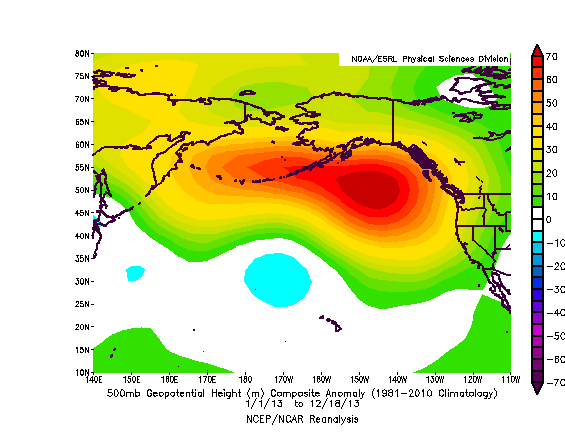
Now here is what the 500 mb geopotential height anomaly looked like over the last year, viaNOAA:

2013 anomaly
That is either a highly accurate prediction or one heck of a coincidence.
The San Jose Mercury News explained that “meteorologists have fixed their attention on the scientific phenomenon they say is to blame for the emerging drought: a vast zone of high pressure in the atmosphere off the West Coast, nearly four miles high and 2,000 miles long, so stubborn that one researcher has dubbed it the Ridiculously Resilient Ridge.” This high pressure ridge has been acting “like a brick wall” and forcing the jet stream along a much more northerly track, “blocking Pacific winter storms from coming ashore in California, deflecting them up into Alaska and British Columbia, even delivering rain and cold weather to the East Coast.
Last year, I contacted Sloan to ask her if she thought there was a connection between the staggering loss of Arctic sea ice in recent years and the brutal drought gripping the West, as her research predicted. She wrote, “Yes, sadly, I think we were correct in our findings, and it will only be worse with Arctic sea ice diminishing quickly.” Last week, Sloan wrote me:
Yes, in this case I hate that we (Sewall & Sloan) might be correct. And in fact, I think the actual situation in the next few decades could be even more dire that our study suggested. Why do I say that? (1) we did not include changes in greenhouse gases other than CO2; (2) maybe we should have melted more sea ice and see what happens; (3) these atmospheric and precipitation estimates do not include changes in land use, in the US and elsewhere. Changing crops, or urban sprawl increases, or melting Greenland and Northern Hemisphere glaciers will surely have an impact on precipitation patterns.
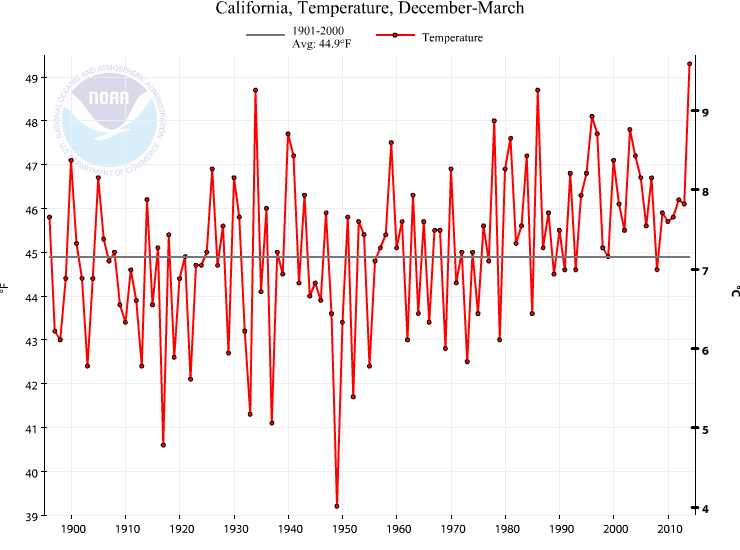
2013-2014 was California’s warmest winter on record. (NOAA/NCDC)
 The increasing trend in annual temperature in California over the past 118 years. (Source: NOAA). This trend mirrors the global increase.
_____________________________________________
_____________________________________________
From UJ:
This same phenomena that is causing the California drought is causing Alaska to get more warm air, which would warm the arctic more (presumably). It also is what pushed cold air down to the Midwest / Great Lakes region this past winter - referred to as the Polar Vortex. We had near record snowfalls, and were colder than usual. It also took longer than normal (by 3-4 weeks) for Spring to get here this year.
It is interesting to see the world as whole - departures from normal - below:


March 2014 land and sea surface temperature anomalies in degrees Celsius. NOAA

Wednesday, June 19, 2013

Heat Records Broken in Alaska

From Climate Central:


A massive dome of high pressure, sometimes referred to as a "heat dome," has set up shop over Alaska, bringing all-time record temperatures just a few weeks after parts of the state had a record cold start to spring. In some cases, towns in Alaska were warmer on Monday and Tuesday than most locations in the lower 48 states.
Forecast temperature anomalies on June 19 from the GFS computer model.
Click image to enlarge. Credit: WeatherBell.com.
For example, Talkeetna set an all-time high temperature record of 96°F on Monday, smashing its previous mark of 91°F set a day earlier, and previously set in June of 1969. In fact, it was warmer in Talkeetna, which is about 110 miles north of Anchorage, than it was in Miami, based on data from the National Weather Service (NWS). (As Weather Underground's Christopher Burt notes, there was an unofficial observation of 98°F on Monday, which would rank among the hottest all-time temperature records for the state.)
In Valdez, which sits along the cool waters of Prince William Sound, the temperature reached a remarkable 90°F Monday, beating the previous all-time mark of 87°F. And in Seward, another coastal port, the temperature hit 88°F, breaking the previous all-time high of 87°F that was set on July 4, 1999.
Extreme heat was also felt across the interior of Alaska, where hot temperatures are expected to continue this week until the large high pressure area, or ridge in the jet stream, weakens and moves away. The heat, combined with low relative humidity and the chance for thunderstorms, is raising the risk of wildfires across parts of Alaska.
A map of the upper level air flow at about 18,000 feet. The bright red area over Alaska corresponds to an unusually strong area of High Pressure bringing warmer-than-average temperatures.
Credit: WeatherBell.com.


Alaska is one of the fastest-warming states in the U.S., largely because the nearby Arctic region is warming rapidly in response to manmade global warming and natural variability. In recent years, Alaska has had to content with large wildfiresmelting permafrost, and reduced sea ice, among other climate-related challenges.