Tuesday, July 31, 2012

"Rare jellyfish appears in San Diego Bay"

Black jellyfish
From LA Times Blogs:
A rare species of jellyfish, distinguishable by its black color and long tentacles, is being spotted along a stretch of San Diego Bay popular with boaters.
With the formal name of Chrysaora achlyos, the so-called "black jellyfish" range from Monterey Bay to the tip of Baja California and seem to be making increasing appearances in San Diego-area waters, perhaps because the water is getting warmer.
This summer, they have been spotted near Shelter Island.
Stepping on the jellyfish, or otherwise coming into contact with one, can be a painful experience. The creatures have nettles that sting and immobilize their prey. Even a dead jellyfish carries a sting -- not enough to kill a human, but enough to be unpleasant.

The jellyfish's body can measure 3 feet in diameter, and the tentacles can be 25 feet or more in length.
-------
The black jellyfish (which can weigh 50 pounds) seem to like the Coronado beaches:

"Lobster shortage in Conn. is a warning"

From the Bangor Daily News.com:


By Hugh Bailey, Connecticut Post

Posted July 28, 2012, at 6:16 a.m.
If lobster is your thing, there’s never been a better time to splurge. Prices are at 30-year lows — below what lobstermen need to charge just to break even.
But they’re not coming from Connecticut. Aside from that 17-pounder liberated from a Niantic restaurant last week, the lobster situation in Long Island Sound is dire. After a spate of die-offs, the haul is about 1 percent of what it was just over a decade ago.
Lobstering is, or was, big business around here. And there have been all sorts of studies and efforts aimed at figuring out what happened, most focused on pesticides that find their way into the Sound. But there’s been nothing conclusive, so more studies are in order.
But there is a more plausible explanation that is for some reason considered controversial: Long Island Sound, like oceans and seas around the world, is heating up because of global climate change. What was once a hospitable habitat for lobsters is now, for the most part, too warm to support them in large numbers.
They’re doing fine just up the coast. It is true that Sound waters don’t circulate as well as the open ocean, but there’s no reason to think pesticides in Maine are any different than the ones we have here. The glut up there is sending prices so low this summer that some lobstermen say it doesn’t pay to catch them.
Experts here have noted that the die-offs have come in years when water temperatures increased. The pesticides don’t help, but it’s hard to see what another round of studies would tell us.
The global-warming-denial industry has gone through a few iterations. For a while it meant acknowledging the rising trend in temperatures but questioning humans’ role in making it happen. Lately, though, the data itself is questioned, which leads to supposed experts trying to deny that it’s hot outside, with every run of cool weather held up as proof that all the science is wrong.
It would be one thing if these were fringe attitudes, but there are U.S. senators pushing this line.
It’s never been clear just what the conspiracy theorists think is in it for the global-warming pushers. What are we supposed to get by believing this? On the other hand, anyone willing to claim it’s all a big hoax is welcomed with open arms by people who stand to profit by that sort of thing.
They don’t need to convince the public. They just need to sow some doubt. Make climate change seem controversial, as if it’s all still up in the air, and no one really knows for sure what’s going on out there. But we do know. And we know making necessary changes could cost certain people some big money.
So we do nothing. And eventually we’ll all pay.
And, sure, the fact that Greenland is melting into the ocean could be happenstance. The drought hitting most of the U.S. could be a coincidence. And maybe there’s something else to blame for all those lobsters dying.
But what we shouldn’t pretend is that this is some long-term hypothesis. This is happening now. It’s affecting the economy, right here in Connecticut. That’s a hundred-million-dollar lobstering industry in shambles, and it won’t be the last one to go.
In a saner world, this would be the talk of the presidential campaign. But since neither side is interested in tackling the issue, we’ll just keep ignoring it.
Officials and homeowners met in Fairfield last week to brainstorm ways to slow beach erosion caused by rising water levels. Expect a lot more of these kind of meetings in coming years.


"India blackouts leave 700 million without power"

From the Guardian:


More than 700 million people in India have been left without power in the world's worst modern blackout, prompting fears that protests and even riots could follow if the country's electricity supply continues to fail to meet growing demand.
Twenty of India's 28 states were hit by power cuts, along with the capital, New Delhi, when three of the five electricity grids failed at lunchtime.
As engineers struggled for hours to fix the problem, hundreds of trains stalled, leaving passengers stranded along thousands of miles of track from Kashmir in the north to Nagaland on the eastern border with Burma.
Traffic lights went out, causing widespread jams in New Delhi, Kolkata and other major cities. Operations were cancelled across the country, with nurses at one hospital just outside Delhi having to manually operate life-saving equipment when back-up generators failed.
Elsewhere, electric crematoriums stopped operating, some with bodies left half burnt before wood was brought in to stoke the furnaces.
As Delhiites sweated in 89% humidity and drivers honked their horns even more impatiently than usual, in West Bengal the power cut left hundreds of miners trapped underground for hours when their lifts broke down. All teh state's government workers were sent homeafter the chief minister announced it would take 10 to 12 hours for the power to return.
First to fail was the northern grid, which had also collapsed the previous day, leaving an estimated 350 million people in the dark for up to 14 hours. This was quickly followed by the eastern grid, which includes Kolkata, then the north-eastern grid.
An estimated 710 million people live in the affected area, ever more of whom require electricity as they snap up the air-conditioning units, flat-screen TVs and other gadgets that have become status symbols among India's burgeoning middle classes.
The two consecutive blackouts raised serious concerns about India's creaky infrastructure and the government's inability to meet its increasing appetite for energy as the country aspires to become a regional superpower....
At the beginning of July, repeated power cuts during a spell of 40C-plus heat prompted hundreds of residents to vandalise electricity substations in the new city of Gurgaon just outside Delhi. Rioters even beat up energy company officials, holding some of them hostage and blocking roads in several parts of the city.
But despite howls of protest from those whose TVs and computers were not working this week, one-third of India's households do not even have electricity to power a light bulb, according to the 2011 census.
A large minority of those in the blackout zone have never been connected to any grid – just 16.4% of the 100 million people who live in the central-eastern state of Bihar have access to electricity, compared with 96.6% in Punjab in the west.

Thursday, July 26, 2012

"Greenland ice sheet melted at unprecedented rate during July"

From the Guardian.UK:
"Scientists at Nasa admitted they thought satellite readings were a mistake after images showed 97% surface melt over four days"
Greenland ice sheet composite.View larger picture
The Greenland ice sheet on July 8, left, and four days later on the right. In the image, the areas classified as 'probable melt' (light pink) correspond to those sites where at least one satellite detected surface melting. The areas classified as 'melt' (dark pink) correspond to sites where two or three satellites detected surface melting. Photograph: Nasa

The Greenland ice sheet melted at a faster rate this month than at any other time in recorded history, with virtually the entire ice sheet showing signs of thaw.
The rapid melting over just four days was captured by three satellites. It has stunned and alarmed scientists, and deepened fears about the pace and future consequences of climate change....
The set of images released by Nasa on Tuesday show a rapid thaw between 8 July and 12 July. Within that four-day period, measurements from three satellites showed a swift expansion of the area of melting ice, from about 40% of the ice sheet surface to 97%.
Scientists attributed the sudden melt to a heat dome, or a burst of unusually warm air, which hovered over Greenland from 8 July until 16 July.
Greenland had returned to more typical summer conditions by 21 or 22 July, Mote told the Guardian.
But he said the event, while exceptional, should be viewed alongside other compelling evidence of climate change, including on the ground in Greenland.
"What we are seeing at the highest elevations may be a sort of sign of what is going on across the ice sheet," he said. "At lower elevations on the ice sheet, we are seeing earlier melting, melting later in the
season, and more frequent melting over the last 30 years and that is consistent of what you would expect with a warming climate."
Zwally, who has made almost yearly trips to the Greenland ice sheet for more than three decades, said he had never seen such a rapid melt.
About half of Greenland's surface ice sheet melts during a typical summer, but Zwally said he and other scientists had been recording an acceleration of that melting process over the last few decades. This year his team had to rebuild their camp, at Swiss Station, when the snow and ice supports melted.
_____

Meltwater from Greenland glacier wipes out key crossing

Scientists in Kangerlussuaq on western edge of ice sheet film runoff from glacier washing out roads and taking out a tractor

US Drought Monitor 7-24-2012

droughtmonitor.unl.edu/

I live in one of the "exceptional" areas - so this is hitting home. 
___
From weather.com:
The 2012 drought disaster is rapidly worsening in severity, especially over the nation's agricultural heartland, according to the latest weekly U.S. Drought Monitor report, released Thursday.While the area covered by the overall drought grew only slightly, the intensity increased alarmingly. 
Nationally, the percentage of the country in "extreme" to "exceptional" drought – the two worst categories on the scale – jumped from 13.53% to 20.57%. In other words, another 219,000 square miles was added to the area in extreme drought – an area slightly larger than the states of California and New York combined. 
All percentage figures refer to the contiguous 48 states: 
- The percentage of the country in "severe" drought (level 2) or worse set a new 21st-century high for the second straight week, rising from 42.23% last week to 45.57% this week. 
- The percentage of country in "exceptional" drought climbed from 0.99% last week to 2.38% this week – a considerable jump, but still well below the levels in the 2011 Southern Plains drought.

"Weather Extremes Leave Parts of U.S. Grid Buckling"


WASHINGTON — From highways in Texas to nuclear power plants in Illinois, the concrete, steel and sophisticated engineering that undergird the nation’s infrastructure are being taxed to worrisome degrees by heat, drought and vicious storms.
On a single day this month here, a US Airways regional jet became stuck in asphalt that had softened in 100-degree temperatures, and a subway train derailed after the heat stretched the track so far that it kinked — inserting a sharp angle into a stretch that was supposed to be straight. In East Texas, heat and drought have had a startling effect on the clay-rich soils under highways, which “just shrink like crazy,” leading to “horrendous cracking,” said Tom Scullion, senior research engineer with the Texas Transportation Institute at Texas A&M University. In Northeastern and Midwestern states, he said, unusually high heat is causing highway sections to expand beyond their design limits, press against each other and “pop up,” creating jarring and even hazardous speed bumps.
Excessive warmth and dryness are threatening other parts of the grid as well. In the Chicago area, a twin-unit nuclear plant had to get special permission to keep operating this month because the pond it uses for cooling water rose to 102 degrees; its license to operate allows it to go only to 100. According to the Midwest Independent System Operator, the grid operator for the region, a different power plant had had to shut because the body of water from which it draws its cooling water had dropped so low that the intake pipe became high and dry; another had to cut back generation because cooling water was too warm.
The frequency of extreme weather is up over the past few years, and people who deal with infrastructure expect that to continue. Leading climate models suggest that weather-sensitive parts of the infrastructure will be seeing many more extreme episodes, along with shifts in weather patterns and rising maximum (and minimum) temperatures.
“We’ve got the ‘storm of the century’ every year now,” said Bill Gausman, a senior vice president and a 38-year veteran at the Potomac Electric Power Company, which took eight days to recover from the June 29 “derecho” storm that raced from the Midwest to the Eastern Seaboard and knocked out power for 4.3 million people in 10 states and the District of Columbia.
In general, nobody in charge of anything made of steel and concrete can plan based on past trends, said Vicki Arroyo, who heads the Georgetown Climate Center at Georgetown University Law Center in Washington, a clearinghouse on climate-change adaptation strategies.
Highways, Mr. Scullion noted, are designed for the local climate, taking into account things like temperature and rainfall. “When you get outside of those things, man, all bets are off.” As weather patterns shift, he said, “we could have some very dramatic failures of highway systems.”
Adaptation efforts are taking place nationwide. Some are as huge as the multibillion-dollar effort to increase the height of levees and flood walls in New Orleans because of projections of rising sea levels and stronger storms to come; others as mundane as resizing drainage culverts in Vermont, where Hurricane Irene damaged about 2,000 culverts. “They just got blown out,” said Sue Minter, the Irene recovery officer for the state.
In Washington, the subway system, which opened in 1976, has revised its operating procedures. Authorities will now watch the rail temperature and order trains to slow down if it gets too hot. When railroads install tracks in cold weather, they heat the metal to a “neutral” temperature so it reaches a moderate length, and will withstand the shrinkage and growth typical for that climate. But if the heat historically seen in the South becomes normal farther north, the rails will be too long for that weather, and will have an increased tendency to kink. So railroad officials say they will begin to undertake much more frequent inspection.
Some utilities are re-examining long-held views on the economics of protecting against the weather. Pepco, the utility serving the area around Washington, has repeatedly studied the idea of burying more power lines, and the company and its regulators have always decided that the cost outweighed the benefit. But the company has had five storms in the last two and a half years for which recovery took at least five days, and after the derecho last month, the consensus has changed. Both the District of Columbia and Montgomery County, Md., have held hearings to discuss the option — though in the District alone, the cost would be $1.1 billion to $5.8 billion, depending on how many of the power lines were put underground.
Even without storms, heat waves are changing the pattern of electricity use, raising peak demand higher than ever. That implies the need for new investment in generating stations, transmission lines and local distribution lines that will be used at full capacity for only a few hundred hours a year. “We build the system for the 10 percent of the time we need it,” said Mark Gabriel, a senior vice president of Black & Veatch, an engineering firm. And that 10 percent is “getting more extreme.”...
Ms. Arroyo of Georgetown said the federal government must do more. “They are not acknowledging that the future will look different from the past,” she said, “and so we keep putting people and infrastructure in harm’s way.”

Wednesday, July 25, 2012

"Beijing's worst storms for 60 years kill at least 37"

From the Guardian.UKFlooded streets in Beijing after China's heaviest rain in six decades, with up to 460mm (18in) falling in some places since Saturday Link to this video
The heaviest rainstorm in Beijing in six decades has killed at least 37 people, flooded streets and stranded 80,000 people at the main airport, state media and the government said on Sunday.
The storm, which started on Saturday afternoon and continued late into the night, flooded major roads and sent torrents of water tumbling down steps into underpasses.
The Beijing city government said on its official microblog that at least 37 people had died, including 25 drowned, six crushed in collapsing homes, five electrocuted and one struck by lightning.
More than 500 flights were cancelled at Beijing's Capital International Airport, the Beijing News added.
The subway system was largely unaffected by the floods but was swamped with people desperate to get home and unable to use cars, buses or taxis.
The city received about 170mm (6.7 inches) of rain on average, but one township in Fangshan District to Beijing's west was hit by 460mm, Xinhua news agency said.
The Beijing city government said on its website it was working to get the metropolis back on its feet, and warned people to prepare for further bad weather.
"The weather forecasters say that from late July to early September this city is prone to flooding, and there could be further large-scale storms or extreme weather," it said.

Thursday, July 19, 2012


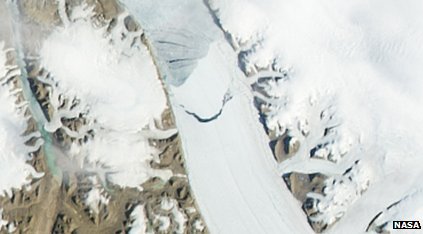
Iceberg twice the size of Manhattan breaking off the Peterman Glacier in Greenland. AP/NASA image.

Nice Transit of Venus Video

Video from NOAA Satellite

The Heat Goes On


 The US drought with record high temperatures continues. Other places like the UK are having record rainfall. Japan also had severe flooding from the rain.

Record High Temps in Red (lows in blue) 7-17--7-19

101 degrees on one side of the rain, 74 degrees on the other


This is corn in Brownsburg, IN.
The rain events have been spottier than usual. A small storm popping up, dropping a little rain, dissipating.

We hear thunder and get a few drops.

The map with the weather stations is from a couple of days ago - a storm got some areas and temporarily a relief from the 100 degree heat.

Owen County, Indiana, where I live, is in the official disaster area.

Fortunately we continue to have water in our well. We aren't wasting any (much). I water a few pots and recently planted blueberries a little. We hope we can make it until the drought is over (I hope it will be over).

Much is dry. The grass doesn't grow - we don't worry about it. Most of the established trees seem fine. Some have dried and dropped some leaves already.

Farmers are having a tough time.

The dried up lake with boats is Morse Reservoir - just north of Indianapolis. It's not completely dried up - just the shallower parts. Morse, Geist and Eagle Creek are where Indy gets their water.


Morse Reservoir showing drought effects


Saturday, June 30, 2012

It's hot.... and dry

We could use some rain.


Thursday's significant temperature records:

• 109° in Chesterfiled, Missouri (well short of state monthly record of 112°)• 108° in Lawrenceville, Illinois (ties all-time state June monthly record of 108° at Palestine in June 1954)• 108° in Huntingsburg, Indiana (well short of state monthly record of 111°)• 107° in Defiance, Ohio (1° short of all-time state June record-108° in Germantown in 1934)• 111° in Evening Shade, Arkansas (short of state June record of 113° in 1936)• 108° in Smyrna, Tennessee (short of 110° state record in 1936)• 107° in Little Rock, Arkansas (all-time June monthly record)
From the Weather Underground - Jeff Masters
The Amazing June Heat Wave of 2012

One of the most intense heat waves in U.S. history has enveloped portions of the western plains and Midwest and has now spread eastward. All-time heat records have fallen at a number of significant weather stations. And it is still just June. Is this a prelude for the coming summer or just a flash in the pan? 

June had been a warm but not excessively so month until around June 20-23rd when an upper level high pressure dome that had been centered over the Baja of Mexico began to move/expand northeastward and strengthen dramatically. Between June 23 and June 27 this dome remained nearly stationary over the southern plains and maintained its strength.


The water vapor image for 3Z on June 23 shows a deep trough over the Pacific Ocean west of California amplifying the high pressure ridge over the southwest and southern plains. Image from UNYSYS GOES West satellite.


he air aloft became so abnormally warm that the NWS office in Dodge City focused on how intense the air aloft was in their daily discussions. At the 850 millibar level (about 5000’) the temperature was averaging an amazing 30°C (86°F) at the 5 a.m. (12Z) observation times on June 23-27!

The heat at surface level reached its greatest extent on June 26th, although the period of all-time records broken ranged from June 23 to June 27.

Here is a surface temperature map for 5p.m CST time on June 26:


Could this be the Beginning of Another ‘Summer of 1936'?

The only previous June heat waves in U.S. history that compare to the current one were those of 1934, 1936, and 1954. The summer of 1934 went on to be the warmest on record for the U.S. (74.6° June-August average) and July 1936 the single hottest month on record (77.4° average).

Ominously, some of the June records that have so far been set this month have eclipsed those of June 1934 and 1936 (1954 turned out be a summer of only slightly above long-term average normal temperature).


From the Weather Underground blog - by  Christopher C. Burt

Saturday, June 23, 2012

" Corporate Profits Just Hit An All-Time High, Wages Just Hit An All-Time Low"

Corporate profit margins just hit an all-time high. Companies are making more per dollar of sales than they ever have before. (And some people are still saying that companies are suffering from "too much regulation" and "too many taxes." Maybe little companies are, but big ones certainly aren't)

Wages as a percent of the economy are at an all-time low. This is both cause and effect. One reason companies are so profitable is that they're paying employees less than they ever have as a share of GDP. And that, in turn, is one reason the economy is so weak: Those "wages" are other companies' revenue.

---------------------------------

Of course it wouldn't have to be like this. 

Sea Level Rise in the Coming Centuries

From the University of Copenhagen:
“Based on the current situation we have projected changes in sea level 500 years into the future. We are not looking at what is happening with the climate, but are focusing exclusively on sea levels”, explains Aslak Grinsted, a researcher at the Centre for Ice and Climate, the Niels Bohr Institute at the University of Copenhagen.

The research group has made calculations for four scenarios: A pessimistic one, where the emissions continue to increase. This will mean that sea levels will rise 1.1 meters by the year 2100 and will have risen 5.5 meters by the year 2500.Even in the most optimistic scenario, which requires extremely dramatic climate change goals, major technological advances and strong international cooperation to stop emitting greenhouse gases and polluting the atmosphere, the sea would continue to rise. By the year 2100 it will have risen by 60 cm and by the year 2500 the rise in sea level will be 1.8 meters. For the two more realistic scenarios, calculated based on the emissions and pollution stabilizing, the results show that there will be a sea level rise of about 75 cm and that by the year 2500 the sea will have risen by 2 meters. 

Sunday, May 13, 2012

Study links biodiversity and language loss/ nature and culture


The decline of linguistic and cultural diversity is linked to the loss of biodiversity, a study has suggested.
The authors said that 70% of the world's languages were found within the planet's biodiversity hotspots.
Data showed that as these important environmental areas were degraded over time, cultures and languages in the area were also being lost.
The results of the study have been published in the Proceedings of the National Academy of Sciences (PNAS).
"Biologists estimate annual loss of species at 1,000 times or more greater than historic rates, and linguists predict that 50-90% of the world's languages will disappear by the end of the century," the researchers wrote...
"We used improved language data to really get a more solid sense of how languages and biodiversity co-occurred and an understanding of how geographically extensive the language was."
He said the study achieved this by also looking at smaller areas with high biodiversity, such as national parks or other protected habitats.
"When we did that, not only did we get a sense of co-occurrence at a regional scale, but we also got a sense that co-occurrence was found at a much finer scale," he said.
"We are not quite sure yet why this happens, but in a lot of cases it may well be that biodiversity evolved as part-and-parcel of cultural diversity, and vice versa."
In their paper, the researchers pointed out that, out of the 6,900 or more languages spoken on Earth, more than 4,800 occurred in regions containing high biodiversity....


Friday, May 04, 2012

"Climate Change Trends: Carbon Emissions Giants"

Nice Resource from NPR - interactive maps with info. Showing emissions by country, emissions per person, population growth + coal reserves, more


Right now, 10 countries — including the U.S., China and Russia — are responsible for 80 percent of the world's carbon dioxide emissions. The United States is the world's second largest emitter (China ranks no. 1), sending around 5.8 million metric tons of CO2 into the atmosphere a year. That's the equivalent to a year's worth of greenhouse gas emissions from 1.1 billion average passenger vehicles. Below, a look at today's big CO2 emitters — and projected emissions giants in 2030.